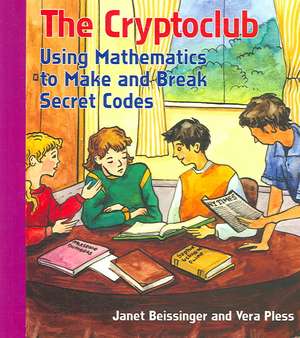
The Cryptoclub: Using Mathematics to Make and Break Secret Codes
Autor Janet Beissinger, Vera Plessen Limba Engleză Paperback – 8 noi 2006
The accompanying workbook, The Cryptoclub Workbook: Using Mathematics to Make and Break Secret Codes provides students with problems related to each section to help them master the concepts introduced throughout the book. A PDF version of the workbook is available at no charge on the download tab, a printed workbook is available for $19.95 (K00701). The teacher manual can be requested from the publisher by contacting the Academic Sales Manager, Susie Carlisle
Preț: 396.19 lei
Preț vechi: 495.24 lei
-20%
Puncte Express: 594
Carte disponibilă
Livrare economică 06-20 noiembrie
Livrare express 22-28 octombrie pentru 22.40 lei
Livrare prin curier în România Termenul estimat este afișat lângă disponibilitate.
Transport gratuit de la 400.00 lei Plată online sau ramburs, în funcție de opțiunile comenzii.
Retur gratuit în 14 zile Comandă securizată și suport în română.
Specificații
ISBN-13: 9781568812236
ISBN-10: 156881223X
Pagini: 216
Ilustrații: colour illustrations, black & white line drawings, colour line drawings, black & white tables
Dimensiuni: 203 x 229 x 12 mm
Greutate: 0.22 kg
Ediția:1
Editura: CRC Press
Colecția A K Peters/CRC Press
ISBN-10: 156881223X
Pagini: 216
Ilustrații: colour illustrations, black & white line drawings, colour line drawings, black & white tables
Dimensiuni: 203 x 229 x 12 mm
Greutate: 0.22 kg
Ediția:1
Editura: CRC Press
Colecția A K Peters/CRC Press
V-ar putea interesa
-
 Cryptography: A Very Short IntroductionSean Murphy-35%Preț: 49.20 lei76.17 lei
 -
 Numbers: A Very Short IntroductionPeter M. Higgins-20%Preț: 57.15 lei71.12 lei
 -
 CryptanalysisHelen Fouche Gaines-19%Preț: 77.68 lei96.09 lei
 -
 Cryptography: The Science of Secret WritingLaurence D. SmithPreț: 53.69 lei
 -
 Codes, Ciphers and Secret WritingMartin Gardner-34%Preț: 35.29 lei53.65 lei
 -
 Break the Code: Cryptography for BeginnersBud JohnsonPreț: 43.23 lei
 -
 Implementing Cryptography Using PythonShannon W Bray-20%Preț: 250.47 lei313.09 lei
 -
 Cryptography and Network SecurityWilliam Stallings-20%Preț: 634.17 lei792.71 lei
 -
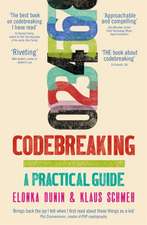 Codebreaking: A Practical GuideKlaus Schmeh-39%Preț: 82.79 lei134.73 lei
 -
 The Manga Guide To CryptographyMasaaki Mitani-35%Preț: 119.07 lei183.64 lei
 -
 -36%Preț: 188.12 lei295.22 lei
 -
 Serious Cryptography: A Practical Introduction to Modern EncryptionJean-Philippe Aumasson-36%Preț: 244.93 lei385.48 lei
 -
 -23%Preț: 97.18 lei126.42 lei
 -
 -35%Preț: 121.39 lei185.35 lei
 -
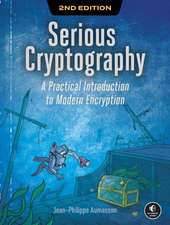 Serious Cryptography, 2nd Edition: A Practical Introduction to Modern EncryptionJean-Philippe Aumasson-36%Preț: 298.89 lei464.51 lei
 -
 The Code Book: The Secret History of Codes and Code-BreakingDr. Simon SinghPreț: 65.80 lei
 -
 Maths for Practice and RevisionPeter RobsonPreț: 35.38 lei
 -
 Codes and CiphersSteven GoodwinPreț: 52.13 lei
 -
 Classical and Modern Cryptography for BeginnersRajkumar Banoth-20%Preț: 390.08 lei487.59 lei
 -
 CryptographySimon Rubinstein-SalzedoPreț: 368.16 lei
Public țintă
Undergraduate CoreRecenzii
One of the holy grails of education is making math fun, without reducing its rigor. Many people attempt this task, but few succeed. I believe that Janet Beissinger and Vera Pless are among the rare success stories with their book … it is a fabulous supplement to more traditional curriculums. Pattern recognition, probability, prime numbers, exponents, modular arithmetic, factoring, organizing data, and inverses are among the topics that the book explores in a meaningful and interesting way. Even more important, it gives young (or maybe not so young!) students an opportunity to practice rigorous critical thinking in a meaningful context. Code cracking is a great example of open-ended problems that require tenacity, organization, and creative thinking to solve.
—Jessie Mathisen, Articles for Reading, November 2009
Students Tackle Cryptography—University of Illinois at Chicago professors craft program to show middle schoolers that problem solving is fun.
—The Chicago Tribune, July 2009
The Cryptoclub is very clearly written and illustrated, in full color, and clearly laid out. I truly enjoyed The Cryptoclub. It is SO interesting! How could you lay a book down when there is a secret message to unravel!… This book is perfect for motivating teenagers’ interest in math. It lets them study something fascinating outside the main curriculum — cryptography — which is at the same time a highly useful application of math.
—Homeschool Math, October 2007
The Cryptoclub is more than just a math book: a story line is woven around each type of code, making it more interesting for students. This book could serve as a resource for enrichment or gifted programs [and] could easily be incorporated into a cross-curricular thematic unit.
—Judith Casey, NCTM, August 2007
A fine book that introduces middle school pupils to coding … Despite its challenging mathematical content, there is nothing dry about this book. All the techniques employed for modern children’s books are used here to good effect: a story line to connect the topics, with coloured illustrations, boxes to set of examples and exercises, as well as a number of historical anecdotes set on special pages.
—CMS Notes, March 2007
Mathematical material is brought to life with fictionalized stories about a group of ‘Cryptokids’ as well as true stories from the history of cryptography.
—Book News, December 2006
The Cryptoclub presents a number of different systems of encryption and methods of breaking them … Each type of cipher is presented in detail and exercises are included, allowing students to apply the techniques presented. The Cryptoclub also includes short descriptions of famous examples of secret codes, including the Beale Ciphers, the Zimmerman telegram, and the German Enigma cipher. The Cryptoclub is intended for middle-school students, and could be used for classroom teaching or as a supplemental or recreational book for students interested in cryptography. However, the potential appeal is much broader: the simplest ciphers could be solved by a child in grade school, and much of The Cryptoclub can be enjoyed by adults as well.
—Sarah Boslaugh, MAA Reviews, October 2006
Listen to a video review of the book at http://www.republicofmath.com/cryptoclub-review
—Jessie Mathisen, Articles for Reading, November 2009
Students Tackle Cryptography—University of Illinois at Chicago professors craft program to show middle schoolers that problem solving is fun.
—The Chicago Tribune, July 2009
The Cryptoclub is very clearly written and illustrated, in full color, and clearly laid out. I truly enjoyed The Cryptoclub. It is SO interesting! How could you lay a book down when there is a secret message to unravel!… This book is perfect for motivating teenagers’ interest in math. It lets them study something fascinating outside the main curriculum — cryptography — which is at the same time a highly useful application of math.
—Homeschool Math, October 2007
The Cryptoclub is more than just a math book: a story line is woven around each type of code, making it more interesting for students. This book could serve as a resource for enrichment or gifted programs [and] could easily be incorporated into a cross-curricular thematic unit.
—Judith Casey, NCTM, August 2007
A fine book that introduces middle school pupils to coding … Despite its challenging mathematical content, there is nothing dry about this book. All the techniques employed for modern children’s books are used here to good effect: a story line to connect the topics, with coloured illustrations, boxes to set of examples and exercises, as well as a number of historical anecdotes set on special pages.
—CMS Notes, March 2007
Mathematical material is brought to life with fictionalized stories about a group of ‘Cryptokids’ as well as true stories from the history of cryptography.
—Book News, December 2006
The Cryptoclub presents a number of different systems of encryption and methods of breaking them … Each type of cipher is presented in detail and exercises are included, allowing students to apply the techniques presented. The Cryptoclub also includes short descriptions of famous examples of secret codes, including the Beale Ciphers, the Zimmerman telegram, and the German Enigma cipher. The Cryptoclub is intended for middle-school students, and could be used for classroom teaching or as a supplemental or recreational book for students interested in cryptography. However, the potential appeal is much broader: the simplest ciphers could be solved by a child in grade school, and much of The Cryptoclub can be enjoyed by adults as well.
—Sarah Boslaugh, MAA Reviews, October 2006
Listen to a video review of the book at http://www.republicofmath.com/cryptoclub-review
Notă biografică
Janet Beissinger is a research assistant professor at the University of Illinois, Chicago's Institute for Mathematics and Science Education. She helped develop the widely used Math Trailblazers curriculum for grades K-5. Vera Pless, also a professor at UIC, is the author of Introduction to Coding Theory and has published over 100 papers.
Cuprins
Introduction to Cryptography. Caesar Ciphers. Sending Messages with Numbers. Breaking Caesar Ciphers. Substitution Ciphers. Keyword Ciphers. Letter Frequencies. Breaking Substitution Ciphers. Vigenère Ciphers. Combining Caesar Ciphers. Cracking Vigenère Ciphers When You Know the Key Length. Factoring. Using Common Factors to Crack Vigenère Ciphers. Modular (Clock) Arithmetic. Introduction to Modular Arithmetic. Applications of Modular Arithmetic. Multiplicative and Affine Ciphers. Multiplicative Ciphers. Using Inverses to Decrypt. Affine Ciphers. Math for Modern Cryptography. Finding Prime Numbers. Raising to Powers. Public Key Cryptography. The RSA Cryptosystem. Revisiting Inverses in Modular Arithmetic. Sending RSA Messages.
Descriere
This book covers classic coding methods such as Caesar, substitution, Vigenère, and multiplicative ciphers as well as the modern RSA.The accompanying workbook provides students with problems related to each section to help them master the concepts introduced throughout the book.