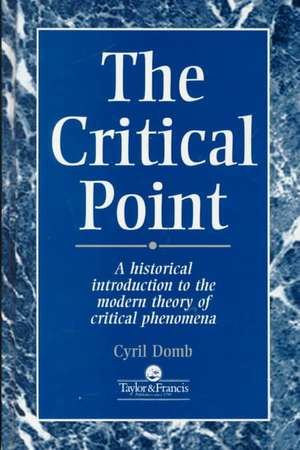
The Critical Point: A Historical Introduction To The Modern Theory Of Critical Phenomena
Autor C Domben Limba Engleză Hardback – 20 feb 1996
| Toate formatele și edițiile | Preț | Express |
|---|---|---|
| Paperback (1) | 386.06 lei 3-5 săpt. | |
| CRC Press – 5 sep 2019 | 386.06 lei 3-5 săpt. | |
| Hardback (1) | 1331.79 lei 3-5 săpt. | |
| CRC Press – 20 feb 1996 | 1331.79 lei 3-5 săpt. |
Preț: 1331.79 lei
Preț vechi: 1889.39 lei
-30%
Puncte Express: 1998
Preț estimativ în valută:
235.70€ • 275.46$ • 204.63£
235.70€ • 275.46$ • 204.63£
Carte disponibilă
Livrare economică 29 ianuarie-12 februarie
Preluare comenzi: 021 569.72.76
Specificații
ISBN-13: 9780748404353
ISBN-10: 074840435X
Pagini: 394
Dimensiuni: 156 x 234 x 26 mm
Greutate: 0.7 kg
Ediția:1
Editura: CRC Press
Colecția CRC Press
ISBN-10: 074840435X
Pagini: 394
Dimensiuni: 156 x 234 x 26 mm
Greutate: 0.7 kg
Ediția:1
Editura: CRC Press
Colecția CRC Press
V-ar putea interesa
-
 Madness: A Brief HistoryRoy Porter-21%Preț: 78.22 lei98.86 lei
 -
 The Science of MusicRobin Maconie-24%Preț: 467.65 lei615.47 lei
 -
 -24%Preț: 370.98 lei485.70 lei
 -
 Revolutions in MathematicsDonald Gillies-34%Preț: 631.70 lei961.14 lei
 -
 -14%Preț: 359.54 lei416.86 lei
 -
 The Right and the GoodDavid Ross-18%Preț: 200.02 lei244.28 lei
 -
 Concepts of JusticeD. D. Raphael-14%Preț: 321.67 lei373.78 lei
 -
 Spinoza's Heresy: Immortality and the Jewish MindSteven NadlerPreț: 358.17 lei
 -
 Bodin: On SovereigntyJean BodinPreț: 265.17 lei
 -
 Marx: Early Political WritingsKarl MarxPreț: 122.26 lei
 -
 Preț: 155.13 lei
 -
 Morris: News from NowhereWilliam MorrisPreț: 306.22 lei
 -
 -19%Preț: 494.72 lei610.77 lei
 -
 Stirner: The Ego and its OwnMax StirnerPreț: 406.17 lei
 -
 Preț: 287.89 lei
 -
 Preț: 382.46 lei
 -
 A Brief History of the FutureJohn Naughton-27%Preț: 55.36 lei75.95 lei
 -
 Preț: 260.15 lei
 -
 de la Mettrie's GhostC. NunnPreț: 133.95 lei
Public țintă
Academic and Professional Practice & DevelopmentCuprins
"1. Preface 2. Historical Survey 3. Fluids: Classical Theory 4. Light Scattering and Correlations: Classical Theory 5. The Onsager Revolution 6. Reconciliation 7. Renormalization Group 8. Appendix: Related Topics 9. References 10. Index
Contents
Preface
Foreword: About the Author and the Subject
1
Contents
Preface
Foreword: About the Author and the Subject
1
Descriere
.The relationship between liquids and gases engaged the attention of a number of distinguished scientists in the mid 19th Century. In a definitive paper published in 1869, Thomas Andrews described experiments he performed on carbon dioxide and from which he concluded that a critical temperature exists below which liquids and gases are distinct phases of matter, but above which they merge into a single fluid phase. During the years which followed, other natural phenomena were discovered to which the same critical point description can be applied - such as ferromagnetism and solutions. This book provides an historical account of theoretical explanations of critical phenomena which ultimately led to a major triumph of statistical mechanics in the 20th Century - with the award of the Nobel Prize for Physics