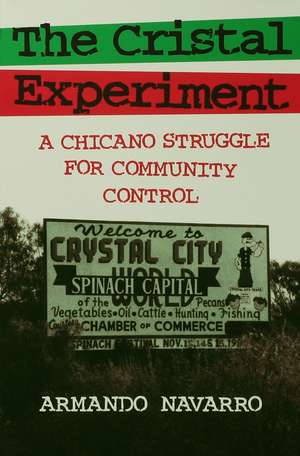
The Cristal Experiment: A Chicano Struggle for Community Control
Autor Armando Navarroen Limba Engleză Paperback – 23 iun 1998
Amidst the turbulence and militancy of the 1960s and early 1970s, the Mexicano population of the dusty agricultural town of Crystal City, Texas (Cristal in Spanish), staged two electoral revolts, each time winning control of the city council and school board. The landmark city council victory in 1963 was a first for Mexican Americans in South Texas, and Cristal—the “spinach capital of the world”—became for a time the political capital of the Chicano Movement.
In The Cristal Experiment, Armando Navarro presents the most comprehensive examination to date of the rise of the Chicano political movement in Cristal, its successes and conflicts (both internal and external), and its eventual decline. He looks particularly at the larger and more successful “Second Revolt” in 1970 and its aftermath up to 1981, examining the political, economic, educational, and social changes for Mexicanos that resulted. Drawing upon nearly 100 interviews, a wealth of secondary materials, and his own experiences as a political organizer in the Chicano Movement, Navarro offers a shrewd and insightful analysis not only of the events in Cristal, but also of the workings of local politics generally, the politics of community control, and the factors inherent in the American political system that lead to the self-destruction of political movements. As both a political scientist and an organizer, he outlines important lessons to be learned from what happened in Cristal and to the Chicano Movement.
In The Cristal Experiment, Armando Navarro presents the most comprehensive examination to date of the rise of the Chicano political movement in Cristal, its successes and conflicts (both internal and external), and its eventual decline. He looks particularly at the larger and more successful “Second Revolt” in 1970 and its aftermath up to 1981, examining the political, economic, educational, and social changes for Mexicanos that resulted. Drawing upon nearly 100 interviews, a wealth of secondary materials, and his own experiences as a political organizer in the Chicano Movement, Navarro offers a shrewd and insightful analysis not only of the events in Cristal, but also of the workings of local politics generally, the politics of community control, and the factors inherent in the American political system that lead to the self-destruction of political movements. As both a political scientist and an organizer, he outlines important lessons to be learned from what happened in Cristal and to the Chicano Movement.
Preț: 173.55 lei
Puncte Express: 260
Preț estimativ în valută:
30.69€ • 36.02$ • 26.62£
30.69€ • 36.02$ • 26.62£
Carte disponibilă
Livrare economică 17 februarie-03 martie
Specificații
ISBN-13: 9780299158248
ISBN-10: 0299158241
Pagini: 424
Dimensiuni: 152 x 229 x 25 mm
Greutate: 0.64 kg
Ediția:New.
Editura: University of Wisconsin Press
Colecția University of Wisconsin Press
ISBN-10: 0299158241
Pagini: 424
Dimensiuni: 152 x 229 x 25 mm
Greutate: 0.64 kg
Ediția:New.
Editura: University of Wisconsin Press
Colecția University of Wisconsin Press
V-ar putea interesa
-
 Preț: 288.26 lei
 -
 Preț: 283.72 lei
 -
 The Political Integration of Ethnic Minorities in BritainAnthony F. Heath-34%Preț: 735.97 lei1112.05 lei
 -
 -34%Preț: 428.53 lei652.16 lei
 -
 Multiculturalism and Minority Rights in the Arab WorldWill Kymlicka-28%Preț: 737.53 lei1020.30 lei
 -
 Criminal Law and Cultural DiversityWill Kymlicka-34%Preț: 644.85 lei974.04 lei
 -
 The First Civil Right: How Liberals Built Prison AmericaNaomi Murakawa-24%Preț: 276.99 lei362.71 lei
 -
 Preț: 208.89 lei
 -
 Strangers at Our DoorZ BaumanPreț: 84.02 lei
 -
 Separate and Dominate: Feminism and Racism After the War on TerrorChristine DelphyPreț: 120.02 lei
 -
 Anders Breivik and the Rise of IslamophobiaSindre BangstadPreț: 152.13 lei
 -
 Debating Cultural HybridityPnina WerbnerPreț: 158.21 lei
 -
 -46%Preț: 91.28 lei170.60 lei
Recenzii
“Navarro extends the story of Cristal, the mecca of Chicanismo, beyond where others have left off. It will be important to scholars interested in the Chicano Movement, Chicano history in general, community studies, politics and ethnic nationalism.”—Ignacio Garcia, Brigham Young University, author of Chicanismo: The Forging of a Militant Ethos among Mexican-Americans
Notă biografică
Armando Navarro, a political scientist, is associate professor of ethnic studies at the University of California, Riverside, and author of Mexican American Youth Organization: Avant-Garde of the Chicano Movement. For more than twenty-five years he has been an activist and professional political organizer in California, working with the Mexican-American Political Organization, the Raza Unida Party, Congreso para Pueblo Unidos, the Institute for Social Justice, Californios for Fair Representation, Impacto/2000, and other organizations.
Descriere
Amidst the turbulence and militancy of the 1960s and early 1970s, the Mexicano population of the dusty agricultural town of Crystal City, Texas (Cristal in Spanish), staged two electoral revolts, each time winning control of the city council and school board. The landmark city council victory in 1963 was a first for Mexican Americans in South Texas, and Cristal—the “spinach capital of the world”—became for a time the political capital of the Chicano Movement.
In The Cristal Experiment, Armando Navarro presents the most comprehensive examination to date of the rise of the Chicano political movement in Cristal, its successes and conflicts (both internal and external), and its eventual decline. He looks particularly at the larger and more successful “Second Revolt” in 1970 and its aftermath up to 1981, examining the political, economic, educational, and social changes for Mexicanos that resulted. Drawing upon nearly 100 interviews, a wealth of secondary materials, and his own experiences as a political organizer in the Chicano Movement, Navarro offers a shrewd and insightful analysis not only of the events in Cristal, but also of the workings of local politics generally, the politics of community control, and the factors inherent in the American political system that lead to the self-destruction of political movements. As both a political scientist and an organizer, he outlines important lessons to be learned from what happened in Cristal and to the Chicano Movement.
In The Cristal Experiment, Armando Navarro presents the most comprehensive examination to date of the rise of the Chicano political movement in Cristal, its successes and conflicts (both internal and external), and its eventual decline. He looks particularly at the larger and more successful “Second Revolt” in 1970 and its aftermath up to 1981, examining the political, economic, educational, and social changes for Mexicanos that resulted. Drawing upon nearly 100 interviews, a wealth of secondary materials, and his own experiences as a political organizer in the Chicano Movement, Navarro offers a shrewd and insightful analysis not only of the events in Cristal, but also of the workings of local politics generally, the politics of community control, and the factors inherent in the American political system that lead to the self-destruction of political movements. As both a political scientist and an organizer, he outlines important lessons to be learned from what happened in Cristal and to the Chicano Movement.