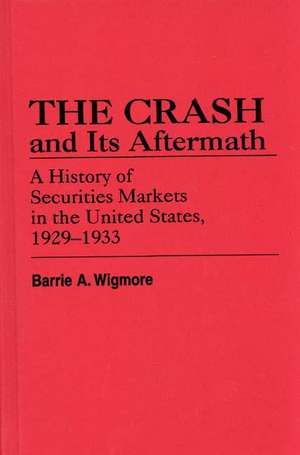
The Crash and Its Aftermath
Autor Barrie A. Wigmoreen Limba Engleză Hardback – 5 sep 2000
Preț: 1070.38 lei
Preț vechi: 1605.12 lei
-33%
Puncte Express: 1606
Carte tipărită la comandă
Livrare economică 17 septembrie-01 octombrie
Livrare prin curier în România Termenul estimat este afișat lângă disponibilitate.
Transport gratuit pentru acest produs Plată online sau ramburs, în funcție de opțiunile comenzii.
Retur gratuit în 14 zile Comandă securizată și suport în română.
Specificații
ISBN-13: 9780313245749
ISBN-10: 0313245746
Pagini: 754
Dimensiuni: 164 x 236 x 48 mm
Greutate: 1.28 kg
Editura: Praeger
ISBN-10: 0313245746
Pagini: 754
Dimensiuni: 164 x 236 x 48 mm
Greutate: 1.28 kg
Editura: Praeger
V-ar putea interesa
-
 EnronBrian CruverPreț: 111.23 lei
 -
 The Disciplined TraderMark DouglasPreț: 339.09 lei
 -
 Commodities and CapabilitiesAmartya SenPreț: 215.65 lei
 -
 Speculation, Trading, and BubblesJosé a ScheinkmanPreț: 107.56 lei
 -
 The Poker Face of Wall StreetAaron BrownPreț: 136.52 lei
 -
 Getting Started in Value InvestingCharles S MizrahiPreț: 188.27 lei
 -
 The Education of a SpeculatorVictor NiederhofferPreț: 247.89 lei
 -
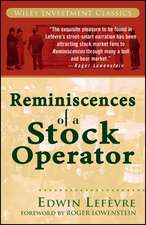 Reminiscences of a Stock OperatorEdwin LefevrePreț: 137.63 lei
 -
 Where Are the Customers' Yachts?Fred SchwedPreț: 119.39 lei
 -
 The Intelligent Guide to Stock Market InvestmentKevin KeaseyPreț: 362.67 lei
 -
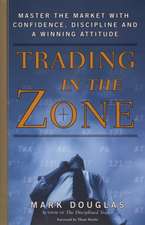 Trading in the ZoneMark Douglas-4%Preț: 374.34 lei389.93 lei
 -
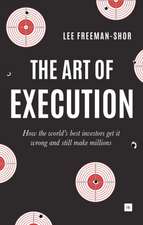 The Art of ExecutionLee Freeman-Shor-13%Preț: 121.82 lei140.05 lei
 -
 Fuel Hedging and Risk ManagementSimo M. Dafir-8%Preț: 576.38 lei626.50 lei
 -
 How to Make a Million - SlowlyJohn LeePreț: 163.63 lei
 -
 Back to SchoolWarren BuffettPreț: 102.06 lei
 -
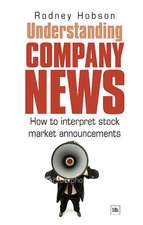 Understanding Company NewsRodney Hobson-13%Preț: 90.02 lei103.02 lei
Descriere
The Crash and Its Aftermath is an excellent work of reference on the Great Contraction. It will be useful both to people with only a passing curiosity about the Crash and to those for whom the Great Depression is a major scholarly concern. Business History
From now on any serious student of the Depression will be obliged to consult this work for a sense of securities price movements, investor attitudes, and relevant contemporary sources. Journal of Economic History
This is the first book to focus on the broader structural changes which took place in the financial industry over the full period of decline from the Stock Market Crash in 1929 to the end of President Franklin D. Roosevelt's One Hundred Days in 1933. The basis for many of Wigmore's comments is an analysis of 142 leading companies whose stocks constituted approximately 77 percent of the market value of all New York Stock Exchange stocks. Wigmore also examines the various bond markets and relates the money market to the bond market, monetary policy, business conditions, and the problems of the banking system. Treating each year from 1929 to 1933 separately, Wigmore shows the interrelation between the stock, bond, and money markets and events in politics, the economy, international trade and finance, and monetary policy. The Statistical Appendix of 41 tables consolidates financial statistics which have hitherto been widely dispersed, permitting in-depth study.
From now on any serious student of the Depression will be obliged to consult this work for a sense of securities price movements, investor attitudes, and relevant contemporary sources. Journal of Economic History
This is the first book to focus on the broader structural changes which took place in the financial industry over the full period of decline from the Stock Market Crash in 1929 to the end of President Franklin D. Roosevelt's One Hundred Days in 1933. The basis for many of Wigmore's comments is an analysis of 142 leading companies whose stocks constituted approximately 77 percent of the market value of all New York Stock Exchange stocks. Wigmore also examines the various bond markets and relates the money market to the bond market, monetary policy, business conditions, and the problems of the banking system. Treating each year from 1929 to 1933 separately, Wigmore shows the interrelation between the stock, bond, and money markets and events in politics, the economy, international trade and finance, and monetary policy. The Statistical Appendix of 41 tables consolidates financial statistics which have hitherto been widely dispersed, permitting in-depth study.