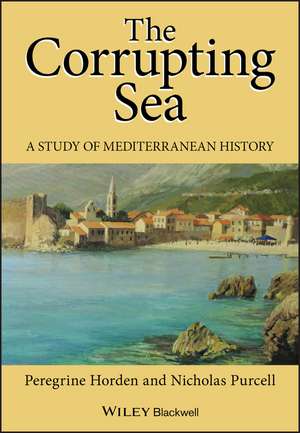
The Corrupting Sea - A Study of Mediterranean of History
Autor Nicholas Purcell, Peregrine Hordenen Limba Engleză Paperback – 14 ian 2000
Adresat studenților avansați, cercetătorilor și practicienilor din domeniile istoriei antice și medievale, arheologiei și antropologiei, The Corrupting Sea reprezintă o resursă fundamentală pentru înțelegerea bazelor ecologice ale civilizației. Nicholas Purcell și Peregrine Horden propun o schimbare de paradigmă în istoriografia regională, mutând accentul de la narațiunile politice tradiționale către o analiză a interacțiunii umane cu mediul pe parcursul a trei milenii. Observăm că autorii nu se limitează la o descriere geografică, ci introduc conceptul de „microecologii”, demonstrând cum fragmentarea peisajului mediteranean a forțat comunitățile să creeze rețele complexe de supraviețuire și schimb. Apreciem rigoarea celor 784 de pagini, care integrează date din științele umaniste și cele naturale pentru a explica stabilitatea și volatilitatea regiunii. Spre deosebire de abordările cronologice liniare, structura acestei lucrări este tematică și analitică, oferind o perspectivă de tip „longue durée” asupra adaptabilității umane. Credem că relevanța sa pentru curriculumul de istorie europeană și mediteraneană este critică, oferind instrumente metodologice pentru interpretarea peisajelor arheologice și a structurilor sociale medievale. În contextul literaturii de specialitate, The Corrupting Sea completează perspectiva oferită de The Mediterranean de J. Donald Hughes, adăugând o profunzime teoretică superioară și o analiză structurală a rețelelor de conectivitate pe care lucrarea lui Hughes, mai degrabă un manual accesibil, o tratează la nivel general. De asemenea, dacă The Mountains of the Mediterranean World de J. R. McNeill se concentrează pe zonele înalte și impactul lor social, lucrarea lui Purcell și Horden reușește să integreze aceste zone într-un sistem ecologic unitar, explicând cum marea și muntele au funcționat ca un tot unitar în modelarea destinelor istorice.
Preț: 401.62 lei
Carte disponibilă
Livrare economică 01-15 octombrie
Livrare express 17-23 septembrie pentru 79.95 lei
Specificații
ISBN-10: 0631218904
Pagini: 784
Dimensiuni: 170 x 244 x 42 mm
Greutate: 1.31 kg
Ediția:New.
Editura: John Wiley and Sons Ltd
Locul publicării:Chichester, United Kingdom
V-ar putea interesa
-
 The Early Byzantine HistoriansW. Treadgold-18%Preț: 1000.31 lei1219.89 lei
 -
 Preț: 377.59 lei
 -
 Mediterranean EncountersFariba ZarinebafPreț: 320.67 lei
 -
 The Spectacle of SufferingPieter SpierenburgPreț: 351.69 lei
 -
 Church and Society in Catholic Europe of the Eighteenth CenturyWilliam J. CallahanPreț: 331.50 lei
 -
 Preț: 295.99 lei
 -
 Empires of the SeaRoger CrowleyPreț: 92.27 lei
 -
 -16%Preț: 206.77 lei247.34 lei
 -
 Preț: 301.11 lei
 -
 Preț: 502.44 lei
 -
 Empress of the EastLeslie PeircePreț: 92.73 lei
 -
 Histoire de Charles VII, roi de France, et de son époque, 1403-1461. 3. 1444-1461 (Éd.1862-1865)Auguste Vallet De VirivillePreț: 231.67 lei
 -
 Histoire de Charles VII, roi de France, et de son époque, 1403-1461. 1. 1403-1428 (Éd.1862-1865)Auguste Vallet De VirivillePreț: 230.86 lei
 -
 Histoire de Charles VII. Tome 4,Année 1444-1449 (Éd.1881-1891)Gaston Du Fresne de BeaucourtPreț: 216.32 lei
 -
 Histoire de Charles VII. Tome 5,Année 1449-1453 (Éd.1881-1891)Gaston Du Fresne de BeaucourtPreț: 223.53 lei
 -
 Histoire de Charles VII. Tome 6 (Éd.1881-1891)Gaston Du Fresne de BeaucourtPreț: 262.02 lei
 -
 Preț: 215.00 lei
 -
 Histoire de DesaixEdmond Bonnal De GangesPreț: 193.07 lei
 -
 Histoire de dix ans de la Franche-Comté de Bourgogne, 1632-1642, (Éd.1843)Jean Girardot de NozeroyPreț: 176.58 lei
 -
 Preț: 146.13 lei
 -
 Histoire de Dunkerque (Éd.1852)Victor DerodePreț: 231.67 lei
 -
 Histoire de Florence. T. 1 (Éd.1877-1883)François-Tommy PerrensPreț: 258.31 lei
 -
 Histoire de Florence. T. 2 (Éd.1877-1883)François-Tommy PerrensPreț: 240.41 lei
 -
 Les légions de l'Espérance et de l'Athénée à Turin, 1799-1801Jean D'Orléans GuisePreț: 79.38 lei
 -
 Saint Telme, de l'ordre de Saint Dominique, patron des marinsP. -G. KerambrunPreț: 80.11 lei
Public țintă
advanced students and scholars of ancient and medieval European history, archaeology and anthropologyDe ce să citești această carte
Recomandăm această carte specialiștilor care doresc să depășească istoria evenimențială. Cititorul câștigă o înțelegere profundă a modului în care geografia a dictat rețelele comerciale și sociale timp de 3.000 de ani. Este un instrument esențial pentru orice bibliotecă academică, oferind un model teoretic robust despre cum micro-regiunile izolate au reușit să creeze o unitate culturală și economică sub presiunea factorilor de mediu.
Descriere
Notă biografică
Cuprins
Acknowledgements ix
Note on References x
Abbreviations xi
Introduction 1
Part One: 'Frogs round a Pond': Ideas of the Mediterranean 7
I A Geographical Expression 9
1. What is the Mediterranean?;2. The Challenge of the Continents;3. The Mediterranean Disintegrated; 4. Intimations of Unity
II a Historian's Mediterranean 26
1. The Imaginary Sea; 2. Four Men in a Boat; 3. The End of the Mediterranean; 4. Mediterranean History; 5. Historical Ecology
Part Two: 'Short Distances and Definite Places': Mediterranean Microecologies 51
III Four Definite Places 53
1. The Biqa; 2. South Etruria; 3. The Green Mountain, Cyrenaica; 4. Melos; 5. 'La trame du monde'; 6. Mountains and Pastures; 7. Theodoric and Dante
IV Ecology and the Larger Settlement 89
1. An Urban Tradition; 2. Definitions; 3. The Urban Variable; 4. Types and Theories; 5. Consumption; 6. Settlement Ecology; 7. Autarky; 8. Dispersed Hinterlands
V Connectivity 123
1. Lines of Sound and Lines of Sight; 2. Extended Archipelagos; 3. Shipping Lanes; 4. Economies Compared; 5. The Early Medieval Depression; 6. Connectivity Maintained?; 7. Conclusion Copyrighted Material
Part Three: Revolution and Catastrophe 173
VI Imperatives of Survival: Diversify, Store, Redistribute 175
1. The History of Mediterranean Food Systems; 2. The New Ecological Economic History; 3. Understanding the Marginal; 4. The Integrated Mediterranean Forest; 5. The Underestimated Mediterranean Wetland; 6. 'These Places Feed Many Pickling-Fish .'; 7. Mediterranean Animal Husbandry; 8. Cereals and the Dry Margin; 9. The Case of the Tree-Crop; 10. The Mediterranean Garden; 11. The Smaller Mediterranean Island
VII Technology and Agrarian Change 231
1. Working the Soil; 2. The Irrigated Landscape; 3. On the Diversity of Cultivated Plants; 4. Abatement and Intensification; 5. Anatomy of the Mediterranean Countryman; 6. Colonizations and Allotments; 7. The Reception of Innovation
VIII Mediterranean Catastrophes 298
1. On the History of Catastrophe; 2. An Unstable World; 3. Alluvial Catastrophe and its Causes; 4. Sediments and History; 5. The History of Vegetation; 6. Environmental History without Catastrophe
IX Mobility of Goods and People 342
1. Inescapable Redistribution; 2. Animal, Vegetable and ; 3. The Problem of Mediterranean Textiles; 4. Problems with High Commerce; 5. The Ultimate Resource; 6. Organized Mobility; 7. Places of Redistribution
Part Four: The Geography of Religion 401
X 'territories of Grace' 403
1. Religion and the Physical Environment; 2. A Perilous Environment; 3. The Sacralized Economy; 4. The Religion of Mobility; 5. The Religion of Boundary and Belonging
Part Five: 'Museums of Man'? The Uses of Social Anthropology 461
XI 'mists of Time': Anthropology and Continuity 463
1. Survivals Revisited; 2. Balanced Arcadias; 3. The Presence of the Past; 4. Upstreaming
XII 'i also Have a Moustache': Anthropology and
Mediterranean Unity 485
1. Grands faits méditerranéens?; 2. Mediterranean Values?; 3. Honour and Shame I; 4. Honour and Shame II; 5. Honour in the City; 6. Pattern and Depth; 7. Distinctiveness; 8. Origins; 9. History; 10. The Case for Mediterraneanism
Bibliographical Essays 530
Consolidated Bibliography 642
Index 737