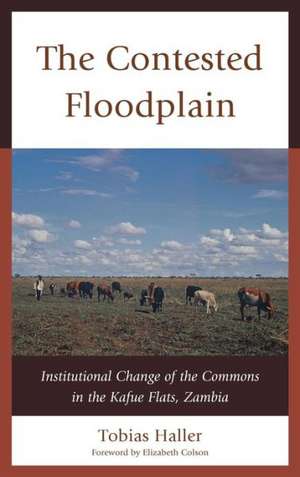
The Contested Floodplain: Institutional Change of the Commons in the Kafue Flats, Zambia
Autor Tobias Halleren Limba Engleză Hardback – 27 dec 2012
Preț: 923.32 lei
Preț vechi: 1392.86 lei
-34%
Puncte Express: 1385
Preț estimativ în valută:
163.46€ • 190.34$ • 142.00£
163.46€ • 190.34$ • 142.00£
Carte tipărită la comandă
Livrare economică 23 februarie-09 martie
Preluare comenzi: 021 569.72.76
Specificații
ISBN-13: 9780739169568
ISBN-10: 0739169564
Pagini: 555
Dimensiuni: 162 x 235 x 40 mm
Greutate: 1.03 kg
Editura: Bloomsbury Publishing
Colecția Lexington Books
Locul publicării:New York, United States
ISBN-10: 0739169564
Pagini: 555
Dimensiuni: 162 x 235 x 40 mm
Greutate: 1.03 kg
Editura: Bloomsbury Publishing
Colecția Lexington Books
Locul publicării:New York, United States
Cuprins
Foreword: by Elizabeth Colson, Professor Emeritus, University of California, Berkeley
Chapter 1: Introduction: the role of institutions in the management of common pool resources
Chapter 2: The Kafue Flats Ecosystem: A rich floodplain in a semi-arid environment
Chapter 3: A "fierce" people. Ethnography of the Ila, Balundwe and Batwa
Chapter 4: From Lozi raids to ineffective state control: the political economy of Southern Province and Zambia
Chapter 5: Transformations in a pastoral commons: Institutional change of cattle and pasture management
Chapter 6: We will throw the Lozi into the water" Institutional change and conflict in the fisheries
Chapter 7: From hunting to poaching: Wildlife management from Common Property to de facto open access
Chapter 8: Irrigation for the poor - cattle for the rich? Contesting the institutional design
of the floodplain
Conclusions: Institutional change, bargaining power and conflicts
Chapter 1: Introduction: the role of institutions in the management of common pool resources
Chapter 2: The Kafue Flats Ecosystem: A rich floodplain in a semi-arid environment
Chapter 3: A "fierce" people. Ethnography of the Ila, Balundwe and Batwa
Chapter 4: From Lozi raids to ineffective state control: the political economy of Southern Province and Zambia
Chapter 5: Transformations in a pastoral commons: Institutional change of cattle and pasture management
Chapter 6: We will throw the Lozi into the water" Institutional change and conflict in the fisheries
Chapter 7: From hunting to poaching: Wildlife management from Common Property to de facto open access
Chapter 8: Irrigation for the poor - cattle for the rich? Contesting the institutional design
of the floodplain
Conclusions: Institutional change, bargaining power and conflicts
Recenzii
Environmental management in Africa suffers from a dearth of deep scholarly study. Fusing Elinor Ostrom's institutional analysis, Fikret Berkes's "traditional ecological knowledge," and Jean Ensminger's theories in economic anthropology, Haller (anthropology, Univ. of Berne, Switzerland) seeks to explain why common pool resources in central Zambia are under threat of overuse and mismanagement. He presents lengthy introductions on the ecology, the people, and the history of the area before moving into the heart of his analysis. This is important, as his analysis portrays a complex web of power structures, authority figures, and ideology. Without the first several chapters, the reader would be easily lost. Fortunately, Haller's mixed qualitative and quantitative approach to moving through various levels of power successfully shows how a changing economy, legal regimes, and the environment itself threaten local management strategies. The book is written at an advanced level. Haller covers an important topic and presents a strong case study. Summing Up: Recommended.
Haller's extensive examination of this particular floodplain in Central Africa offers a much needed longitudinal understanding of the history of social, environmental, and institutional change leading up to the current problems of sustainable common pool resource use. . . .Taken together, Haller's ethnography, framed with current theoretical discussion, results in a robust and important monograph in political-ecology, of which ecological and economic anthropologists, Africanists, environmental scientists, and historians should take note. . . .The ethnographic data and detail in this volume are profound, and they stand equally alongside other classics in anthropology. . . .The theoretical framework advances our understanding of institutional change, illustrated so well through this case study, and consequently stands as an example of well-integrated theory and grounded ethnography. . . .The Contested Floodplain stands as a solid scientific endeavor.
The Contested Floodplain is the most detailed analysis to date of the impact of external institutional changes on the population and environment of an African floodplain. Starting with analysis of the cultural and socio-economic systems of pre-colonial herders, fishers, and farmers living on Zambia's Kafue Flats, Tobias Haller explains institutional impacts associated with British and Zambian governance that converted previously viable systems of limited access commons into a degraded open access system.
Haller's extensive examination of this particular floodplain in Central Africa offers a much needed longitudinal understanding of the history of social, environmental, and institutional change leading up to the current problems of sustainable common pool resource use. . . .Taken together, Haller's ethnography, framed with current theoretical discussion, results in a robust and important monograph in political-ecology, of which ecological and economic anthropologists, Africanists, environmental scientists, and historians should take note. . . .The ethnographic data and detail in this volume are profound, and they stand equally alongside other classics in anthropology. . . .The theoretical framework advances our understanding of institutional change, illustrated so well through this case study, and consequently stands as an example of well-integrated theory and grounded ethnography. . . .The Contested Floodplain stands as a solid scientific endeavor.
The Contested Floodplain is the most detailed analysis to date of the impact of external institutional changes on the population and environment of an African floodplain. Starting with analysis of the cultural and socio-economic systems of pre-colonial herders, fishers, and farmers living on Zambia's Kafue Flats, Tobias Haller explains institutional impacts associated with British and Zambian governance that converted previously viable systems of limited access commons into a degraded open access system.