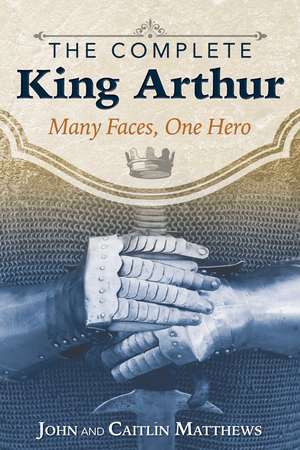
The Complete King Arthur: Many Faces, One Hero: Inner Traditions
Autor John Matthews, Caitlín Matthewsen Limba Engleză Paperback – 15 iun 2017
Observăm încă de la prima răsfoire că The Complete King Arthur nu este doar o altă culegere de legende, ci un instrument de studiu vizual spectaculos. Insertul color de opt pagini și ilustrațiile atent selectate nu au doar un rol estetic, ci servesc drept ghid instructiv prin geografia și artefactele unei epoci adesea numite „întunecate”. Această dimensiune vizuală ne ajută să ancorăm teoriile complexe în realitatea fizică a siturilor arheologice de la Zidul lui Hadrian sau din Cornwall.
Ne-a atras atenția rigoarea cu care soții John Matthews și Caitlín Matthews distilează patru decenii de cercetare într-o structură logică, ce pornește de la „Arthur al Romei” și culminează cu „Arthur al fabulei”. Autorii nu se limitează la o singură variantă a adevărului, ci explorează fiecare fațetă: a fost el un [Artorius] roman, un lider de război împotriva saxonilor sau o proiecție mitică necesară supraviețuirii culturale? Ca și King Arthur de Rodney Castleden, această lucrare pune un accent deosebit pe dovezile arheologice și documentare pentru a separa realitatea de ficțiune, dar se distinge printr-un stil propriu, mult mai enciclopedic, ce integrează dimensiunea spirituală și mitologică a legendei.
În contextul operei lor vaste, acest volum rafinează temele explorate anterior în The Great Book of King Arthur and His Knights of the Round Table, trecând de la repovestirea literară la o analiză istorică exhaustivă. The Complete King Arthur reușește să fie în același timp un omagiu adus tradiției celtice și un tratat de istorie critică, oferind cititorului o imagine completă a celui care a devenit „Rex Quondam, Rexque Futurus”.


Preț: 112.71 lei
Preț vechi: 146.41 lei
-23%
Carte disponibilă
Livrare economică 06-18 noiembrie
Specificații
ISBN-10: 1620555999
Pagini: 424
Ilustrații: Includes 8-page color insert and 4 b&w illustrations
Dimensiuni: 152 x 229 x 23 mm
Greutate: 0.57 kg
Editura: Inner Traditions/Bear & Company
Colecția Inner Traditions
Seria Inner Traditions
De ce să citești această carte
Recomandăm această carte pasionaților de istorie medievală și mitologie care caută o perspectivă academică, dar accesibilă. Veți câștiga o înțelegere profundă a modului în care un personaj istoric real este transformat de timp în simbol cultural. Este resursa definitivă pentru oricine dorește să exploreze misterul Camelotului dincolo de clișeele cinematografice, beneficiind de expertiza celor mai respectați cercetători ai curentului arthurian.
Despre autor
John Matthews și Caitlín Matthews sunt recunoscuți internațional ca autorități în domeniul tradițiilor celtice și al legendelor arthuriene, având la activ peste 40 de ani de studii dedicate acestor subiecte. John Matthews este Senior Lecturer în cadrul diviziei de Artă de la Nanyang Technological University, Singapore, și a publicat numeroase lucrări de referință, inclusiv The Prophecies of Merlin. Expertiza lor combină cercetarea istorică riguroasă cu o înțelegere profundă a simbolismului ezoteric, fiind consultanți frecvenți pentru producții documentare și cinematografice care vizează epoca medievală timpurie.
Descriere scurtă
• Explores the history of every Arthur candidate and the geographical arguments that have placed him in different locations
• Examines 1,800 years of evidence for Arthur’s life and the famous series of 12 battles fought against the Saxons in the 6th century
• Reconstructs the history of the 6th century in Britain, when the first references to Arthur and the core events of his reign appear
Few legends have had the enduring influence of those surrounding King Arthur. Many believe the stories are based on historical truth. For others Arthur represents the archetype of the brilliant monarch reigning over a fairy-tale kingdom, offering his knights the opportunity to prove their mettle in battle and find gnostic illumination through initiation into sacred mysteries like that of the Grail.
Presenting the culmination of more than 40 years’ research, John and Caitlín Matthews examine the historical and mythological evidence for every major theory about the existence of King Arthur. Drawing on modern techniques in archaeology and scholarship, they reconstruct the history of the 6th century in Britain, the period when the first unambiguous references to Arthur appear. They explore the history of every Arthur candidate, the geographical arguments that have placed him in different locations, and the evidence for his life and famous battles fought against the Saxons. Was the greatest British hero of all time not a king but a 2nd-century Roman officer active around Hadrian’s Wall in Cumbria? A 5th-century soldier who operated in areas as far apart as Cornwall, Wales, Scotland, or Brittany? Or an entirely mythical fiction that provided a figure of light during a dark period of British history?
Examining other literary figures from the 5th century such as Vortigern and Ambrosius, the authors also break down the plots of all the major Arthurian romances, including those by Chretien de Troyes, Sir Thomas Malory, and Robert de Boron, to reveal the historical events they are based on. Piecing together the many fragments that constitute the image of Arthur, both the man and the myth, the authors show how each face of Arthur has something to offer and how his modern popularity proves the enduring power of the hero-myth, truly earning Arthur the title he first received in the 15th century: The Once and Future King.
Notă biografică
Extras
Arthur of the Battles
Defender of the Land
A War Leader’s Rise to Power
In the written sources Arthur appears as a dux bellorum or “leader of battles,” not yet a king. In describing the “Wonders of Britain,” Nennius calls Arthur simply a miles, or soldier.1 In the Vatican recension of Historia Brittonum, we hear that: “although many were more noble than he, Arthur was the leader and victor in twelve battles.”2 How did a man so obscure rise from the ranks to gain twelve famous victories? How he came to this position, what military methods he used, who were his allies and enemies will be examined here as we seek the motivations for Arthur’s battles beyond the bare accounts of the chronicles.
Gildas’s insistence that Ambrosius was the victor at Badon is not necessarily at odds with Nennius’s account of Arthur’s victory. If Ambrosius had been Arthur’s commander in chief, both men could have taken part in the battle and could therefore both be said to be victorious. In the common parlance of war, a battle is normally attributed to its commander in chief, not to any subordinate general, however valiant, although special campaigns might single out an individual as particularly successful.
Was Arthur known to his contemporaries as “Arthur of Badon?” The historian William of Malmesbury, writing in the first quarter of the twelfth century, gives us a brief glimpse of Arthur at the side of Ambrosius:
When (Vortigern) died, the British strength decayed; their hopes becoming diminished, fled; and they would have soon perished altogether, had not Ambrosius, the sole survivor of the Romans, who became monarch after Vortigern, quelled the presumptuous barbarians by the powerful aid of warlike Arthur. This is that Arthur of whom the Britons fondly fable, even to the present day: a man worthy to be celebrated, not by idle fictions, but in authentic history. He, indeed, for a long time upheld the sinking state, and roused the broken spirit of his countrymen to war. Finally, at the siege of Mount Badon, relying on an image of the Virgin which he had affixed to his armour, he engaged nine hundred of the enemy singlehanded, and dispersed them with incredible slaughter.3
The passage is largely attributable to Nennius’s Historia Brittonum, and the variations may be of William’s own creation, but even here we have “a warlike Arthur,” not a king.
We do not know the nature of Ambrosius’s relationship to Arthur. Had Arthur been a relative this would surely have been remembered in the genealogical record. In terms of the military emergency in which Britain found itself, it is possible that Ambrosius, acculturated in the Roman way, adopted Arthur. Adoption of a successor was a Roman custom among both its emperors as well as its citizens, recognized within Roman law so that childless men could appoint responsible inheritors. There are two obstacles to this, for Ambrosius had descendants, according to Gildas, and if Arthur had been formally adopted, we would expect to have some account of him as “Arthur, son of Ambrosius.”
We have already seen how Vortigern continued to rule as king while his son Vortimer acted as the active general of his forces only a generation before Arthur’s time, and it is more likely that Arthur was Ambrosius’s military successor rather than his adopted son. Ambrosius Aurelianus is a resoundingly Roman name with no British equivalent until Nennius calls him Emrys Guletic, or “Ambrosius the Sovereign.” In the mid-fifth century British men still bore Latinate names, but successive generations favored British ones. What if Ambrosius had a British military nickname like “Uter Pendragon” or “the Terrible Draco-Leader.” Such a nickname would explain why Ambrosius is associated with the story of Vortigern’s tower and the dragons as well as providing a battle cry to rally behind. Nennius’s story about a cloth with two worms upon it could well represent the two standards of the British and Saxons. A draco standard, so much a part of the legionary insignia of Lucius Artorius Castus, was the rallying point both for the British and the Sarmatians he lead.
If such a nom de guerre had been applied to Ambrosius, it might well have led to the later association between Uther and Arthur as father and son; for, while it is clear that Arthur is no one’s son in the early record, both he and his predecessor bear the name “Pendragon” in later legend. The draco standard of the legions gradually mutated into the red dragon emblem of Gwynedd, still in use today as the national standard of Wales.
So where did Arthur of the Battles originate? There is a poem in the Book of Taliesin that gives us a clue to his antecedents and makes powerful sense. Already mentioned in chapter 1, where it has been seen as complementary evidence for the Roman origins of Arthur, “Kadeir Teyrnon” may also support the antecedents of a fifth-century northern Arthur. The poem discusses the ruler of Britain as a man born and bred on the Wall as well as one militarily qualified to its supervision.
Declare the clear ode
In inspiration’s own metre:
A man sprung of two authors,
Of a cavalry wing’s steel.
His spear and his wisdom,
His judicious course,
His kingly sovereignty
His assault over the Wall,
His rightful seat Amongst the defenders of the Wall. . . .
From the slaughter of chieftains,
From the destruction of armies,
From the loricated legion,
Sprang the Guledic,
Around the fierce old boundary.4
The “fierce old boundary” is none other than Hadrian’s Wall (see plate 3). This poem suggests a man who was born either of native stock and Roman lineage or perhaps one who is half-native and half-foreigner; we might take our pick from the men of Rheged, the Gododdin, or of Pictish or Dalriadan origin, which might help explain from whence the name “Arthur” was first introduced.
Cuprins
Dates, Names, and Time Line of Significant Events
Introduction: The Once and Future King
1 Arthur of Rome: Commander of Legions
2 Arthur of the Shadows: A Hero in the Making
3 Arthur of the Battles: Defender of the Land
4 Arthur of Myth: Granter of Quests
5 Arthur of Britain: The Making of a King
6 King Arthur: Lord of Camelot
7 Arthur of Fable: A Nation’s Hero
8 Arthur Everywhere: Rex Quondam, Rexque Futurus
Appendix: “The Sovereign’s Chair”
Notes
Bibliography/Further Reading
Arthurian Societies and Resources
Index
Recenzii
“The Matthews have done it again! Here is a compact assembly of Arthurian sources from ancient Rome through the classics, including many obscure bits. A wonderful and entertaining read.”
“Beautifully written and extensively researched, The Complete King Arthur provides a thorough overview of past and present examples of the tradition and the possible sources from which they sprang. Accessible to scholars and general readers alike, this study is a necessary addition to the library of anyone who loves King Arthur.”
“What a treasure this book is, a gift of great magnitude from the Matthews to all the rest of us. I so wish I had had it when I was immersing myself in Arthur in college many decades ago. The Mathews are the rarest of writers: scholars who are poets, poets who are scholars, singers of myth and history. They understand that facts are the basis of story, but equally, story is the basis of facts. Over the years of their phenomenal body of work, they have never set aside one for the other but have fed them together, in great measure.”
"Because the Matthews have been studying Celtic traditions, including the Arthurian legends, for forty years, The Complete King Arthur really is complete."