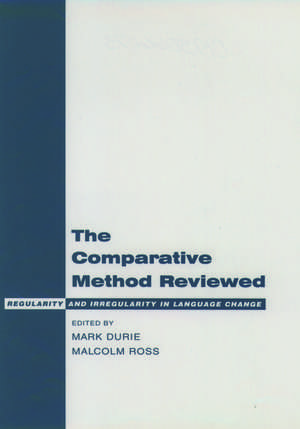
The Comparative Method Reviewed: Regularity and Irregularity in Language Change
Editat de Mark Durie, Malcolm Rossen Limba Engleză Hardback – 8 aug 1996
Preț: 1080.54 lei
Preț vechi: 1580.66 lei
-32%
Puncte Express: 1621
Carte tipărită la comandă
Livrare economică 04-15 decembrie
Livrare prin curier în România Termenul estimat este afișat lângă disponibilitate.
Transport gratuit pentru acest produs Plată online sau ramburs, în funcție de opțiunile comenzii.
Retur gratuit în 14 zile Comandă securizată și suport în română.
Specificații
ISBN-13: 9780195066074
ISBN-10: 0195066073
Pagini: 336
Ilustrații: line figures, tables
Dimensiuni: 162 x 243 x 27 mm
Greutate: 0.74 kg
Ediția:1
Editura: Oxford University Press
Colecția OUP USA
Locul publicării:New York, United States
ISBN-10: 0195066073
Pagini: 336
Ilustrații: line figures, tables
Dimensiuni: 162 x 243 x 27 mm
Greutate: 0.74 kg
Ediția:1
Editura: Oxford University Press
Colecția OUP USA
Locul publicării:New York, United States
V-ar putea interesa
-
 A Linguistic History of ArabicJonathan Owens-24%Preț: 414.40 lei542.98 lei
 -
 Damp Squid: The English Language Laid BareJeremy Butterfield-20%Preț: 72.96 lei91.28 lei
 -
 -21%Preț: 939.91 lei1193.79 lei
 -
 -30%Preț: 1012.73 lei1450.14 lei
 -
 -20%Preț: 491.95 lei613.36 lei
 -
 Word Order in Old ItalianCecilia Poletto-31%Preț: 944.55 lei1375.61 lei
 -
 -33%Preț: 1462.91 lei2173.11 lei
 -
 Cultivating the Arts in Education and TherapyMalcolm RossPreț: 469.52 lei
 -
 Fundamentals of PsycholinguisticsEM FernandezPreț: 250.02 lei
 -
 Preț: 422.02 lei
Recenzii
Its stength lies in its concentration on relaticely unfamiliar material, presented by scholars whose expertise is palpable at every turn. There is no doub that the effort that is requires to penetrate and , where necessary, to restate the authors' theoretical methodological premises and conclusions - the very conclusions likely to net the book some eager readers - will be well repaid. It is badly needed.
This wonderfully stimulating book... takes an honorable place in modern scholarship on reconstruction and language relatedness. Drawing on 'difficult' data from largely non-Indo-European languages... it highlights what the standard linguistics textbooks do not - the 'rough edges', the problems with the received wisdom.
This wonderfully stimulating book... takes an honorable place in modern scholarship on reconstruction and language relatedness. Drawing on 'difficult' data from largely non-Indo-European languages... it highlights what the standard linguistics textbooks do not - the 'rough edges', the problems with the received wisdom.