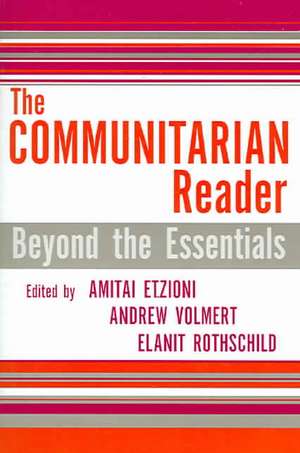
The Communitarian Reader: Beyond the Essentials: Rights & Responsibilities
Editat de Andrew Volmert, Elanit Rothschild Contribuţii de Don Browning, Richard Coughlin, Alan Ehrenhalt, RICHARD A. EPSTEIN, Amitai Etzioni, Francis Fukuyama, William A. Galston, Steven J. Heyman, Hans Joas, David Karp, Douglas W. Kmiec, Philip Langdon, Stephen Macedo, Sasha Polankow-Suransky, Jonathan Rauch, Dr. Pepper Schwartz, Philip Selznick, Thomas A. Spragens Jr., Charles Taylor, Laurence H. Tribe, Eugen Volokh, Alan Wolfe, C Robert Zelnicken Limba Engleză Paperback – sep 2004



Preț: 363.20 lei
Preț vechi: 462.28 lei
-21%
Puncte Express: 545
Carte tipărită la comandă
Livrare economică 23 noiembrie-07 decembrie
Livrare prin curier în România Termenul estimat este afișat lângă disponibilitate.
Transport gratuit de la 400.00 lei Plată online sau ramburs, în funcție de opțiunile comenzii.
Retur gratuit în 14 zile Comandă securizată și suport în română.
Specificații
ISBN-13: 9780742542198
ISBN-10: 074254219X
Pagini: 279
Dimensiuni: 154 x 234 x 21 mm
Greutate: 0.37 kg
Editura: Bloomsbury Publishing
Colecția Rowman & Littlefield
Seria Rights & Responsibilities
Locul publicării:New York, United States
ISBN-10: 074254219X
Pagini: 279
Dimensiuni: 154 x 234 x 21 mm
Greutate: 0.37 kg
Editura: Bloomsbury Publishing
Colecția Rowman & Littlefield
Seria Rights & Responsibilities
Locul publicării:New York, United States
V-ar putea interesa
-
 The Jaguar SmileSalman Rushdie-21%Preț: 55.39 lei69.77 lei
 -
 Justice GameGeoffrey Robertson-19%Preț: 86.07 lei106.25 lei
 -
 NationalismJohn Hutchinson-12%Preț: 381.64 lei434.42 lei
 -
 -31%Preț: 583.14 lei840.53 lei
 -
 A New Handbook of Political ScienceRobert E. Goodin-30%Preț: 661.92 lei947.10 lei
 -
 On the Ethics of War and TerrorismUwe Steinhoff-31%Preț: 738.02 lei1074.70 lei
 -
 -28%Preț: 400.53 lei557.75 lei
 -
 Sale Of The Century: The Inside Story of the Second Russian RevolutionChrystia Freeland-27%Preț: 78.47 lei107.41 lei
 -
 The Quest for Cosmic JusticeThomas SowellPreț: 103.50 lei
 -
 The Heart of Things: Applying Philosophy to the 21st CenturyProf A.C. Grayling-6%Preț: 67.41 lei71.43 lei
 -
 Free RadicalTony Benn-42%Preț: 139.05 lei238.76 lei
 -
 Preț: 332.28 lei
 -
 The Betrayal of AmericaVincent BugliosiPreț: 107.12 lei
 -
 Preț: 98.95 lei
 -
 Perpetual War for Perpetual PeaceGore VidalPreț: 71.44 lei
Cuprins
Chapter 1 Introduction
Chapter 2 The Responsive Community Platform: Rights and Responsibilities
Part 3 I Theory and Social Philosophy
Chapter 4 No Community, No Democracy
Chapter 5 Combining Value Pluralism and Moral Universalism: Isaiah Berlin and Beyond
Chapter 6 Legislating Morality in Liberal Democracies
Chapter 7 On a Communitarian Faith
Chapter 8 Are Particularistic Obligations Justified? A Communitarian Examination
Part 9 II The Communitarian Society
Chapter 10 Enforcing Norms: When the Law Gets in the Way
Chapter 11 Social Mores Are Not Enough
Chapter 12 Confessions of an Alleged Libertarian (and the Virtues of "Soft" Communitarianism)
Chapter 13 The Contours of Remoralization
Chapter 14 The Duty to Rescue: A Liberal Communitarian Approach
Chapter 15 Does Socioeconomic Inequality Undermine Community? Implications for Communitarian Theory
Chapter 16 Americans as Communitarians: An Empirical Study
Part 17 III Community
Chapter 18 Developing Civil Society: Can the Workplace Replace Bowling?
Chapter 19 Self-Sacrifice, Self-Fulfillment, and Mutuality: The Evolution of Marriage
Chapter 20 Peer Marriage
Chapter 21 Community and the Corner Store: Retrieving Human-Scale Commerce
Chapter 22 Boston's Ten Point Coalition: A Faith-Based Approach to Fighting Crime in the Inner City
Chapter 23 Can Design Make Community?
Part 24 IV Communitarian Policies
Chapter 25 Rights and Responsibilities, 2001
Chapter 26 Confusing Freedom with License-Licenses Terrorism, Not Freedom
Chapter 27 We Can Strike a Balance on Civil Liberties
Chapter 28 Liberal Sectarianism? Social Capital, Religious Communities, and Public Funds
Chapter 29 The Benefits of Surveillance?
Chapter 30 Military Secrets and First Amendment Values
Chapter 31 Diversity Within Unity: A New Approach to Immigrants and Minorities
Part 32 V Dialogues
Chapter 33 Virtue and the State: A Dialogue between a Communitarian and a Social Conservative
Chapter 34 Virtue, Self-Interest, and the Good: A Dialogue on Communitarianism and Classical Liberalism
Chapter 2 The Responsive Community Platform: Rights and Responsibilities
Part 3 I Theory and Social Philosophy
Chapter 4 No Community, No Democracy
Chapter 5 Combining Value Pluralism and Moral Universalism: Isaiah Berlin and Beyond
Chapter 6 Legislating Morality in Liberal Democracies
Chapter 7 On a Communitarian Faith
Chapter 8 Are Particularistic Obligations Justified? A Communitarian Examination
Part 9 II The Communitarian Society
Chapter 10 Enforcing Norms: When the Law Gets in the Way
Chapter 11 Social Mores Are Not Enough
Chapter 12 Confessions of an Alleged Libertarian (and the Virtues of "Soft" Communitarianism)
Chapter 13 The Contours of Remoralization
Chapter 14 The Duty to Rescue: A Liberal Communitarian Approach
Chapter 15 Does Socioeconomic Inequality Undermine Community? Implications for Communitarian Theory
Chapter 16 Americans as Communitarians: An Empirical Study
Part 17 III Community
Chapter 18 Developing Civil Society: Can the Workplace Replace Bowling?
Chapter 19 Self-Sacrifice, Self-Fulfillment, and Mutuality: The Evolution of Marriage
Chapter 20 Peer Marriage
Chapter 21 Community and the Corner Store: Retrieving Human-Scale Commerce
Chapter 22 Boston's Ten Point Coalition: A Faith-Based Approach to Fighting Crime in the Inner City
Chapter 23 Can Design Make Community?
Part 24 IV Communitarian Policies
Chapter 25 Rights and Responsibilities, 2001
Chapter 26 Confusing Freedom with License-Licenses Terrorism, Not Freedom
Chapter 27 We Can Strike a Balance on Civil Liberties
Chapter 28 Liberal Sectarianism? Social Capital, Religious Communities, and Public Funds
Chapter 29 The Benefits of Surveillance?
Chapter 30 Military Secrets and First Amendment Values
Chapter 31 Diversity Within Unity: A New Approach to Immigrants and Minorities
Part 32 V Dialogues
Chapter 33 Virtue and the State: A Dialogue between a Communitarian and a Social Conservative
Chapter 34 Virtue, Self-Interest, and the Good: A Dialogue on Communitarianism and Classical Liberalism
Recenzii
The Communitarian Reader: Beyond the Essentials accomplishes just what its name implies. It offers a sophisticated sampling of provacative essays from a variety of communitarian perspectives. Rather than setting forth a standard communitarian 'truth,' it gathers together a series of fascinating and sometimes divergent views, bound together by an appreciation of the value of community and social responsibility.
Many people suspect that a new way must exist between the doctrine of laissez-faire (with its disdain for the bonds of society) and the doctrine of prescriptive conservatism (with its disdain for individual liberties). That new way does exist. It is called 'communitarianism,' and Amitai Etzioni is its leading theorist. This book presents an exciting and practical alternative to philosophies that have failed us.
A fresh, communitarian imagination animates these accessible theoretical essays, lively position pieces, and timely reports on American social trends. Here are lots of conversation-starters for anyone who wants to create a more responsible society.
This is an important collection of papers on communitarian themes. The authors are uniformly first-rate thinkers, and anyone who wants an overview of the subject can do no better than turning to the workn assembled by Etzioni and his collegues.
In a time with questions of local versus global allegiance, concerns for what is an appropriate moral focus, and arguments for how to instill 'proper' values into children, the issues raised in this excellent and thought-provoking reader are critical to ponder and discuss. Americans still argue the value of liberal thought in regard to the body politics, and this book provides a useful and important alternative to that view of human associations. This book can be read with profit by all segments of the public and university communities.
Professor Etzioni has put himself in excellent company, usefully extending the communitarian project both practically and theoretically with input from many of the top political thinkers of our time. An invaluable volume for academicians, policymakers, and anyone concerned with the dissolution of social capital in our increasingly fragmented world.
Many people suspect that a new way must exist between the doctrine of laissez-faire (with its disdain for the bonds of society) and the doctrine of prescriptive conservatism (with its disdain for individual liberties). That new way does exist. It is called 'communitarianism,' and Amitai Etzioni is its leading theorist. This book presents an exciting and practical alternative to philosophies that have failed us.
A fresh, communitarian imagination animates these accessible theoretical essays, lively position pieces, and timely reports on American social trends. Here are lots of conversation-starters for anyone who wants to create a more responsible society.
This is an important collection of papers on communitarian themes. The authors are uniformly first-rate thinkers, and anyone who wants an overview of the subject can do no better than turning to the workn assembled by Etzioni and his collegues.
In a time with questions of local versus global allegiance, concerns for what is an appropriate moral focus, and arguments for how to instill 'proper' values into children, the issues raised in this excellent and thought-provoking reader are critical to ponder and discuss. Americans still argue the value of liberal thought in regard to the body politics, and this book provides a useful and important alternative to that view of human associations. This book can be read with profit by all segments of the public and university communities.
Professor Etzioni has put himself in excellent company, usefully extending the communitarian project both practically and theoretically with input from many of the top political thinkers of our time. An invaluable volume for academicians, policymakers, and anyone concerned with the dissolution of social capital in our increasingly fragmented world.