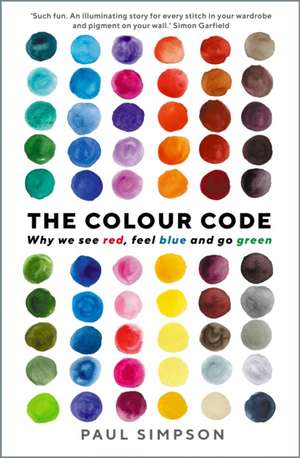
The Colour Code: Why we see red, feel blue and go green
Autor Paul Simpsonen Limba Engleză Paperback – 7 oct 2021
Literatura academică dedicată cromaticii tinde adesea să se fragmenteze între rigoarea fizicii optice și abstractizarea istoriei artei, lăsând un gol în zona sintezei accesibile care să explice impactul culorii asupra vieții cotidiene. The Colour Code completează această lacună printr-o abordare enciclopedică, dar surprinzător de ludică. Considerăm că forța acestui volum rezidă în capacitatea de a conecta concepte tehnice, precum compoziția chimică a pigmenților toxici de arsenic din tapetele lui William Morris, cu fenomene sociale moderne, cum ar fi simbolistica rozului în marșurile politice contemporane.
Spre deosebire de lucrări strict teoretice, această ediție Profile pune accent pe componenta vizuală. Cititorii familiarizați cu The Secret Language Of Color de Arielle Eckstut vor aprecia aici o schimbare de ritm; dacă Eckstut se concentrează pe mecanismele naturale, Paul Simpson preferă o perspectivă culturală extinsă. Reținem detalii fascinante despre obsesia lui Frank Sinatra pentru portocaliu sau despre „Mummy Brown”, pigmentul obținut din rămășițe umane, oferind o textură narativă mult mai densă decât un simplu manual de popularizare a științei.
În contextul operei sale anterioare, The Colour Code pare o evoluție firească pentru un autor care a explorat extremele experienței umane în The Mammoth Book of Air Disasters and Near Misses sau psihologia în The Serial Killer Files. Simpson își păstrează stilul jurnalistic, precis și alert, reușind să transforme spectrul vizual într-un catalog de curiozități istorice. De la negrul iconic al rochiilor lui Audrey Hepburn până la biologia rară a găinii indoneziene complet negre, volumul propune o lectură fragmentată, ideală pentru cei care caută informație factuală prezentată cu umor și rigoare documentară.
Preț: 93.92 lei
Preț vechi: 111.53 lei
-16%
Carte disponibilă
Livrare economică 07-21 noiembrie
Livrare express 27-31 octombrie pentru 54.76 lei
Specificații
ISBN-10: 1781256268
Pagini: 352
Ilustrații: Full colour
Dimensiuni: 128 x 196 x 30 mm
Greutate: 0.58 kg
Ediția:Main
Editura: Profile
Colecția Profile Books
Locul publicării:London, United Kingdom
V-ar putea interesa
-
 -15%Preț: 203.65 lei238.66 lei
 -
 Brand Gap, The: Revised EditionMarty NeumeierPreț: 224.44 lei
 -
 Journal of a SolitudeMay SartonPreț: 87.25 lei
 -
 Book of IdeasRadim MalinicPreț: 166.10 lei
 -
 Book of IdeasRadim MalinicPreț: 166.03 lei
 -
 How to Find Fulfilling WorkRoman Krznaric-40%Preț: 46.88 lei78.39 lei
 -
 What Does Polyamory Look Like?Mim ChapmanPreț: 85.01 lei
 -
 -27%Preț: 46.23 lei63.05 lei
 -
 The Secret Lives of ColourKassia St Clair-24%Preț: 94.58 lei124.86 lei
 -
 101 Things I Learned(r) in Business School (Second Edition)Michael W PreisPreț: 113.09 lei
 -
 -23%Preț: 116.73 lei152.06 lei
 -
 -26%Preț: 165.16 lei223.64 lei
 -
 -23%Preț: 113.49 lei148.22 lei
 -
 The Typography Idea Book: Inspiration from 50 MastersGail Anderson-28%Preț: 96.75 lei133.78 lei
 -
 The Illustration Idea Book: Inspiration from 50 MastersGail Anderson-26%Preț: 80.53 lei108.44 lei
 -
 Thinking with TypeEllen Lupton-10%Preț: 145.52 lei161.13 lei
 -
 Type Matters!Jim WilliamsPreț: 143.19 lei
 -
 Preț: 28.89 lei
 -
 -16%Preț: 186.68 lei222.29 lei
 -
 Logo ModernismJens Müller-2%Preț: 522.79 lei533.45 lei
 -
 Why bees do not see red and we sometimes feel blueJoanna ZoelzerPreț: 189.38 lei
De ce să citești această carte
Recomandăm această carte oricărui cititor curios să înțeleagă cum culorile ne modelează deciziile de cumpărare, stările emoționale și istoria culturală. Este o resursă excelentă pentru studenții la arte sau design, dar și pentru pasionații de trivia științific, oferind argumente concrete despre originea pigmenților și evoluția percepției vizuale, totul într-un format grafic atractiv care facilitează învățarea rapidă.
Despre autor
Paul Simpson este un autor și editor polivalent, a cărui carieră reflectă o curiozitate intelectuală vastă. A editat numeroase reviste și a lansat publicația sportivă FourFourTwo, scriind în paralel pentru titluri prestigioase precum The Times și Financial Times. Bibliografia sa diversă cuprinde biografii, ghiduri cinematografice și volume de cercetare documentară despre dezastre și criminalistică. În The Colour Code, Simpson își folosește experiența de jurnalist de investigație pentru a extrage cele mai fascinante fapte din istoria științei și a artei, oferind o perspectivă proaspătă asupra modului în care interacționăm cu lumea vizibilă.
Notă biografică
Descriere scurtă
Recenzii
Fun ... If you want to know about football strips or national flags, why fire engines are red, why the Pope wears white or why the leader of the Tour de France has a yellow jersey you'll find the answer here
An entertaining, surprisingly informative piece of work that might even change the way we see the things around us
Descriere
How many colours are there? In the West we see seven, but the Chinese see five, while the Piraha tribe in the Amazon have no words for the spectrum. Colour isn't something we see; it's something we think. In this popular culture miscellany, Paul Simpson takes eleven key colours and explores how they have shaped our evolution as a species, persuaded us in politics and culture and allowed us to express or oppress personal freedoms.
His book investigates such issues as the shifting gender of pink, the poisonous potential of green, the decadence of yellow, the performance-diminishing impact of grey and the ways in which orange has shaped power in Europe.