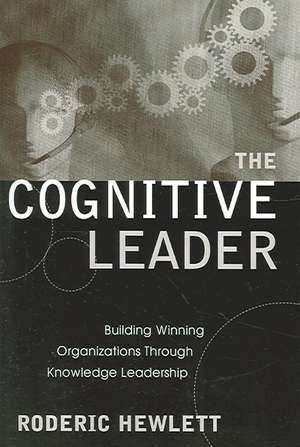
The Cognitive Leader: Building Winning Organizations through Knowledge Leadership
Autor Roderic Hewletten Limba Engleză Paperback – noi 2005
Challenges for leaders today are myriad and often seem overwhelmingly complex, but solutions begin with basics such as understanding how to: acquire needed competitive knowledge and capital, use knowledge to produce lasting results, build an organization that is aligned with mission, and improve decision-making. This book describes the process of knowledge leadership and highlights effective tools for all leaders to be successful.
Knowledge leadership is the new tool of the leadership trade. Learn to use knowledge wisely.
Preț: 260.34 lei
Preț vechi: 341.81 lei
-24%
Puncte Express: 391
Carte tipărită la comandă
Livrare economică 09-23 decembrie
Livrare prin curier în România Termenul estimat este afișat lângă disponibilitate.
Transport gratuit de la 400.00 lei Plată online sau ramburs, în funcție de opțiunile comenzii.
Retur gratuit în 14 zile Comandă securizată și suport în română.
Specificații
ISBN-13: 9781578863112
ISBN-10: 1578863112
Pagini: 111
Dimensiuni: 148 x 228 x 12 mm
Greutate: 0.2 kg
Editura: Bloomsbury Publishing
Colecția R&L Education
Locul publicării:New York, United States
ISBN-10: 1578863112
Pagini: 111
Dimensiuni: 148 x 228 x 12 mm
Greutate: 0.2 kg
Editura: Bloomsbury Publishing
Colecția R&L Education
Locul publicării:New York, United States
Recenzii
The book is a good outline of what leaders need to be aware of as we transition into an era in which information is a commodity and the application of the right information by the right people at the right time for the right result becomes the focus for competitive advantage.
Hewlett describes how to utilize knowledge about people, products, services, competitors, and environments to further decision making and the success of organizations. Following a description of knowledge and its effects, he discusses professional intellect, human and structural capital, "knowledge organizations," and the roles of leader and workers.
Hewlett describes how to utilize knowledge about people, products, services, competitors, and environments to further decision making and the success of organizations. Following a description of knowledge and its effects, he discusses professional intellect, human and structural capital, "knowledge organizations," and the roles of leader and workers.