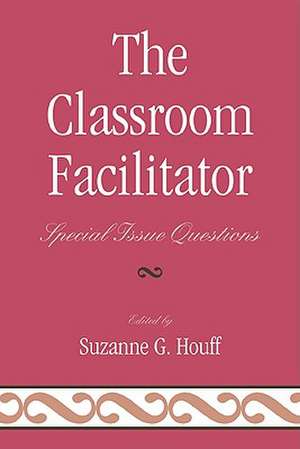
The Classroom Facilitator: Special Issue Questions
Editat de Suzanne G. Houff Contribuţii de Laurie S. Abeel, Teresa Coffman, Norah S. Hooper, Jane Huffman, H. Nicole Myers, Kavatus Newell, Patricia Reynolds, John St. Clair, Sharon Teaboen Limba Engleză Paperback – 16 aug 2010
Preț: 344.16 lei
Preț vechi: 505.52 lei
-32%
Puncte Express: 516
Carte tipărită la comandă
Livrare economică 23 noiembrie-07 decembrie
Livrare prin curier în România Termenul estimat este afișat lângă disponibilitate.
Transport gratuit de la 400.00 lei Plată online sau ramburs, în funcție de opțiunile comenzii.
Retur gratuit în 14 zile Comandă securizată și suport în română.
Specificații
ISBN-13: 9781607094920
ISBN-10: 1607094924
Pagini: 204
Dimensiuni: 150 x 228 x 16 mm
Greutate: 0.3 kg
Editura: Bloomsbury Publishing
Colecția R&L Education
Locul publicării:New York, United States
ISBN-10: 1607094924
Pagini: 204
Dimensiuni: 150 x 228 x 16 mm
Greutate: 0.3 kg
Editura: Bloomsbury Publishing
Colecția R&L Education
Locul publicării:New York, United States
Cuprins
Chapter 1 Introduction
Chapter 2 How Does Social and Emotional Learning Impact on the Classroom?
Chapter 3 What is Culturally Responsive Instruction?
Chapter 4 Where Do These Children Come From?
Chapter 5 What is Special about Special Education?
Chapter 6 How Do I Teach the Student with Autism Spectrum Disorder?
Chapter 7 How Do I Teach the Student Identified as Talented and Gifted?
Chapter 8 How Can I Use Technology to Support Reflection?
Chapter 9 How Can I Use Technology in Student Assessment?
Chapter 10 How Can I Use and Integrate Instructional Technology?
Chapter 11 Conclusion
Chapter 2 How Does Social and Emotional Learning Impact on the Classroom?
Chapter 3 What is Culturally Responsive Instruction?
Chapter 4 Where Do These Children Come From?
Chapter 5 What is Special about Special Education?
Chapter 6 How Do I Teach the Student with Autism Spectrum Disorder?
Chapter 7 How Do I Teach the Student Identified as Talented and Gifted?
Chapter 8 How Can I Use Technology to Support Reflection?
Chapter 9 How Can I Use Technology in Student Assessment?
Chapter 10 How Can I Use and Integrate Instructional Technology?
Chapter 11 Conclusion
Recenzii
The phrase: 'Try it; you'll like it' is an appropriate description of The Classroom Facilitator. Classroom teachers are constantly in search of ways to improve their teaching and to assist their students. The Classroom Facilitator offers a practical guide to reach students and offers activities that are doable in the student-centered classroom. To meet twenty-first-century goals teachers want a how-to book that offers realistic approaches to teaching; The Classroom Facilitator presents useful integration of methodology and pedagogy to meet these needs.
In a real world of information clouds, the question is not whether to use social media, web 2.0, and new technologies to enhance reflective learning but how to use them. Had Dewey had these tools at his disposal, surely he would have found useful and productive methods to maximize his theories on reflection. As learning managers, we seek to develop students as skilled critical thinkers. Classroom teachers will find valuable tools in The Classroom Facilitator.
This volume contends that teachers are facilitators who create student-centered and activity-based classrooms where students are held responsible for their own learning. Houff (education, U. of Mary Washington) assembles nine chapters around questions teachers, administrators, and staff development coordinators have about special issues related to students and facilitating learning, from the impact of social and emotional learning to teaching gifted and talented students. Education academics and practitioners from the US address developmentally appropriate instruction, special education, English as a second language, the culturally responsive classroom, teaching students with autism, and using technology in reflection, assessment, and instruction.
In a real world of information clouds, the question is not whether to use social media, web 2.0, and new technologies to enhance reflective learning but how to use them. Had Dewey had these tools at his disposal, surely he would have found useful and productive methods to maximize his theories on reflection. As learning managers, we seek to develop students as skilled critical thinkers. Classroom teachers will find valuable tools in The Classroom Facilitator.
This volume contends that teachers are facilitators who create student-centered and activity-based classrooms where students are held responsible for their own learning. Houff (education, U. of Mary Washington) assembles nine chapters around questions teachers, administrators, and staff development coordinators have about special issues related to students and facilitating learning, from the impact of social and emotional learning to teaching gifted and talented students. Education academics and practitioners from the US address developmentally appropriate instruction, special education, English as a second language, the culturally responsive classroom, teaching students with autism, and using technology in reflection, assessment, and instruction.