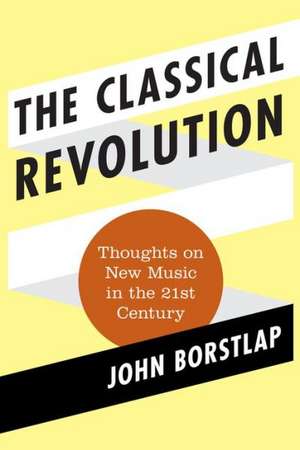
The Classical Revolution: Thoughts on New Music in the 21st Century: Modern Traditionalist Classical Music
Autor John Borstlapen Limba Engleză Hardback – 13 dec 2012
As Borstlap points out, part of the ongoing problem of contemporary music, a problem first created by modernism, is a profound misunderstanding of musical modernism itself. At the heart of his argument is the distinction between music and "sonic art" a distinction that renders superfluous the loaded labels of "progressive" and "conservative" in disputes over music. Addressing questions of cultural identity, musical meaning, and the aesthetics of beauty, The Classical Revolution closely examines the institutional biases of the modern-music establishment and its all-too-solid grip on the production and reception of new music. By drawing attention to new classical composers in a traditionalist mold, Borstlap illustrates how their increasing success in the realm of performance-as opposed to academic study-bespeaks a broader set of trends in serious contemporary composition.
The Classical Revolution is an accessible and informative polemic for music lovers with an interest in the meaning of classical music in general, and the classical tradition in particular which seems to be re-emerging in the 21st century. It should equally interest academics, music directors, promoters, programmers, musicians, and music students alike since here, a wide field of new musical experience opens itself up, with a hopeful perspective on the future of music.

Preț: 476.23 lei
Preț vechi: 686.88 lei
-31%
Puncte Express: 714
Carte tipărită la comandă
Livrare economică 07-21 decembrie
Livrare prin curier în România Termenul estimat este afișat lângă disponibilitate.
Transport gratuit pentru acest produs Plată online sau ramburs, în funcție de opțiunile comenzii.
Retur gratuit în 14 zile Comandă securizată și suport în română.
Specificații
ISBN-13: 9780810884571
ISBN-10: 0810884577
Pagini: 147
Dimensiuni: 152 x 230 x 16 mm
Greutate: 0.36 kg
Editura: Bloomsbury Publishing
Colecția Scarecrow Press
Seria Modern Traditionalist Classical Music
Locul publicării:New York, United States
ISBN-10: 0810884577
Pagini: 147
Dimensiuni: 152 x 230 x 16 mm
Greutate: 0.36 kg
Editura: Bloomsbury Publishing
Colecția Scarecrow Press
Seria Modern Traditionalist Classical Music
Locul publicării:New York, United States
V-ar putea interesa
-
 Portrait of ElgarMichael Kennedy-28%Preț: 452.77 lei631.81 lei
 -
 The Music of Benjamin BrittenPeter Evans-27%Preț: 558.34 lei761.39 lei
 -
 Peter Warlock: The Life of Philip HeseltineBarry Smith-28%Preț: 420.02 lei585.47 lei
 -
 New Vocal Repertory 2Jane Manning-20%Preț: 278.17 lei349.25 lei
 -
 Music and Sexuality in BrittenPhilip BrettPreț: 275.79 lei
 -
 The Cambridge Companion to JazzMervyn CookePreț: 325.24 lei
 -
 Rip it Up and Start AgainSimon ReynoldsPreț: 107.74 lei
 -
 Sviatoslav RichterM. Bruno MonsaingeonPreț: 138.34 lei
 -
 Hallelujah JunctionJohn AdamsPreț: 93.75 lei
 -
 -37%Preț: 227.98 lei363.64 lei
 -
 Haunted Weather: Music, Silence, and MemoryDavid ToopPreț: 75.10 lei
 -
 Erik SatieMary E. DavisPreț: 135.13 lei
Cuprins
Introduction
Classical Music - a Dying Culture?
Chapter 1
The Classical Revolution: The Shock of the Old
Chapter 2
The Fallacy of Modernism, I
Chapter 3
The Fallacy of Modernism, II
Chapter 4
Temples of Delight: How Not to Build a Concert Hall
Chapter 5
The Enduring Presence of the Past
Chapter 6
The Search for Meaning
Chapter 7
The Cultural Shopping Mall: Pluralism and Choice
Chapter 8
Conclusion: The Debate about Beauty
Chapter 9
Some Composers
Further Reading
Classical Music - a Dying Culture?
Chapter 1
The Classical Revolution: The Shock of the Old
Chapter 2
The Fallacy of Modernism, I
Chapter 3
The Fallacy of Modernism, II
Chapter 4
Temples of Delight: How Not to Build a Concert Hall
Chapter 5
The Enduring Presence of the Past
Chapter 6
The Search for Meaning
Chapter 7
The Cultural Shopping Mall: Pluralism and Choice
Chapter 8
Conclusion: The Debate about Beauty
Chapter 9
Some Composers
Further Reading
Recenzii
The Classical Revolution: Thoughts on New Music in the 21st Century is rich in discussion worthy arguments. ... Because of the numerous issues raised (including the relationship of originality and aesthetic quality, the relationship with non-European cultures, the importance of spirituality) Borstlap's book about the current issues of composition and a new classicism is an important contribution to musical aesthetics.
In The Classical Revolution: Thoughts on New Music in the 21st Century, John Borstlap offers an excellent and expansive view of where we now are in the larger world of contemporary art music (music in the tradition of Western classical music), both in America, and from his vantage point, in Europe.
The recent. . . article by Dutch composer John Borstlap on the problem of gaining exposure for music written in 'pre-modern' tonal traditions is developed in his new book, taking as a starting point the Orwellian epigram[.] . . . Is the restoration of music traditions desirable or even possible in today's multicultural Europe. How may traditionally-based music each a wide audience in overcoming today's persuasive pop/tv-driven culture? . . . Is this the price we continue to pay for Nazism and a once-great universal art's destruction? Borstlap's solutions from a challenging argument that all who care about music and its place in society should absorb.
In The Classical Revolution: Thoughts on New Music in the 21st Century, John Borstlap offers an excellent and expansive view of where we now are in the larger world of contemporary art music (music in the tradition of Western classical music), both in America, and from his vantage point, in Europe.
The recent. . . article by Dutch composer John Borstlap on the problem of gaining exposure for music written in 'pre-modern' tonal traditions is developed in his new book, taking as a starting point the Orwellian epigram[.] . . . Is the restoration of music traditions desirable or even possible in today's multicultural Europe. How may traditionally-based music each a wide audience in overcoming today's persuasive pop/tv-driven culture? . . . Is this the price we continue to pay for Nazism and a once-great universal art's destruction? Borstlap's solutions from a challenging argument that all who care about music and its place in society should absorb.