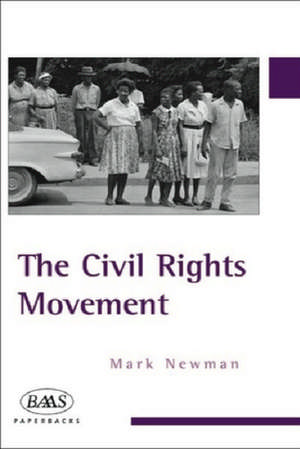
The Civil Rights Movement
Autor Mark Newmanen Limba Engleză Paperback – 19 iul 2004
Mark Newman outlines the range of responses to the movement from the north to the south, examining the role of the federal government, the church, and organized labor, and assessing the impact of the Cold War. The book discusses local, regional, and national civil rights campaigns, the utility of non-violent direct action, and the resurgence of Black Nationalism. It examines the achievements and disintegration of the national civil rights coalition, the role of Martin Luther King Jr., the NAACP, and the contributions made by many otherwise ordinary men and women.
Preț: 192.32 lei
Puncte Express: 288
Carte disponibilă
Livrare economică 07-21 octombrie
Livrare prin curier în România Termenul estimat este afișat lângă disponibilitate.
Transport gratuit de la 400.00 lei Plată online sau ramburs, în funcție de opțiunile comenzii.
Retur gratuit în 14 zile Comandă securizată și suport în română.
Specificații
ISBN-13: 9780748615933
ISBN-10: 0748615938
Pagini: 200
Dimensiuni: 142 x 217 x 18 mm
Greutate: 0.31 kg
Editura: EDINBURGH UNIVERSITY PRESS
ISBN-10: 0748615938
Pagini: 200
Dimensiuni: 142 x 217 x 18 mm
Greutate: 0.31 kg
Editura: EDINBURGH UNIVERSITY PRESS
V-ar putea interesa
-
 Hidden FiguresMargot Lee ShetterlyPreț: 87.82 lei
 -
 Texas RisingStephen L MoorePreț: 109.77 lei
 -
 KissingerNiall Ferguson-16%Preț: 116.13 lei138.82 lei
 -
 Ronald ReaganMichael Schaller-19%Preț: 79.66 lei98.75 lei
 -
 Preț: 106.98 lei
 -
 The N WordJabari AsimPreț: 107.13 lei
 -
 The Imperial PresidencyArthur Meier Jr. SchlesingerPreț: 186.59 lei
 -
 -10%Preț: 134.95 lei149.31 lei
 -
 American Culture in the 1950sMartin Halliwell-16%Preț: 203.13 lei241.08 lei
 -
 American Culture in the 1980sGraham Thompson-16%Preț: 201.86 lei240.28 lei
 -
 American Culture in the 1960sSharon Monteith-16%Preț: 202.54 lei240.69 lei
 -
 The American SouthDaniel Letwin-16%Preț: 236.25 lei280.92 lei
 -
 American Culture in the 1920sSusan Currell-16%Preț: 181.03 lei216.71 lei
 -
 -22%Preț: 193.56 lei248.05 lei
 -
 The Cuban Missile CrisisJonathan Colman-16%Preț: 209.66 lei248.72 lei
 -
 Preț: 363.89 lei
 -
 Divine AgitatorsMark NewmanPreț: 281.98 lei
 -
 Preț: 258.24 lei
 -
 Preț: 446.59 lei
 -
 Black Hawk and the Warrior's PathRoger L NicholsPreț: 267.51 lei
 -
 -23%Preț: 276.27 lei360.88 lei
 -
 All Our RelationsWinona LadukePreț: 110.58 lei
 -
 The Secret Societies of All Ages & Countries (Two Volumes in One)Charles William HeckethornPreț: 238.51 lei
 -
 Rio de JaneiroLuiz Eduardo SoaresPreț: 113.68 lei
Descriere
Descriere de la o altă ediție sau format:
Mark Newman outlines the range of white responses to the Civil Rights Movement and analyses both northern and southern opinion. He examines the role of the federal government, the church and organized labor, as well as the impact of the Cold War. The book discusses local, regional, and national civil rights campaigns; the utility of nonviolent direct action; and the resurgence of Black Nationalism. And it explains the development, achievements and disintegration of the national civil rights coalition, the role of Martin Luther King Jr. and the contribution of many otherwise ordinary men and women to the movement.
The National Association for the Advancement of Colored People receives particular attention, with contrasts drawn between the national office and state conferences and local branches. In detailing and assessing the African-American struggle between the 1930s and 1980s, Newman widens the movement's traditional chronology, offering readers a broad-ranging history.
Mark Newman outlines the range of white responses to the Civil Rights Movement and analyses both northern and southern opinion. He examines the role of the federal government, the church and organized labor, as well as the impact of the Cold War. The book discusses local, regional, and national civil rights campaigns; the utility of nonviolent direct action; and the resurgence of Black Nationalism. And it explains the development, achievements and disintegration of the national civil rights coalition, the role of Martin Luther King Jr. and the contribution of many otherwise ordinary men and women to the movement.
The National Association for the Advancement of Colored People receives particular attention, with contrasts drawn between the national office and state conferences and local branches. In detailing and assessing the African-American struggle between the 1930s and 1980s, Newman widens the movement's traditional chronology, offering readers a broad-ranging history.
Cuprins
Abbreviations
Chronology
Prerequisites for Change
The Emergence of the Movement, 1941-1959
The End of Jim Crow in the South, 1960-1965
The Disintegration of the National Civil Rights Coalition, 1964-1968
Civil Rights in a Conservative Era
Conclusion
Suggestions for Further Reading
Index
Chronology
Prerequisites for Change
The Emergence of the Movement, 1941-1959
The End of Jim Crow in the South, 1960-1965
The Disintegration of the National Civil Rights Coalition, 1964-1968
Civil Rights in a Conservative Era
Conclusion
Suggestions for Further Reading
Index