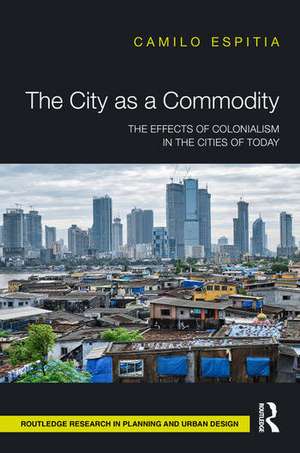
The City as a Commodity: The Effects of Colonialism in the Cities of Today: Routledge Research in Planning and Urban Design
Autor Camilo Espitiaen Limba Engleză Hardback – 27 oct 2026
Through a comprehensive analysis of urban economic policies, interviews with local practitioners, and community conversations, this book synthesizes fragmented literature into a cohesive narrative. It delves into the legacy of colonization, urban segregation, economic disparities, and political participation, illustrating how cities worldwide have been shaped by these forces. Case studies from Jakarta, Indonesia; Santiago, Chile; Kinshasa, Democratic Republic of the Congo; Mumbai, India; and Lowell, USA, provide real-world examples of cities grappling with issues such as displacement, cultural suppression, and socioeconomic inequity, while highlighting efforts to rewrite their stories.
This book is an essential resource for urban planning researchers, students, and professionals interested in urban policy, colonial studies, and the intersection of social justice and city development. It offers valuable insights into the systemic challenges cities face and the potential pathways to creating more equitable urban environments.
Din seria Routledge Research in Planning and Urban Design
-
 Preț: 441.05 lei
 - 15%
 Preț: 422.92 lei
 - 15%
 Preț: 424.63 lei
 - 18%
 Preț: 1110.91 lei
 -
 Preț: 470.05 lei
 - 18%
 Preț: 1356.63 lei
 -
 Preț: 311.10 lei
 - 15%
 Preț: 461.56 lei
 - 15%
 Preț: 428.35 lei
 -
 Preț: 454.61 lei
 - 18%
 Preț: 1258.16 lei
 -
 Preț: 464.26 lei
 - 20%
 Preț: 1172.66 lei
 - 18%
 Preț: 1109.80 lei
 -
 Preț: 439.05 lei
 - 15%
 Preț: 430.16 lei
 - 18%
 Preț: 1110.57 lei
 - 18%
 Preț: 1309.15 lei
 -
 Preț: 457.50 lei
 - 18%
 Preț: 1112.51 lei
 - 18%
 Preț: 1114.82 lei
 - 18%
 Preț: 1304.54 lei
 -
 Preț: 438.63 lei
 -
 Preț: 477.59 lei
 -
 Preț: 441.18 lei
 -
 Preț: 462.00 lei
 - 15%
 Preț: 458.46 lei
 - 18%
 Preț: 1260.75 lei
 -
 Preț: 437.36 lei
 - 18%
 Preț: 1112.44 lei
 - 18%
 Preț: 1114.82 lei
 - 15%
 Preț: 433.41 lei
 - 18%
 Preț: 790.65 lei
 - 18%
 Preț: 1302.78 lei
Preț: 1123.11 lei
Preț vechi: 1484.99 lei
-24% Nou
Puncte Express: 1685
Carte indisponibilă temporar
Doresc să fiu notificat când acest titlu va fi disponibil:
Se trimite...
Specificații
ISBN-13: 9781041106296
ISBN-10: 1041106297
Pagini: 178
Dimensiuni: 156 x 234 mm
Greutate: 0.49 kg
Ediția:1
Editura: Taylor & Francis
Colecția Routledge
Seria Routledge Research in Planning and Urban Design
Locul publicării:Oxford, United Kingdom
ISBN-10: 1041106297
Pagini: 178
Dimensiuni: 156 x 234 mm
Greutate: 0.49 kg
Ediția:1
Editura: Taylor & Francis
Colecția Routledge
Seria Routledge Research in Planning and Urban Design
Locul publicării:Oxford, United Kingdom
Public țintă
Academic, Postgraduate, and Undergraduate AdvancedCuprins
1. Introduction 2. The City as a Commodity 3. Urban Segregation (Jakarta, Indonesia) 4. Urban Displacement and Immigration (Santiago de Chile, Chile) 5. Urban Cultural Suppression - (Kinshasa, Congo) 6. Local Political Representation - (Lowell, Massachusetts, United States) 7. Socioeconomic Inequality (Mumbai, India) 8. Moving Forward
Notă biografică
Camilo Espitia was born and raised in Bogotá, Colombia, but has been living in the United States for over 20 years. He now serves as Deputy Director of the Department of Planning and Development for the City of Lowell in Massachusetts. Previously, he worked as a planner in other U.S. cities in the private sector, and prior to that worked as an architect and planner in projects outside the United States, including those in Colombia, Argentina, and Mexico. He holds a Master’s degree in Engineering in Sustainable Smart Cities from the University of Alabama at Birmingham and a Professional Bachelor’s degree in Architecture from Florida Atlantic University. He also holds a Public Policy Certificate from Harvard University Kennedy School.
Descriere
The City as a Commodity: The Effects of Colonialism in the Cities of Todayexplores how urban planning, policy, and land use shaped by colonial foundations have transformed cities into commodities prioritising extraction and production over thriving ecosystems.