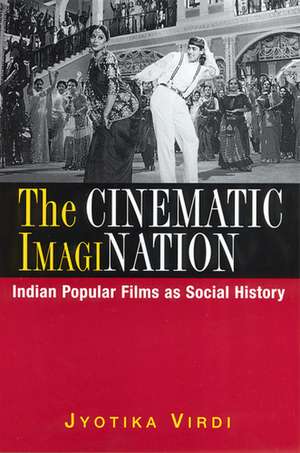
The Cinematic ImagiNation: Indian Popular Films as Social History
Autor Jyotika Virdien Limba Engleză Paperback – 7 mar 2003
"This book makes an important contribution to the field of Asian film criticism, Indian film history, cultural studies, and gender studies. The Cinematic ImagiNation provides readers with valuable insight into the relationships between nation-building, gender, sexuality, the family, and popular cinema, using post-Independence India as a case study."
--Gina Marchetti, author of Romance and the "Yellow Peril": Race, Sex, and Discursive Strategies in Hollywood Fiction
India produces more films than any other country in the world, and these works are avidly consumed by non-Western cultures in Africa, Eastern Europe, the Middle East, and by the Indian communities in Australia, Britain, the Caribbean Islands, and North America. Jyotika Virdi focuses on how this dominant medium configures the "nation" in post-Independence Hindi cinema. She scrutinizes approximately thirty films that have appeared since 1950 and demonstrates how concepts of the nation form the center of this cinema's moral universe. As a kind of storytelling, Indian cinema provides a fascinating account of social history and cultural politics, with the family deployed as a symbol of the nation. Virdi demonstrates how the portrayal of the nation as a mythical community in Hindi films collapses under the weight of its own contradictions--irreconcilable differences that encompass gender, sexuality, family, class, and religious communities. Through these film narratives, the author traces transactions among the various constituencies that struggle, accommodate, coexist uneasily, or reconstitute each other over time, and, in the process, reveal the topography of postcolonial culture.
--Gina Marchetti, author of Romance and the "Yellow Peril": Race, Sex, and Discursive Strategies in Hollywood Fiction
India produces more films than any other country in the world, and these works are avidly consumed by non-Western cultures in Africa, Eastern Europe, the Middle East, and by the Indian communities in Australia, Britain, the Caribbean Islands, and North America. Jyotika Virdi focuses on how this dominant medium configures the "nation" in post-Independence Hindi cinema. She scrutinizes approximately thirty films that have appeared since 1950 and demonstrates how concepts of the nation form the center of this cinema's moral universe. As a kind of storytelling, Indian cinema provides a fascinating account of social history and cultural politics, with the family deployed as a symbol of the nation. Virdi demonstrates how the portrayal of the nation as a mythical community in Hindi films collapses under the weight of its own contradictions--irreconcilable differences that encompass gender, sexuality, family, class, and religious communities. Through these film narratives, the author traces transactions among the various constituencies that struggle, accommodate, coexist uneasily, or reconstitute each other over time, and, in the process, reveal the topography of postcolonial culture.
Preț: 327.93 lei
Puncte Express: 492
Carte tipărită la comandă
Livrare economică 26 noiembrie-10 decembrie
Livrare prin curier în România Termenul estimat este afișat lângă disponibilitate.
Transport gratuit de la 400.00 lei Plată online sau ramburs, în funcție de opțiunile comenzii.
Retur gratuit în 14 zile Comandă securizată și suport în română.
Specificații
ISBN-13: 9780813531915
ISBN-10: 0813531918
Pagini: 280
Ilustrații: 26
Dimensiuni: 152 x 229 x 18 mm
Greutate: 0.4 kg
Ediția:None
Editura: Rutgers University Press
Colecția Rutgers University Press
ISBN-10: 0813531918
Pagini: 280
Ilustrații: 26
Dimensiuni: 152 x 229 x 18 mm
Greutate: 0.4 kg
Ediția:None
Editura: Rutgers University Press
Colecția Rutgers University Press
V-ar putea interesa
-
 Easily DistractedSteve Coogan-25%Preț: 64.64 lei85.64 lei
 -
 Preț: 302.16 lei
 -
 Ayoade on AyoadeRichard AyoadePreț: 79.55 lei
 -
 Preț: 299.42 lei
 -
 The Writers: A History of American Screenwriters and Their GuildMiranda J. BanksPreț: 316.36 lei
 -
 -13%Preț: 176.61 lei202.51 lei
 -
 Picture ThisMolly Bang-14%Preț: 120.66 lei139.76 lei
 -
 DialogueRobert McKeePreț: 209.88 lei
 -
 Films of the New French ExtremityAlexandra WestPreț: 243.47 lei
 -
 -19%Preț: 58.46 lei71.92 lei
 -
 Envisioning American UtopiasAntje DallmannPreț: 384.12 lei
 -
 The Stanley Kubrick ArchivesAlison CastlePreț: 192.65 lei
Notă biografică
JYOTIKA VIRDI teaches communication/film/media studies at the University of Windsor, Canada.
Cuprins
Nation and its discontents. The nation, in theory ; The creative ImagiNation ; Theorizing national cinema ; Nation and its embodiments ; Pleasure and terror of the feminine
The idealized woman. Fixing the figure of the woman ; Woman, community, nation ; The "social butterfly."
Heroes and villains: narrating the nation. Masculinity ; Heroes and villains ; Sons and mothers
Heroines, romance, and social history. Reading resistance ; Contesting the Laxman Rekha ; Film/star text: reading social change
The sexed body. Filmic love ; Victims to vigilantes ; Rape and the rape threat ; The sexed body and specular pleasure ; Double-speak about the body ; Unsettled scores
Re-reading romance. Transgressions of "true love" ; Reinstating "family values" ; Romantic love and the culture of consumption ; The end of the Nehruvian Era
The idealized woman. Fixing the figure of the woman ; Woman, community, nation ; The "social butterfly."
Heroes and villains: narrating the nation. Masculinity ; Heroes and villains ; Sons and mothers
Heroines, romance, and social history. Reading resistance ; Contesting the Laxman Rekha ; Film/star text: reading social change
The sexed body. Filmic love ; Victims to vigilantes ; Rape and the rape threat ; The sexed body and specular pleasure ; Double-speak about the body ; Unsettled scores
Re-reading romance. Transgressions of "true love" ; Reinstating "family values" ; Romantic love and the culture of consumption ; The end of the Nehruvian Era
Recenzii
This book makes an important contribution to the field of Asian film criticism, Indian film history, cultural studies, and gender studies. The Cinematic ImagiNation provides readers with valuable insight into the relationships between nation-building gender, sexuality, the family, and popular cinema, using post-Independence India as a case study.
Descriere
India produces more films than any other country in the world, and these works are avidly consumed by non-Western cultures in Africa, Eastern Europe, the Middle East, and by the Indian communities in Australia, Britain, the Caribbean Islands, and North America. Jyotika Virdi focuses on how this dominant medium configures the "nation" in post-Independence Hindi cinema. She scrutinizes approximately thirty films that have appeared since 1950 and demonstrates how concepts of the nation form the center of this cinema's moral universe.