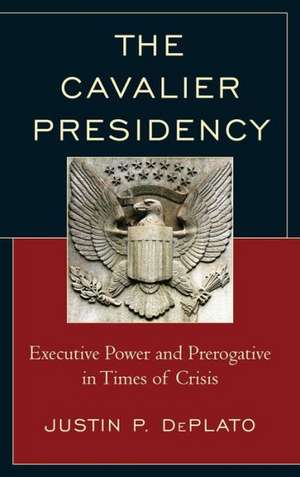
The Cavalier Presidency: Executive Power and Prerogative in Times of Crisis
Autor Justin P. DePlatoen Limba Engleză Hardback – 14 feb 2014
The book addresses the fundamental question of whether executive power in times of crisis may be unfettered and discretionary or rather does the law define and restrain executive emergency power.
The author reviews and analyzes seven U.S. presidencies that handled a domestic crisis-Washington, Jefferson, Madison, Jackson, Lincoln, G. W. Bush, and Obama-to show that presidents become extraordinarily powerful during crises and act unilaterally without oversight. The use of executive emergency power undermines the normal processes of democratic republicanism and harms the rule of law. The author analyzes the U.S. Constitution, formerly classified Department of Justice Memos, primary sourced letters, signing statements, executive orders, presidential decrees, and original founding documents to comprehensively conclude that presidential prerogative determines what emergency powers are and how they are to be executed.
This book challenges the claim that presidents determine their emergency power with appropriate congressional oversight or consultation. The analysis of the empirical data indicates that presidents do not consult with Congress prior to determining what their emergency powers are and how the president wants to use them.
Justin DePlato joins the highly contentious debate over the use of executive power during crisis and offers a sharp argument against an ever-growing centralized and unchecked federal power. He argues that presidents are becoming increasingly reckless when determining and using power during crisis, often times acting unconstitutional.
| Toate formatele și edițiile | Preț | Express |
|---|---|---|
| Paperback (1) | 307.11 lei 6-8 săpt. | |
| Bloomsbury Publishing – 14 mar 2016 | 307.11 lei 6-8 săpt. | |
| Hardback (1) | 690.14 lei 6-8 săpt. | |
| Bloomsbury Publishing – 14 feb 2014 | 690.14 lei 6-8 săpt. |
Preț: 690.14 lei
Preț vechi: 841.64 lei
-18%
Puncte Express: 1035
Preț estimativ în valută:
122.14€ • 142.74$ • 106.04£
122.14€ • 142.74$ • 106.04£
Carte tipărită la comandă
Livrare economică 19 februarie-05 martie
Preluare comenzi: 021 569.72.76
Specificații
ISBN-13: 9780739188842
ISBN-10: 0739188844
Pagini: 217
Ilustrații: 1 b/w illustrations; 3 tables;
Dimensiuni: 163 x 240 x 21 mm
Greutate: 0.48 kg
Editura: Bloomsbury Publishing
Colecția Lexington Books
Locul publicării:New York, United States
ISBN-10: 0739188844
Pagini: 217
Ilustrații: 1 b/w illustrations; 3 tables;
Dimensiuni: 163 x 240 x 21 mm
Greutate: 0.48 kg
Editura: Bloomsbury Publishing
Colecția Lexington Books
Locul publicării:New York, United States
V-ar putea interesa
-
 The Attalid Kingdom: A Constitutional HistoryR. E. Allen-50%Preț: 566.66 lei1124.66 lei
 -
 -16%Preț: 409.00 lei485.68 lei
 -
 The Oxford Handbook of Law and PoliticsKeith E. Whittington-6%Preț: 289.07 lei307.84 lei
 -
 -6%Preț: 738.15 lei784.22 lei
 -
 -35%Preț: 769.49 lei1175.73 lei
 -
 -14%Preț: 567.07 lei659.37 lei
 -
 Preț: 372.15 lei
 -
 Preț: 251.87 lei
 -
 Preț: 374.91 lei
 -
 The Constitution of the United States, with Index, and the Declaration of IndependenceNational Center for Constitutional StudiPreț: 17.19 lei
 -
 The Constitution of Australia: A Contextual AnalysisProfessor Cheryl Saunders-18%Preț: 191.65 lei232.89 lei
 -
 The Constitution of France: A Contextual AnalysisSophie Boyron-21%Preț: 191.97 lei242.40 lei
 -
 -18%Preț: 191.65 lei232.89 lei
 -
 -18%Preț: 183.95 lei224.09 lei
 -
 Handbook of Public ProtectionMike Nash-29%Preț: 373.45 lei522.38 lei
Cuprins
Introduction
Chapter 1: The Theory of Executive Emergency Power
Chapter 2: American Perspective on Executive Emergency Powers: Anti-Federalists versus Federalists
Chapter 3: George Washington's and Thomas Jefferson's Interpretations and Applications of Executive Emergency Power
Chapter 4: Presidents James Madison's and Andrew Jackson's Interpretations and Applications of Executive Emergency Power
Chapter 5: President Lincoln's Interpretation and Application of Executive Emergency Power
Chapter 6: George W. Bush's Interpretation and Application of Executive Emergency Power Following the Attacks of September 11, 2001
Conclusion
Chapter 1: The Theory of Executive Emergency Power
Chapter 2: American Perspective on Executive Emergency Powers: Anti-Federalists versus Federalists
Chapter 3: George Washington's and Thomas Jefferson's Interpretations and Applications of Executive Emergency Power
Chapter 4: Presidents James Madison's and Andrew Jackson's Interpretations and Applications of Executive Emergency Power
Chapter 5: President Lincoln's Interpretation and Application of Executive Emergency Power
Chapter 6: George W. Bush's Interpretation and Application of Executive Emergency Power Following the Attacks of September 11, 2001
Conclusion
Recenzii
The post-9/11 American presidency has been the focus of much scholarly and popular debate, given the strong exercise of 'emergency' executive power by Presidents George W. Bush and Barack Obama. In The Cavalier Presidency, DePlato takes a closer look at executive emergency power by tracing and examining its use by presidents in several historical eras. DePlato uses these historical eras to highlight a key question in both political thought and action regarding the proper nature of executive emergency power: should such power be merely implied in the constitutional powers of the president or be explicitly defined in law? This leads to other key considerations, such as the proper role of Congress and the overall threat posed to constitutional democracy by emergency executive power. Overall, DePlato's book will be a helpful source for students of American government seeking an introduction to the dilemma of emergency executive power. Summing Up: Recommended. General readers; undergraduate and graduate students.
The arguments made in this book cover an important area of the presidency that is still considered 'unsettled' territory. The book is very well organized and covers key areas of this discussion. Justin DePlato has a point to make and a provocative position to defend.
The arguments made in this book cover an important area of the presidency that is still considered 'unsettled' territory. The book is very well organized and covers key areas of this discussion. Justin DePlato has a point to make and a provocative position to defend.