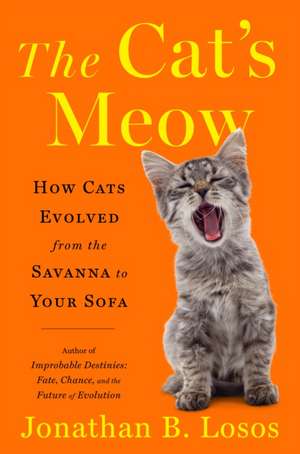
The Cat's Meow
Autor Jonathan B Lososen Limba Engleză Hardback – 2 mai 2023
Descoperim în The Cat's Meow o sinteză remarcabilă a istoriei naturale, bazată pe cele mai recente baze de date din genomică, arheologie criminalistică și studii de teren prin GPS. Jonathan B. Losos, autorul acestui volum în format hardback, reușește să transforme rigoarea academică într-o narațiune accesibilă despre modul în care Felis catus a cucerit globul. Putem afirma că lucrarea reprezintă o evoluție firească a preocupărilor autorului; dacă în How Evolution Shapes Our Lives acesta analiza mecanismele adaptative la nivel general, aici aplică aceleași lentile analitice asupra celui mai popular animal de companie.
Reținem abordarea multidimensională a textului, care nu se limitează la biologia descriptivă. Losos investighează paradoxul pisicii: un prădător care, deși trăiește în casele noastre, rămâne cu un picior în sălbăticie, capabil să revină oricând la starea ferală. Volumul extinde cadrul propus de The Domestic Cat de Dennis C. Turner cu date noi din ultimul deceniu, în special în ceea ce privește diversitatea genetică și impactul ecologic al felinelor. Spre deosebire de abordările mai generale din The Cat de Sarah Brown, Losos pune accent pe întrebări specifice de morfologie și etologie: de ce mieună pisicile domestice, dar nu și rudele lor mari, sau cum a influențat selecția artificială anatomia modernă.
Structura celor 400 de pagini echilibrează observația de laborator cu cea din propriul cămin al autorului. Stilul este deopotrivă analitic și personal, oferind o perspectivă clară asupra viitorului simbiozei dintre feline și oameni. Este o resursă esențială pentru înțelegerea modului în care selecția, atât naturală cât și antropocentrică, continuă să modeleze lumea vie.
Preț: 173.58 lei
Carte disponibilă
Livrare economică 18 mai-01 iunie
Specificații
ISBN-10: 1984878700
Pagini: 400
Dimensiuni: 164 x 236 x 35 mm
Greutate: 0.62 kg
Editura: Penguin Publishing Group
De ce să citești această carte
Recomandăm această carte oricărui pasionat de biologie care dorește să înțeleagă știința din spatele comportamentului felin. Cititorul câștigă o perspectivă avansată asupra evoluției, învățând cum tehnologii precum secvențierea genomică și monitorizarea GPS dezleagă misterele domesticirii. Este o lectură care transformă simpla observație a animalului de companie într-o lecție fascinantă de istorie naturală și genetică aplicată.
Descriere scurtă
The domestic cat-your cat-has, from its evolutionary origins in Africa, been transformed in comparatively little time into one of the most successful and diverse species on the planet. Jonathan Losos, writing as both a scientist and a cat lover, explores how researchers today are unraveling the secrets of the cat, past and present, using all the tools of modern technology, from GPS tracking (you'd be amazed where those backyard cats roam) and genomics (what is your so-called Siamese cat . . . really?) to forensic archaeology. In addition to solving the mysteries of your cat's past, it gives us a cat's-eye view of today's habitats, including meeting wild cousins around the world whose habits your sweet house cat sometimes eerily parallels.
Do lions and tigers meow? If not, why not? Why does my cat leave a dead mouse at my feet (or on my pillow)? Is a pet ocelot a bad idea? When and why did the cat make its real leap off the African plain? What's with all those cats in Egyptian hieroglyphics? In a genial voice, casually deciphering complex science and history with many examples from his own research and multi-cat household, Losos explores how selection, both natural and artificial, over the last several millennia has shaped the contemporary cat, with new breeds vastly different in anatomy and behavior from their ancestral stock. Yet the cat, ever a predator, still seems only one paw out of the wild, and readily reverts to its feral ways as it occupies new lands around the world.
Humans are transforming cats, and they in turn are transforming the world around them. This charming and intelligent book suggests what the future may hold for both Felis catus and Homo sapiens.