Cantitate/Preț
Produs

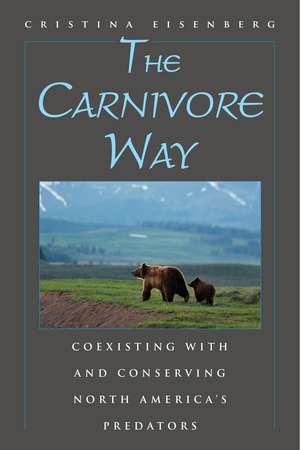
The Carnivore Way: Coexisting with and Conserving North America's Predators

Autor Cristina Eisenberg
en Limba Engleză Paperback – 8 sep 2015

În această lucrare fundamentală pentru ecologia aplicată, The Carnivore Way explorează necesitatea vitală a prădătorilor de vârf în menținerea sănătății peisajelor la scară continentală. Găsim în acest text o argumentație riguroasă pentru crearea unui coridor neîntrerupt — o „cale a carnivorelor” — de-a lungul Munților Stâncoși, de la Alaska până în Mexic. Cristina Eisenberg depășește abordările teoretice clasice, propunând un model de coexistență bazat pe date de teren și pe o înțelegere profundă a dispersiei speciilor.

Structura volumului este echilibrată, fiind împărțită în două secțiuni principale. Prima parte, „Wildways”, analizează ecologia coridoarelor și rolul ecologic general al carnivorelor mari, oferind cadrul teoretic necesar. A doua parte detaliază biologia și managementul a șase specii emblematice: ursul grizzly, lupul, glutonul (wolverine), râsul, puma și jaguarul. Această progresie de la concept la specii specifice face textul extrem de util pentru studenții de la facultățile de silvicultură și protecția mediului. Apreciem în mod deosebit modul în care cele 28 de ilustrații și 15 fotografii completează datele științifice, oferind o perspectivă vizuală asupra provocărilor de conservare.

Lucrarea reprezintă o alternativă aplicată la Carnivore Conservation de John L. Gittleman pentru cursurile de conservarea biodiversității, cu avantajul că se concentrează pe soluția concretă a coridoarelor de migrație și pe integrarea omului în acest ecosistem, nu doar pe protecția izolată. Față de alte studii pur teoretice, The Carnivore Way oferă un ghid practic pentru managerii de resurse care trebuie să echilibreze politicile publice cu nevoile biologice ale faunei sălbatice.

Citește tot Restrânge

Preț: 25953 lei

Puncte Express: 389

Carte disponibilă

Livrare economică 22 iunie-06 iulie
Livrare express 06-12 iunie pentru 3158 lei

Livrare prin curier în România Termenul estimat este afișat lângă disponibilitate.
Transport gratuit de la 40000 lei Plată online sau ramburs, în funcție de opțiunile comenzii.
Retur gratuit în 14 zile Comandă securizată și suport în română.

Specificații

ISBN-13: 9781597269834
ISBN-10: 1597269832
Pagini: 328
Ilustrații: 15 photos, 28 illustrations
Dimensiuni: 152 x 229 x 25 mm
Greutate: 0.45 kg
Ediția:None
Editura: Island Press
Colecția Island Press

De ce să citești această carte

Recomandăm această carte oricărui specialist sau student în ecologie care dorește să înțeleagă dincolo de mituri rolul prădătorilor în ecosistem. Cititorul câștigă o perspectivă clară asupra modului în care un coridor de 7.500 de mile poate asigura reziliența peisajelor naturale. Este o lectură esențială pentru a înțelege cum știința robustă poate fundamenta politici de coexistență între oameni și carnivore mari într-o lume în continuă schimbare.


Despre autor

Cristina Eisenberg este cercetător principal (Lead Scientist) la Earthwatch Institute, unde coordonează inițiative strategice privind sustenabilitatea mediului. Ecolog specializat în studiul lupilor și al dinamicii incendiilor în ecosistemele Munților Stâncoși, deține un doctorat în silvicultură și faună sălbatică de la Oregon State University. Este cercetător asociat la Smithsonian și membru profesional al Boone and Crockett Club. Experiența sa academică este completată de o activitate editorială bogată, fiind și editor de non-ficțiune pentru revista literară Whitefish Review, ceea ce explică stilul său narativ precis și accesibil.


Descriere scurtă

What would it be like to live in a world with no predators roaming our landscapes? Would their elimination, which humans have sought with ever greater urgency in recent times, bring about a pastoral, peaceful human civilization? Or in fact is their existence critical to our own, and do we need to be doing more to assure their health and the health of the landscapes they need to thrive?
 
In The Carnivore Way, Cristina Eisenberg argues compellingly for the necessity of top predators in large, undisturbed landscapes, and how a continental-long corridor—a “carnivore way”—provides the room they need to roam and connected landscapes that allow them to disperse. Eisenberg follows the footsteps of six large carnivores—wolves, grizzly bears, lynx, jaguars, wolverines, and cougars—on a 7,500-mile wildlife corridor from Alaska to Mexico along the Rocky Mountains. Backed by robust science, she shows how their well-being is a critical factor in sustaining healthy landscapes and how it is possible for humans and large carnivores to coexist peacefully and even to thrive.
 
University students in natural resource science programs, resource managers, conservation organizations, and anyone curious about carnivore ecology and management in a changing world will find a thoughtful guide to large carnivore conservation that dispels long-held myths about their ecology and contributions to healthy, resilient landscapes.

Notă biografică

Cristina Eisenberg conducts trophic cascades research focusing on wolves in Rocky Mountain ecosystems and teaches ecological restoration and public policy in the College of Forestry at Oregon State University. Dr. Eisenberg is a Smithsonian Research Associate, an Earthwatch Institute scientist, a Boone and Crockett Club Professional Member, and an Aldo Leopold scholar. She has authored multiple peer-reviewed scientific and literary journal articles and several book chapters. Her first book, The Wolf’s Tooth: Keystone Predators, Trophic Cascades and Biodiversity, was published in 2010 by Island Press.

Cuprins

Introduction: Journey into Wildness  

PART I. Wildways
Chapter 1. Corridor Ecology and Large Carnivores
Chapter 2. The Ecological Role of Large Carnivores
Chapter 3. Crossings

PART II. Where the Carnivores Roam
Chapter 4. Grizzly Bear (Ursus arctos)
Chapter 5. Wolf (Canis lupus)
Chapter 6. Wolverine (Gulo gulo luscus)
Chapter 7. Lynx (Lynx canadensis)
Chapter 8. Cougar (Puma concolor)
Chapter 9. Jaguar (Panthera onca             

Conclusion: Earth Household Notes
Glossary
About the Author
Index

Recenzii

"Using personal anecdotes of encounters with North America predators, supplemented by the results of a number of studies, Eisenberg makes a case for the place of carnivores in the wild."

“Eisenberg is a fine writer...Examining each species separately, [she] is able to deftly touch on diverse themes: border fences; species life histories; ranching; hunting; and trapping; reintroduction efforts; drought and fire; public land availability and management; ranging and dispersal tendencies; and environmental laws and legal structures. The book, like its focal species, roams widely. The author is at her best when telling stories. By discussing how individual animals use their landscape, Eisenberg paints a picture of their trials and tribulations and how they make a living in an increasingly human-dominated environment.”

"Ecologist Cristina Eisenberg travels wildlife corridors between Alaska and northern Mexico, focusing on six species: the grizzly bear, wolf, wolverine, lynx, cougar and jaguar. Examining the science and public policy surrounding these majestic creatures, she argues that we need to give them room to roam—and we can do it in a way that allows us to peacefully coexist."

"[A]n eminently readable primer on predator ecology."

"[T]his fascinating book...offers a blend of research and narrative that will appeal to lay readers..."

"Unfortunately, the topic of large predators can draw plenty of passion and emotion, but that often leaves little room for clear thinking. That's why Cristina Eisenberg's The Carnivore Way is so refreshing. It brings science and rational thought to the issue and shows that we can indeed coexist with large, carnivorous animals—and that most of the issue is with us, not them."

"In this call for a unified vision in conservation, ecologist Cristina Eisenberg argues that big carnivores such as grizzly bears underpin the corridor's ecological health, and need it in turn for dispersal into new territory. She interweaves multiple skeins of science—on predator population resilience, the success of wildlife crossings and more—to build a putative scenario of human-carnivore coexistence."

"In The Carnivore Way, ecologist Cristina Eisenberg argues for the protection of North America's big predators and their expansive habitats. As a researcher, she illustrates the creatures' ecological importance as linchpins of their ecosystems, affecting the populations and dynamics not only of their prey, but of trophic levels throughout the system. She also urges cooperation among the various stakeholders whose livelihoods are impacted by the presence of large carnivores. Coexistence with carnivores is her steady mantra."

"Her doctoral research at Oregon State University and her 2011 book The Wolf’s Tooth made her a leading spokeswoman for the ecological roles of carnivores. Now, in The Carnivore Way, Eisenberg gathers her most compelling stories and the latest science from the Mexico to Alaska to help human beings learn how to coexist with the key carnivores in the Greater Rocky Mountains — the wolf, cougar, grizzly bear, lynx, wolverine and jaguar."

"Eisenberg is showing us the greatest hope that may exist for a "carnivore way"--the people among us who care enough about the wildlife in their backyards to become engaged in a large carnivore conservation on their own terms." 

"It is both informative and thoroughly enjoyable to read, with its combination of personal narrative and well-explained science."

"The Carnivore Way is an accessible, engaging expert’s view of the complex biological, social, and political situation of North American carnivore conservation."

"In today’s political hysteria, I found this profoundly refreshing. Fluidly written, engaging, and informative."

"Carnivores are challenging animals to think about, and we tend to get distracted by their sharp teeth and meat-eating ways. But they have much to teach us about the landscapes we live in, the ecology of our home places, and our own ability to adapt, learn, and coexist. Nobody knows this beter than Cristina Eisenberg, and no one is a more insightful guide into the world of these fascinating wild neighbors."

"An impressive synthesis of conservation and science, The Carnivore Way is the road map for carnivore conservation and connected landscapes in North America's Rocky Mountains. With keen insights into carnivores' roles in ecosystems, their behaviors, and their complex relationships with humans, Cristina Eisenberg compels us to understand why carnivores are essential to the health of ecosystems and our need to coexist with them."

"Eisenberg investigates the extensive cascading biological medicine wheel we know as the natural world, continuing to prove carnivore coexistence is fundamental to our own survival—inextricable. The Carnivore Way makes a remarkable case for immediate overhaul of human intrusion. Our brothers and sisters in other forms depend on us to get this right and their wellbeing distinguishes our own sustained presence. Genius narrative, essential knowledge, this book is beautiful lifeblood."

"With characteristic insight and clarity, Cristina Eisenberg paints the large-carnivore story across a vast canvas. Few can boil down the essentials like Eisenberg in prose that both informs and inspires. She has come through again with an engaging read about iconic species that put to the test our willingness to coexist with other life forms."

"...[Eisenberg] is skilled at translating complex ecological ideas into prose."

"...Eisenberg is always worthwhile reading..."

"[Eisenberg] write[s] inspiringly about research on large carnivores and convincingly argue[s] for the need to deeply understand large carnivore behavior and ecology in order to better manage and conserve them."

"an exceptionally well-written book"