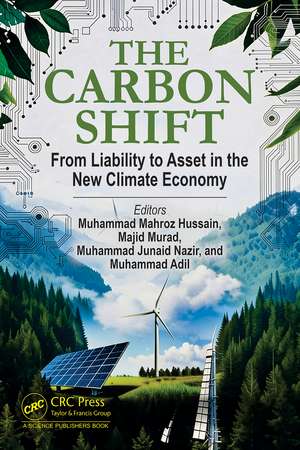
The Carbon Shift: : From Liability to Asset in the New Climate Economy
Editat de Muhammad Mahroz Hussain, Majid Murad, Muhammad Junaid Nazir, Muhammad Adilen Limba Engleză Hardback – 17 noi 2026
Preț: 831.97 lei
Preț vechi: 1014.60 lei
-18% Precomandă
Puncte Express: 1248
Carte nepublicată încă
Livrare prin curier în România Precomanda se expediază când titlul devine disponibil.
Transport gratuit pentru acest produs Plată online sau ramburs, în funcție de opțiunile comenzii.
Retur gratuit în 14 zile Comandă securizată și suport în română.
Doresc să fiu notificat când acest titlu va fi disponibil:
Se trimite...
Specificații
ISBN-13: 9781041290605
ISBN-10: 1041290608
Pagini: 370
Ilustrații: 132
Dimensiuni: 178 x 254 mm
Greutate: 0.86 kg
Ediția:1
Editura: CRC Press
Colecția CRC Press
ISBN-10: 1041290608
Pagini: 370
Ilustrații: 132
Dimensiuni: 178 x 254 mm
Greutate: 0.86 kg
Ediția:1
Editura: CRC Press
Colecția CRC Press
Public țintă
Academic, Postgraduate, Undergraduate Advanced, and Undergraduate CoreCuprins
Preface. The Forgotten Power of Carbon: Beyond Pollution to Regeneration. Biochar and Soil Carbon: Ancient Wisdom, Modern Science. Biochar in Stabilizing Soil Organic Carbon and Building a Sustainable Bioeconomy. Carbon Sequestration in Agriculture: Farming for the Future. Waste to Wealth: How Organic Matter Becomes Climate Solution. The Carbon Farming Boom: Profits from Healthy Soil. Biochar Markets: From Small Farms to Industrial Scale. Carbon Offsets 2.0: Trust, Transparency, and Real Impact. Carbon Farming as a Financial Asset: Integrating ESG Metrics into Agricultural Value Chains. Carbon Pricing for Farmers: Should Government Pay for Soil Health. Carbon Credits for Researchers in the Emerging Climate Economy. The EU, US, and China: Who is Leading the Carbon Removal Economy? The Carbon Trade: South’s Biomass, North’s Markets. The Oil Industry’s Pivot: Are Fossil Fuel Giants Betting on Carbon Sequestration? Blockchain for Carbon: Can Tech Ensure Trust in Removals? The Next Green Revolution: Carbon-Negative Crops? A Post-Extractive Economy: Is Carbon Remediation the New Gold Rush? Index. Editors Biography.
Notă biografică
Dr. Muhammad Mahroz Hussain is a distinguished postdoctoral researcher at the College of Environmental Science and Engineering, Yangzhou University, China. Dr. Hussain earned his M.Sc. (Hons.) and Ph.D. in Environmental Science from the prestigious Institute of Soil and Environmental Sciences, University of Agriculture Faisalabad, Pakistan. As a leading expert in environmental and soil chemistry, with a strong focus on biogeochemistry and the intricate water-soil-plant systems, Dr. Hussain’s research tackles critical global challenges, including the impacts of contaminants on soil, water, human health, and the broader environment, while exploring innovative solutions for food and water security and their profound socio-economic implications. His impressive publication record boasts 30 book chapters, 7 review articles, and 13 original research papers in top-tier international peer-reviewed journals such as the Chemical Engineering Journal, Journal of Hazardous Materials, Science of the Total Environment, Environmental Pollution, Journal of Environmental Management, and others, alongside prestigious collaborations like his joint research program with the University of Wuppertal, Germany. Dr. Hussain’s innovative contributions are further evidenced by his intellectual property achievements: a US Provisional Patent for the source identification of arsenic, along with two patents granted by the Intellectual Property Organization (IPO) of Pakistan, driving sustainable solutions for environmental remediation and global health challenges.
Dr. Majid Murad is currently a postdoctoral researcher at the School of Innovation & Entrepreneurship, Guangzhou University, Guangzhou, China. He previously completed a postdoctoral fellowship at the School of Management, Jiangsu University, Zhenjiang, China, where he also earned his Ph.D. in Management Science & Engineering. Dr. Murad’s research interests include sustainability, environmental management, green entrepreneurship, educational psychology, and organizational behavior. He has published his work in international academic journals indexed by SSCI, SCIE, ESCI, ABDC, and ABS. Additionally, he possesses strong data analysis skills, and is proficient in SPSS, AMOS, Smart-PLS, M-Plus, and NVivo software.
Dr. Muhammad Junaid Nazir is an environmental and agricultural scientist specializing in climate-resilient agriculture, soil carbon/nitrogen cycling, and sustainable crop and soil systems. With a PhD in Environmental Sciences from Jiangsu University and a current postdoctoral position at Tsinghua University, China, his research addresses global challenges like climate change, greenhouse gas emissions, and soil health. Dr. Junaid brings diverse professional experience in agriculture and environmental science, where he optimized crops, soils, and resource management. Dr. Junaid has published impactful studies in top journals, authored book chapters, and collaborates internationally. His expertise spans lab techniques, fieldwork, and climate modeling, with a strong focus on applied innovation. Dr. Junaid is passionate about sustainability, and he engages in farmer outreach and science education initiatives. His academic and practical roles in hands-on expertise in sustainable farming, soil testing, and climate-resilient practices, bridge academic research with real-world agricultural challenges.
Dr. Muhammad Adil is a postdoctoral researcher at the College of Environmental Science and Technology, Yangzhou University, China. Dr. Adil obtained his PhD in Physical Geography from Northwest University, Xi’an, China. His research interests include soil and water conservation in dryland agriculture, conservation tillage systems, soil carbon sequestration, fertilizer use efficiency, bioremediation of toxic chemicals, and precision agriculture. He has published 36 international peer-reviewed articles in high-impact journals such as Soil & Tillage Research, European Journal of Soil Science, Frontiers in Plant Science, Functional Plant Biology, Journal of Hazardous Materials Advances, Scientific Reports, Water, Air, & Soil Pollution, and Frontiers in Microbiology. Dr. Adil has presented his research at international conferences, including the 16th International Conference on Precision Agriculture (Kansas, USA, 2024). He also serves as a reviewer for top journals, including Soil & Tillage Research, Environmental Pollution, Field Crops Research, and Journal of Environmental Management. In addition, he has secured research funding as PI and Co-PI from prestigious programs such as the Henan Research Start-up Funds and the National Natural Science Foundation of China.
Dr. Majid Murad is currently a postdoctoral researcher at the School of Innovation & Entrepreneurship, Guangzhou University, Guangzhou, China. He previously completed a postdoctoral fellowship at the School of Management, Jiangsu University, Zhenjiang, China, where he also earned his Ph.D. in Management Science & Engineering. Dr. Murad’s research interests include sustainability, environmental management, green entrepreneurship, educational psychology, and organizational behavior. He has published his work in international academic journals indexed by SSCI, SCIE, ESCI, ABDC, and ABS. Additionally, he possesses strong data analysis skills, and is proficient in SPSS, AMOS, Smart-PLS, M-Plus, and NVivo software.
Dr. Muhammad Junaid Nazir is an environmental and agricultural scientist specializing in climate-resilient agriculture, soil carbon/nitrogen cycling, and sustainable crop and soil systems. With a PhD in Environmental Sciences from Jiangsu University and a current postdoctoral position at Tsinghua University, China, his research addresses global challenges like climate change, greenhouse gas emissions, and soil health. Dr. Junaid brings diverse professional experience in agriculture and environmental science, where he optimized crops, soils, and resource management. Dr. Junaid has published impactful studies in top journals, authored book chapters, and collaborates internationally. His expertise spans lab techniques, fieldwork, and climate modeling, with a strong focus on applied innovation. Dr. Junaid is passionate about sustainability, and he engages in farmer outreach and science education initiatives. His academic and practical roles in hands-on expertise in sustainable farming, soil testing, and climate-resilient practices, bridge academic research with real-world agricultural challenges.
Dr. Muhammad Adil is a postdoctoral researcher at the College of Environmental Science and Technology, Yangzhou University, China. Dr. Adil obtained his PhD in Physical Geography from Northwest University, Xi’an, China. His research interests include soil and water conservation in dryland agriculture, conservation tillage systems, soil carbon sequestration, fertilizer use efficiency, bioremediation of toxic chemicals, and precision agriculture. He has published 36 international peer-reviewed articles in high-impact journals such as Soil & Tillage Research, European Journal of Soil Science, Frontiers in Plant Science, Functional Plant Biology, Journal of Hazardous Materials Advances, Scientific Reports, Water, Air, & Soil Pollution, and Frontiers in Microbiology. Dr. Adil has presented his research at international conferences, including the 16th International Conference on Precision Agriculture (Kansas, USA, 2024). He also serves as a reviewer for top journals, including Soil & Tillage Research, Environmental Pollution, Field Crops Research, and Journal of Environmental Management. In addition, he has secured research funding as PI and Co-PI from prestigious programs such as the Henan Research Start-up Funds and the National Natural Science Foundation of China.
Descriere
This book reframes the narrow perception of carbon as a pollutant to reveal its true potential as a healing force for our planet. It offers a unique, comprehensive journey that bridges the intricate science of soil carbon sequestration and biochar with the innovative economic models transforming environmental action into profit.