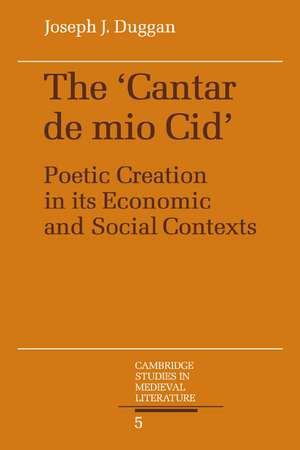
The Cantar de Mio Cid
Autor Joseph J. Dugganen Limba Engleză Paperback – 29 ian 2008
Preț: 307.07 lei
Puncte Express: 461
Carte tipărită la comandă
Livrare economică 14-28 noiembrie
Livrare prin curier în România Termenul estimat este afișat lângă disponibilitate.
Transport gratuit de la 400.00 lei Plată online sau ramburs, în funcție de opțiunile comenzii.
Retur gratuit în 14 zile Comandă securizată și suport în română.
Specificații
ISBN-13: 9780521062978
ISBN-10: 0521062977
Pagini: 192
Dimensiuni: 152 x 229 x 11 mm
Greutate: 0.29 kg
Ediția:New.
Editura: Cambridge University Press
Locul publicării:Cambridge, United Kingdom
ISBN-10: 0521062977
Pagini: 192
Dimensiuni: 152 x 229 x 11 mm
Greutate: 0.29 kg
Ediția:New.
Editura: Cambridge University Press
Locul publicării:Cambridge, United Kingdom
V-ar putea interesa
-
 Ancient Greek LiteratureK. J. Dover-18%Preț: 329.35 lei402.34 lei
 -
 Song of the Distant Dove: Judah Halevi's PilgrimageRaymond P. Scheindlin-28%Preț: 422.38 lei586.86 lei
 -
 -28%Preț: 520.78 lei725.92 lei
 -
 On the MysteriesAndokides-29%Preț: 503.36 lei704.89 lei
 -
 -26%Preț: 812.63 lei1091.43 lei
 -
 Oxford Readings in Greek TragedyErich Segal-34%Preț: 638.31 lei960.57 lei
 -
 -28%Preț: 385.37 lei538.02 lei
 -
 A Companion to PetroniusEdward Courtney-29%Preț: 514.72 lei722.40 lei
 -
 Greek Oratory: Tradition and OriginalityStephen Usher-33%Preț: 607.53 lei901.31 lei
 -
 Apuleius: A Latin SophistS. J. Harrison-28%Preț: 372.78 lei519.77 lei
 -
 Aristophanes AcharniansS. Douglas Olson-33%Preț: 679.62 lei1007.07 lei
 -
 Preț: 523.49 lei
 -
 Patterns of Redemption in Virgil's GeorgicsLlewelyn MorganPreț: 310.94 lei
 -
 Dante's Style in His Lyric PoetryPatrick BoydePreț: 369.76 lei
 -
 Preț: 270.22 lei
 -
 An Introduction to Wolframs 'Parzival'Sacker HughPreț: 302.30 lei
 -
 Preț: 249.98 lei
 -
 The Cambridge Companion to Ancient RhetoricErik GundersonPreț: 286.64 lei
 -
 The Hammer of WitchesChristopher S. MackayPreț: 303.34 lei
 -
 -18%Preț: 161.65 lei196.16 lei
Cuprins
Acknowledgements; Modern equivalents to names in the maps; Maps; 1. Historical and theoretical framework; 2. The acquisition of wealth; 3. Economy and gift-giving; 4. Social status, legitimacy and inherited worth; 5. The poet's milieu; 6. Geography and history; 7. The Cantar de mio Cid and the French epic tradition; 8. Mode of composition; 9. Conclusion; Notes; List of references; Index.
Descriere
Joseph Duggan interprets the Cantar as a work that transmutes moral values first into the economic values of a gift economy, then into genealogical values.