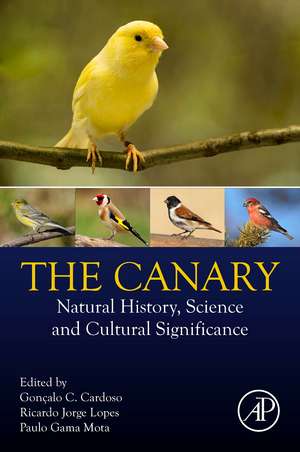
The Canary: Natural History, Science and Cultural Significance
Editat de Goncalo C. Cardoso, Ricardo Jorge Lopes, Paulo Gama Motaen Limba Engleză Paperback – 27 noi 2023
In covering this eclectic array of topics, while always focusing on the canary and its close relatives, this book uses the immense appeal of the canary as a vehicle to present notions of ecology, evolution, biodiversity conservation, and so on, to a wide audience.
- Details all aspects of Crithagra and Serinus canaries as well as relatives like crossbills
- Structured to begin with more accessible topics like natural history, domestication, and conservation
- Closes with discussions of more specialized topics like evolution, neurobiology, behavior and genomics
Preț: 761.16 lei
Preț vechi: 1107.38 lei
-31%
Puncte Express: 1142
Carte tipărită la comandă
Livrare economică 19 noiembrie-03 decembrie
Livrare prin curier în România Termenul estimat este afișat lângă disponibilitate.
Transport gratuit pentru acest produs Plată online sau ramburs, în funcție de opțiunile comenzii.
Retur gratuit în 14 zile Comandă securizată și suport în română.
Specificații
ISBN-13: 9780443153501
ISBN-10: 0443153507
Pagini: 308
Dimensiuni: 152 x 229 x 24 mm
Greutate: 0.48 kg
Editura: ELSEVIER SCIENCE
ISBN-10: 0443153507
Pagini: 308
Dimensiuni: 152 x 229 x 24 mm
Greutate: 0.48 kg
Editura: ELSEVIER SCIENCE
V-ar putea interesa
-
 BIRDS SEX & BEAUTY EXAIIE PBMatt RidleyPreț: 140.08 lei
 -
 -13%Preț: 212.20 lei245.08 lei
 -
 Birds and UsTim Birkhead-19%Preț: 87.26 lei107.35 lei
 -
 Bird Brains and BehaviorGeorg F. Striedter-14%Preț: 527.51 lei613.37 lei
 -
 Preț: 85.23 lei
 -
 Ten Thousand BirdsBob MontgomeriePreț: 399.24 lei
 -
 Doctors by NatureJaap de RoodePreț: 156.74 lei
 -
 Handbook of Bird Biology, 3eIrby J. Lovette-23%Preț: 818.09 lei1062.46 lei
 -
 -24%Preț: 497.82 lei653.21 lei
 -
 Metamorphosis: A Natural and Human HistoryOren Harman-30%Preț: 133.14 lei191.14 lei
 -
 Echoes of Our OriginsShirley C. StrumPreț: 206.86 lei
 -
 One Midsummer's DayMark Cocker-30%Preț: 65.31 lei93.72 lei
 -
 Ten Birds That Changed the WorldStephen MossPreț: 94.37 lei
 -
 A Sweet, Wild NoteRichard SmythPreț: 73.49 lei
 -
 Living with BirdsLen HowardPreț: 120.28 lei
 -
 Springwatch: BirdtopiaJack BaddamsPreț: 122.14 lei
 -
 Whistling in the DarkRichard Mabey-20%Preț: 74.01 lei92.47 lei
 -
 Keeping CanariesBrian KeenanPreț: 117.06 lei
 -
 A Year of Tropical BirdsongDominic Couzens-10%Preț: 131.36 lei145.27 lei
 -
 SparrowKim Todd-10%Preț: 97.56 lei107.83 lei
Public țintă
Ornithologists; animal scientists; researchers in zoology and biodiversityCuprins
Part I: From the Atlantic to peoples’ homes
1. Macaronesian birds and the natural environment of the canary
2. The wild canary – ecology and behavior in the Atlantic
3. The domestication and cultural significance of the canary
Part II: The canary and its relatives
4. The family tree and biogeographic history of canary relatives
5. Ecology and conservation of the world’s canaries
6. The peculiar cousins: lessons from the ecology and evolution of crossbills
7. Evolution of song and colour across the canary relatives
Part III: A model for science
8. What the canary can tell us about singing and the brain
9. Eggs, hormones, and breeding
10. Canary domestication as a model for genomics research
1. Macaronesian birds and the natural environment of the canary
2. The wild canary – ecology and behavior in the Atlantic
3. The domestication and cultural significance of the canary
Part II: The canary and its relatives
4. The family tree and biogeographic history of canary relatives
5. Ecology and conservation of the world’s canaries
6. The peculiar cousins: lessons from the ecology and evolution of crossbills
7. Evolution of song and colour across the canary relatives
Part III: A model for science
8. What the canary can tell us about singing and the brain
9. Eggs, hormones, and breeding
10. Canary domestication as a model for genomics research