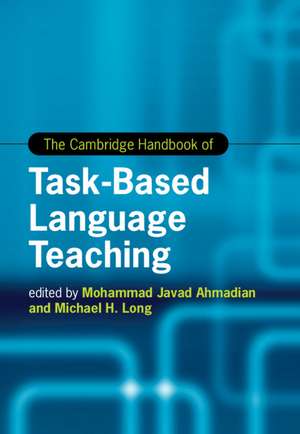
The Cambridge Handbook of Task-Based Language Teaching
Editat de Mohammad Javad Ahmadian, Michael H Longen Limba Engleză Hardback – 9 dec 2021
Preț: 1016.85 lei
Preț vechi: 1320.58 lei
-23%
Puncte Express: 1525
Carte disponibilă
Livrare economică 03-17 noiembrie
Livrare prin curier în România Termenul estimat este afișat lângă disponibilitate.
Transport gratuit pentru acest produs Plată online sau ramburs, în funcție de opțiunile comenzii.
Retur gratuit în 14 zile Comandă securizată și suport în română.
Specificații
ISBN-13: 9781108491389
ISBN-10: 1108491383
Pagini: 710
Dimensiuni: 176 x 246 x 44 mm
Greutate: 1.39 kg
Ediția:Nouă
Editura: Cambridge University Press
Locul publicării:Cambridge, United Kingdom
ISBN-10: 1108491383
Pagini: 710
Dimensiuni: 176 x 246 x 44 mm
Greutate: 1.39 kg
Ediția:Nouă
Editura: Cambridge University Press
Locul publicării:Cambridge, United Kingdom
Cuprins
Preface; Part I. The Rationale for TBLT: 1. The (unsatisfactory) status quo in language teaching: a psycholinguistic rationale for TBLT; 2. A pedagogic rationale for TBLT; Part II. Tasks and Needs Analysis: 3. Why tasks? Task as the unit of analysis in language education; 4. Adapting and advancing task-based needs analysis (NA) methodology across diverse language learning contexts; 4A. Developing a task-based approach: a case study of Australian Aboriginal VET students; 4B. A needs analysis for Syrian refugees in Turkey; 4C. TBLT in a Japanese university: from needs analysis to evaluation; 4D. The implementation of a task-based Spanish language program in Qingdao, China: a case study; 5. The L in TBLT: analyzing target discourse; 5A. Blustery with an occasional downpour: an analysis of target discourse in media weather forecasts; 5B. 'I have a question': A corpus-based analysis of target discourse in office hour interactions; Part III. The Task Syllabus and Materials: 6. The Cognition Hypothesis, the Triadic Componential Framework and the SSARC Model: an instructional design theory of pedagogic task sequencing; 7. From needs analysis to task selection, design, and sequencing; 7A. Task-based telecollaborative exchanges between US and Italian students: a case study in program design and implementation; 8. Exploring the nuts and bolts of task design; 8A. Designing pedagogic tasks for refugees learning English to enter universities in the Netherlands; Part IV. Methodology and Pedagogy: 9. A psycholinguistically motivated methodology for TBLT; 10. Technology-mediated TBLT; 10A. Task-based simulations for diplomatic security agents; 10B. Delivering TBLT at scale: a case study of a needs-based, technology-mediated workplace English program; 10C. TBLT and Indigenous Language Revitalisation; Part V. TBLT with School-age Children: 11. Children interacting in task-supported EFL/CLIL contexts; 11A. Tasks for children: using mainstream content to learn a language; 11B. A case study of a task-based approach for school-age learners in China; Part VI. The Teacher in TBLT: 12. Teacher preparation and support for TBLT; 12A. Connecting teacher training to TBLT implementation: a case study of pre-service teachers in Honduran bilingual schools; 12B. Training for tasks the cooperative way: an online tutored TBLT course for teachers, managers and course designers; Part VII. Task-Based Assessment and Program Evaluation: 13. Task-based, criterion-referenced performance testing; 14. TBLT program evaluation: why and how; 14A. Comparing the effectiveness of TBLT and PPP on L2 grammar learning: a pilot study with Chinese students of Italian L2; 14B. Evaluating the pilot year of a task-based Spanish immersion camp for high schoolers: examining learners' experience of task motivation and difficulty within and following tasks; 14C. Designing a classroom-based TBLA framework for primary schools: blurring the lines between teaching, learning and assessment; Part VIII. Research Needs and Future Prospects: 15. Methodological issues in (cognitively-oriented) TBLT research: advances and challenges; 16. Innovation in language education: a task-based perspective; 17. The adoption of TBLT in diverse contexts: challenges and opportunities; Conclusion.
Descriere
The first comprehensive and accessible guide to the understanding and implementation of task-based language teaching.