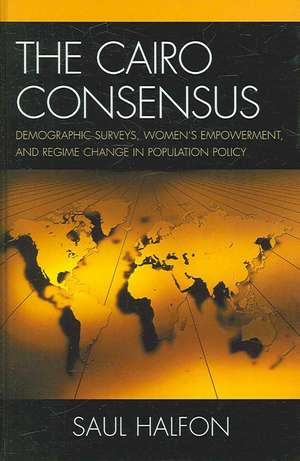
The Cairo Consensus: Demographic Surveys, Women's Empowerment, and Regime Change in Population Policy
Autor Saul Halfonen Limba Engleză Hardback – 6 noi 2006
Preț: 627.79 lei
Preț vechi: 958.94 lei
-35%
Puncte Express: 942
Carte tipărită la comandă
Livrare economică 01-15 decembrie
Livrare prin curier în România Termenul estimat este afișat lângă disponibilitate.
Transport gratuit pentru acest produs Plată online sau ramburs, în funcție de opțiunile comenzii.
Retur gratuit în 14 zile Comandă securizată și suport în română.
Specificații
ISBN-13: 9780739111765
ISBN-10: 0739111760
Pagini: 261
Dimensiuni: 152 x 232 x 20 mm
Greutate: 0.57 kg
Editura: Bloomsbury Publishing
Colecția Lexington Books
Locul publicării:New York, United States
ISBN-10: 0739111760
Pagini: 261
Dimensiuni: 152 x 232 x 20 mm
Greutate: 0.57 kg
Editura: Bloomsbury Publishing
Colecția Lexington Books
Locul publicării:New York, United States
V-ar putea interesa
-
 Doves of WarPaul PrestonPreț: 127.55 lei
 -
 The Courage to HealEllen Bass-18%Preț: 113.87 lei138.61 lei
 -
 Nine Parts of DesireGeraldine BrooksPreț: 115.08 lei
 -
 When God Was A WomanMerlin StonePreț: 105.16 lei
 -
 Essays and Poems and 'Simplicity', a ComedyMary Wortley Montagu-28%Preț: 422.82 lei587.10 lei
 -
 -24%Preț: 622.12 lei820.43 lei
 -
 Factory GirlsLeslie T. Chang-56%Preț: 41.40 lei94.17 lei
 -
 -5%Preț: 324.71 lei341.80 lei
 -
 What Men Don't Tell Women about BusinessChristopher V FlettPreț: 189.62 lei
 -
 Women in Eighteenth Century EuropeMargaret HuntPreț: 427.61 lei
 -
 Articles of FaithCynthia GorneyPreț: 222.57 lei
 -
 Why Gender Matters in EconomicsMukesh EswaranPreț: 468.11 lei
 -
 The Tattooed LadyAmelia Klem OsterudPreț: 128.56 lei
 -
 Bound to Please: A History of the Victorian CorsetLeigh SummersPreț: 260.81 lei
Cuprins
Part 1 Introduction
Chapter 2 Introduction
Chapter 3 Structured Disunity: Rethinking Consensus as a Meraphor for "Getting Along"
Part 4 Population Discourses
Chapter 5 Over-Populating the World:Discourses on "The Population Problem," 1945 to the Present
Chapter 6 Reading Cairo
Chapter 7 Re-Configuring Women's Empowerment :From Politics to Planning
Part 8 Technical Practices in the Population Network
Chapter 9 Contesting Surveys:Co-Producing Demography and Population Policy
Chapter 10 Standardizing Surveys:Building Consensus through Technical Practice
Chapter 11 Narrating Unmet Need
Part 12 Instituting the Cairo Regime
Chapter 13 Translating Unmet Need into Market Demand:Contraceptive Development after Cairo
Chapter 14 Conclusion:Projecting Population Policy
Chapter 2 Introduction
Chapter 3 Structured Disunity: Rethinking Consensus as a Meraphor for "Getting Along"
Part 4 Population Discourses
Chapter 5 Over-Populating the World:Discourses on "The Population Problem," 1945 to the Present
Chapter 6 Reading Cairo
Chapter 7 Re-Configuring Women's Empowerment :From Politics to Planning
Part 8 Technical Practices in the Population Network
Chapter 9 Contesting Surveys:Co-Producing Demography and Population Policy
Chapter 10 Standardizing Surveys:Building Consensus through Technical Practice
Chapter 11 Narrating Unmet Need
Part 12 Instituting the Cairo Regime
Chapter 13 Translating Unmet Need into Market Demand:Contraceptive Development after Cairo
Chapter 14 Conclusion:Projecting Population Policy
Recenzii
Halfon's analysis of the regime change from "population control" to "women's empowerment" enacted as the Cairo consensus ruptures the accepted grand narrative. He foregrounds the scientization of both population policy and social movement worlds through the institutionalization of shared technical language and practices. Making and talking about demographic surveys served as "neutral" sites in and through which the requisite serious negotiations could and did flourish. A brilliant analysis of the too often invisible work of making change in a complex world.
The book is ambitious, wide-ranging, provocative, and creative in its effort to bring a different slant to this challenging subject.
Halfon has clearly done a great deal of literature research and supplemented this with extensive personal interviews with people having some knowledge of the topics he explores. ...Halfon's book at least provides some hope that somewhat disparate interests can continue to muddle toward some general consensus goals.
Halfron's goals are ambitious, which works to his favor especially in his rich discussion of the conceptualization of woman's empowerment and its history within the international community....Halfron's work acts as another significant contribution to the study of postcolonialism.
Contributing to the interpretive turn in international relations scholarship and the global turn in science and technology studies, Saul Halfon has made an outstanding contribution to both fields while building a sorely needed bridge between the two. In tracing the emergence of a global population consensus around women's empowerment, he offers a nuanced understanding of consensus as a terrain of "structured disunity" that is constructed through socio-technical practices. Sophisticated yet lucid and accessible, The Cairo Consensus brings the insights of science and technology studies to a diverse audience in the social sciences, policy analysis, women's studies, and environmental studies.
The book is ambitious, wide-ranging, provocative, and creative in its effort to bring a different slant to this challenging subject.
Halfon has clearly done a great deal of literature research and supplemented this with extensive personal interviews with people having some knowledge of the topics he explores. ...Halfon's book at least provides some hope that somewhat disparate interests can continue to muddle toward some general consensus goals.
Halfron's goals are ambitious, which works to his favor especially in his rich discussion of the conceptualization of woman's empowerment and its history within the international community....Halfron's work acts as another significant contribution to the study of postcolonialism.
Contributing to the interpretive turn in international relations scholarship and the global turn in science and technology studies, Saul Halfon has made an outstanding contribution to both fields while building a sorely needed bridge between the two. In tracing the emergence of a global population consensus around women's empowerment, he offers a nuanced understanding of consensus as a terrain of "structured disunity" that is constructed through socio-technical practices. Sophisticated yet lucid and accessible, The Cairo Consensus brings the insights of science and technology studies to a diverse audience in the social sciences, policy analysis, women's studies, and environmental studies.