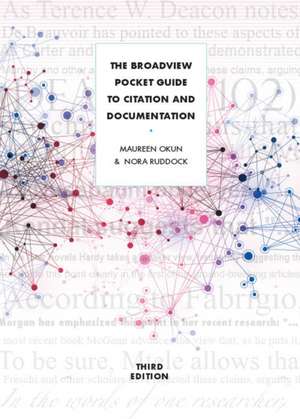
The Broadview Pocket Guide to Citation and Documentation - Third Edition
Autor Maureen Okun, Nora Ruddocken Limba Engleză Spirală – 10 iun 2022
Observăm că literatura academică se confruntă adesea cu o lacună între manualele teoretice voluminoase și nevoia studenților de a avea un instrument de lucru rapid, care să reflecte normele de citare aflate în continuă schimbare. The Broadview Pocket Guide to Citation and Documentation - Third Edition completează exact acest gol, oferind o resursă compactă, dar extrem de riguroasă, pentru mediul universitar. Suntem de părere că ediția a treia este esențială tocmai pentru că încorporează cele mai recente actualizări din 2020 și 2021 ale stilurilor APA și MLA, detalii care fac adesea diferența în evaluarea unei lucrări de cercetare.
Cartea este structurată pentru a ghida cititorul de la principiile etice ale cercetării — cum ar fi evitarea plagiatului — până la mecanica fină a integrării citatelor lungi sau scurte în text. Cuprinsul indică o progresie logică, pornind de la tehnici de parafrazare și rezumare, până la soluții specifice pentru situații complexe, cum sunt lucrările fără paginație sau textele sacre. Acest volum extinde secțiunea de documentare din The Broadview Guide to Writing: A Handbook for Students - Sixth Edition, oferind mai multe exemple practice și un format cu spirală, mult mai ergonomic pentru masa de lucru.
Comparabil cu Cite Right, Third Edition de Charles Lipson în ceea ce privește rigoarea și diversitatea stilurilor abordate, ghidul de față se distinge prin accentul pus pe „signal phrases” și pe integrarea fluidă a surselor, nu doar pe listarea lor mecanică. Față de The Broadview Guide to Grammar, Usage, and Punctuation, care se concentrează pe corectitudinea lingvistică, acest ghid se specializează strict pe arhitectura aparatului critic, fiind un companion indispensabil pentru orice student care dorește să stăpânească normele academice anglo-saxone.
Preț: 122.48 lei
Carte disponibilă
Livrare economică 20 mai-03 iunie
Specificații
ISBN-10: 1554815223
Pagini: 232
Dimensiuni: 127 x 178 x 18 mm
Greutate: 0.26 kg
Ediția:3rd edition
Editura: BROADVIEW PR
Colecția Broadview Press
Locul publicării:Peterborough, Canada
De ce să citești această carte
Această ediție a treia este recomandată studenților și cercetătorilor care redactează lucrări în limba engleză și au nevoie de un ghid de buzunar actualizat la zi. Câștigați claritate în utilizarea stilurilor MLA, APA, Chicago și CSE, evitând erorile de citare care pot duce la acuzații de plagiat. Formatul cu spirală și exemplele extinse fac din acest volum un instrument practic, mult mai ușor de consultat decât manualele standard de scriere academică.
Descriere
The book discusses summary and paraphrase as well as direct quotation, and it includes an extensive treatment of how to integrate quoted material into the text of an academic paper. There is coverage, too, of what constitutes plagiarism—and of how to avoid it.
Recenzii
The book discusses summary and paraphrase as well as direct quotation, and it includes an extensive treatment of how to integrate quoted material into the text of an academic paper. There is coverage, too, of what constitutes plagiarism—and of how to avoid it.
“The third edition of The Broadview Pocket Guide to Citation and Documentation is an excellent and affordable one-stop resource for beginning and advanced writers in a variety of fields. The guide includes the three most used citation styles: MLA, APA, and Chicago. Opening with the basics of ‘Choosing When and What to Quote’ and addressing plagiarism concerns, this guide meets beginning writers right where they are. Introductory sections use familiar language to discuss common citation practices before moving onto the distinctions between the various sources and styles. The visually simple table of contents lists traditional sources as well as blog posts, tweets, online videos, and other popular sources, making the guide useful as a quick documentation reference. In the individual sections, there are numerous and varied explanations under each heading; writers are not only shown how to cite, but why, and given examples. There is practical additional material, including a useful list of words and expressions for signal phrases. Entries added since the second edition, such as how to document stock images, photographs, Zoom lectures, and ‘Indigenous traditional knowledge and oral traditions,’ make the third edition significantly more inclusive and thorough than its predecessor. Instructors of beginning through advanced writers will be hard-pressed to find a more compact, affordable, accessible, and comprehensive guide.” — Deirdre Fagan, Ferris State University
COMMENTS ON THE SECOND EDITION “This is an extraordinarily useful, usable, and affordable reference and supplement for students, writers, and editors. More and more, professionals and students are being called upon to document materials in varying styles, especially in MLA, Chicago, and APA, and this guide offers a convenient and clear reference for the most oft employed styles. In particular, the MLA update is extremely welcome given the guide’s inclusion of the new approach to documenting in MLA as well as multiple specific examples of both traditional sources (like print books and academic journal articles) and more recent source types (such as graphic narratives, tweets, and online video). I was particularly impressed with the entries that provided different examples for sources based on the access or presentation model for the source, such as an interview published in print in a newspaper versus an interview accessed via an online video posting.” — Brian Gastle, Western Carolina University
“The Broadview Pocket Guide [to Citation and Documentation] is an efficient and effective tool for all kinds of learners in all academic disciplines and successfully demonstrates the most-used citation styles of the academic curriculum. The Pocket Guide is particularly insightful in terms of defining and avoiding plagiarism with real-world examples of its professional and academic consequences. Its multiple-view approach includes descriptions, examples, and online links which accommodates all student learning styles. Especially welcome are its practical elements—charts of signal phrases, citation tables that help use the new MLA style, bullet points at the end of each section which highlight the most significant elements of each style, and sample essays—all of which provide quick and easy access for students as they write and edit academic papers.” — Aleksondra Hultquist, Stockton University
“The second edition of Broadview’s Guide to Citation and Documentation incorporates everything you need for referencing across style guides into one efficient handbook. The editors include recent changes adopted by the MLA and provide citation information for an expanded variety of digital and live media, from online videos to entries in a wiki. Much appreciated is the extended section on plagiarism, which clearly explains when, and not just how, to cite quoted material—indispensable for students at all levels of research.” — Tabitha Sparks, McGill University
Cuprins
- Avoiding Plagiarism—and Choosing When and What to Quote
- Citation and Documentation
- Incorporating Sources
- Summarizing
- Paraphrasing
- Quoting Directly
- Formatting Quotations
- Short Prose Quotations
- Long Prose Quotations
- Verse Quotations
- Quotations within Quotations
- Adding to or Deleting from a Quotation
- Using square brackets to add to a quotation
- Using an ellipsis to delete from a quotation
- Integrating Quotations
- Avoiding “dumped” quotations
- Formatting Quotations
- Signal Phrases
- About In-Text Citations
- 1.in-text citations
- 2.no signal phrase
- 3.placing of in-text citations
- 4.in-text citation when text is in parentheses
- 5.page number unavailable
- 6.one page or less
- 7.multiple authors
- 8.corporate author
- 9.more than one work by the same author cited
- 10.multi-volume works
- 11.two or more authors with the same last name
- 12.indirect quotations
- 13.short poems
- 14.longer poems
- 15.novels or short stories
- 16.plays
- 17.works without page numbers
- 18.sacred texts
- 19.works in an anthology or book of readings
- 20.tweets
- About Works Cited
- MLA Core Elements
- Author
- Title of Source
- Title of Container
- Contributor
- Version
- Number
- Publisher
- Publication Date
- Location
- Supplemental Elements
- Date of Original Publication
- City of Publication
- Books in a Series
- Unexpected Type of Work
- Date of Access
- Examples
- 21.single author
- 22.two authors
- 23.three or more authors
- 24.corporate author
- 25.works with an anonymous author
- 26.two or more works by the same author
- 27.works under a pseudonym
- 28.edited works
- 29.works in translation
- 30.selections from anthologies or collections of readings
- 31.cross-references for works from the same collection or anthology
- 32.multi-volume works
- 33.different editions
- 34.republished sources
- 35.reference work entries
- 36.works with a title in the title
- 37.material from prefaces, introductions, etc.
- 38.magazine articles
- 39.newspaper articles
- 40.journal articles
- 41.book reviews
- 42.periodical publications in online databases
- 43.illustrated books
- 44.graphic narratives
- 45.films or television episodes
- 46.online videos
- 47.radio broadcasts
- 48.podcasts
- 49.recorded music
- 50.live performances
- 51.works of visual art
- 52.interviews
- 53.online projects
- 54.e-books
- 55.information databases
- 56.entry in a wiki
- 57.blog post
- 58.e-mail message
- 59.tweet
- 60.comment posted on a webpage
- MLA Core Elements
- MLA Style Sample Essay
- Incorporating Sources in APA Style
- Summarizing
- Paraphrasing
- Quoting Directly
- Formatting Quotations
- Short Quotations
- Long Quotations
- Quotations within Quotations
- Adding to or Deleting from a Quotation
- Using square brackets to add to a quotation
- Using an ellipsis to delete from a quotation
- Integrating Quotations
- Avoiding “dumped” quotations
- Formatting Quotations
- Signal Phrases
- About In-Text Citations
- 1.in-text citation
- 2.no signal phrase (or author not named in signal phrase)
- 3.titles of stand-alone works
- 4.titles of articles and chapters of books
- 5.placing of in-text citations
- 6.citations when text is in parentheses
- 7.electronic source—page number unavailable
- 8.audiovisual works
- 9.two or more dates for a work
- 10.two authors
- 11.three or more authors
- 12.organization as author
- 13.author not given
- 14.date not given
- 15.two or more works in the same citation
- 16.two or more authors with the same last name
- 17.works in a collection of readings or anthology
- 18.indirect source
- 19.personal communications
- 20.Indigenous traditional knowledge and oral traditions
- About References
- 21.work with single author
- 22.two authors
- 23.three to twenty authors
- 24.more than twenty authors
- 25.works with an organization as author
- 26.works with unknown author
- 27.two or more works by the same author
- 28.two or more works by the same author in the same year
- 29.prefaces, introductions, forewords, afterwords
- 30.edited works
- 31.works with an author and a translator
- 32.selections from edited books and collections of readings
- 33.selections from multivolume works
- 34.ebooks and audiobooks
- 35.periodical articles (with and without DOIs)
- 36.abstract of a periodical article
- 37.magazine articles
- 38.newspaper articles
- 39.reviews
- 40.reference work entries with an individual author
- 41.reference work entries with an organization as author
- 42.diagnostic manuals (DSM and ICD)
- 43.articles from databases
- 44.dissertations from databases, published and unpublished
- 45.data sets
- 46.software and reference apps
- 47.films and video recordings
- 48.episodes from television series
- 49.TED talks
- 50.YouTube and other streaming videos
- 51.podcasts
- 52.music recordings
- 53.recorded webinars
- 54.interviews
- 55.blog posts
- 56.Wikipedia article
- 57.social media
- 58.Facebook posts
- 59.Instagram photos or videos
- 60.tweets
- 61.other webpages and websites
- 62.visual works
- 63.work of art in a gallery or gallery website
- 64.stock images or clip art
- 65.infographics
- 66.maps
- 67.photographs
- 68.PowerPoint slides, lecture notes, recorded Zoom lectures
- 69.conference presentations
- APA Style Sample Essay
- About Chicago Style
- 1.notes
- 2.titles: italics/quotation marks
- 3.multiple references to the same work
- 4.page number or date unavailable
- 5.two or more dates for a work
- 6.two or three authors
- 7.four or more authors
- 8.organization as author/reference work/government document
- 9.works from a collection of readings or anthology
- 10.indirect source
- 11.two or more works by the same author
- 12.edited works
- 13.translated works
- 14.e-books
- 15.magazine articles
- 16.newspaper articles
- 17.journal articles
- 18.films and video recordings
- 19.television broadcasts
- 20.sound recordings
- 21.interviews and personal communications
- 22.book reviews
- 23.blog posts
- 24.websites
- 25.online videos
- 26.tweets
- Chicago Style Sample
- In-Text Citation
- citation-name format
- citation-sequence format
- name-year format
- List of References
- citation-name format
- citation-sequence format
- name-year format
- CSE Style Samples
- citation-name format
- citation-sequence format
- name-year format