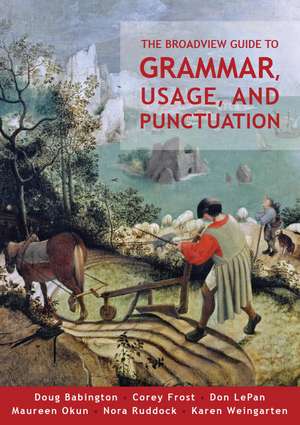
The Broadview Guide to Grammar, Usage, and Punctuation: The Mechanics of Good Writing
Autor Corey Frost, Karen Weingarten, Doug Babington, Don LePan, Maureen Okunen Limba Engleză Paperback – 15 mar 2024
Notăm cu interes apariția The Broadview Guide to Grammar, Usage, and Punctuation, un manual conceput ca un instrument de sine stătător, extras din apreciatul material de referință The Broadview Guide to Writing. Publicat de Broadview Press, acest volum rafinează mecanica scrierii corecte într-un format accesibil, fiind destinat studenților din învățământul terțiar și celor care folosesc engleza ca limbă adițională. Reținem organizarea riguroasă în patru secțiuni care ghidează cititorul de la fundamentele părților de vorbire până la nuanțele subtile ale punctuației.
Secțiunea de gramatică oferă o analiză detaliată a sintaxei, tratând cu precizie problemele frecvente precum frazele de tip „run-on” sau fragmentele de propoziție incomplete. În capitolul dedicat utilizării (Usage), autorii propun recomandări actualizate pentru sute de puncte care generează adesea confuzie, în timp ce secțiunea de punctuație clarifică utilizarea colonului și a punctului și virgulei. Cititorii familiarizați cu Improve Your Grammar de Vanessa Jakeman vor aprecia aici abordarea mai academică și contextul oferit de exercițiile interactive de pe site-ul însoțitor, care transformă studiul pasiv într-o experiență aplicată.
Această lucrare se înscrie în linia ghidurilor practice semnate de Corey Frost, Don LePan și Maureen Okun, precum The Broadview Pocket Guide to Writing sau The Broadview Guide to Writing: A Handbook for Students. Spre deosebire de versiunile anterioare axate pe procesul de scriere în ansamblu, acest volum se concentrează strict pe mecanică, oferind o claritate superioară asupra regulilor structurale. Prezența unei secțiuni dedicate vorbitorilor non-nativi (EAL) subliniază relevanța sa în curriculumul internațional contemporan, oferind soluții specifice pentru dificultățile de transfer lingvistic.
Preț: 191.11 lei
Carte disponibilă
Livrare economică 16-30 mai
Livrare express 05-09 mai pentru 72.78 lei
Specificații
ISBN-10: 1554816777
Pagini: 320
Dimensiuni: 152 x 216 x 15 mm
Greutate: 0.45 kg
Editura: BROADVIEW PR
Colecția Broadview Press
Locul publicării:Peterborough, Canada
De ce să citești această carte
Recomandăm acest ghid studenților și profesioniștilor care doresc să își perfecționeze scrierea academică în limba engleză. Câștigul major este accesul la explicații logice pentru reguli complexe, susținute de un portal web cu sute de exerciții. Este resursa ideală pentru a elimina erorile de topică și punctuație, oferind siguranța necesară în redactarea eseurilor sau a documentelor oficiale într-un stil impecabil.
Despre autor
Echipa de autori reunește specialiști de renume în retorică și compoziție. Corey Frost a coordonat programul Writing Across the Curriculum la Brooklyn College și este profesor la New Jersey City University. Karen Weingarten predă la Queens College (CUNY), fiind expertă în literatură și scriere introductivă. Doug Babington este profesor emerit la Queen’s University, unde a condus centrul de scriere timp de mulți ani. Don LePan este fondatorul Broadview Press și autorul mai multor ghiduri lingvistice, iar Maureen Okun este profesoară la Vancouver Island University, specializată în documentare și citare academică.
Descriere
The book is divided into four sections. The Grammar section provides unrivalled coverage of complete and incomplete sentences, dangling constructions, and other subjects that give many writers special difficulty. The Usage section offers sensible and up-to-date advice on hundreds of points that frequently cause confusion. The Punctuation section provides a wealth of helpful guidance on all aspects of punctuation, with particular attention paid to such vexed questions as when to use the colon and the semi-colon, and (when using quotation marks) how to properly integrate quotations into one’s own text. A final section, English as an Additional Language, gives a wide range of helpful advice on special issues that may arise for those whose native language is not English.
A companion website provides hundreds of exercises on every topic covered in the book itself. Many of these are interactive; on completing an exercise, students are told how they did—and explanations are provided as to why the right answers are right and the wrong answers are wrong.
This book is adapted from The Broadview Guide to Writing, which is available in American and Canadian editions
Recenzii
The book is divided into four sections. The Grammar section provides unrivalled coverage of complete and incomplete sentences, dangling constructions, and other subjects that give many writers special difficulty. The Usage section offers sensible and up-to-date advice on hundreds of points that frequently cause confusion. The Punctuation section provides a wealth of helpful guidance on all aspects of punctuation, with particular attention paid to such vexed questions as when to use the colon and the semi-colon, and (when using quotation marks) how to properly integrate quotations into one’s own text. A final section, English as an Additional Language, gives a wide range of helpful advice on special issues that may arise for those whose native language is not English.
A companion website provides hundreds of exercises on every topic covered in the book itself. Many of these are interactive; on completing an exercise, students are told how they did—and explanations are provided as to why the right answers are right and the wrong answers are wrong.
This book is adapted from The Broadview Guide to Writing, which is available in American and Canadian editions
Comments on The Broadview Guide to Grammar, Usage, and Punctuation and on The Broadview Guide to Writing:
“The Broadview Guide to Grammar, Usage, and Punctuation is a superb, comprehensive guide that I'll be adopting across all my writing courses. It’s easy for students to navigate, and it clarifies meanings of key terms in a way that other grammar guides do not. The coverage of run-on sentences and sentence fragments is particularly strong—as is the coverage of subject–verb agreement errors and of dangling modifiers. The coverage of special issues arising for those whose first language is not English is well thought-out. Throughout, the examples are excellent, spanning a variety of contexts and disciplines, and the text is highly readable, especially when compared to other guides I have used. The exercises on the user-friendly companion website are original and engaging; I will definitely assign these. The Broadview Guide to Grammar, Usage, and Punctuation fills a need for a detailed but easily comprehensible student guide, and it’s certain to be of use across a range of disciplines.” — Louise Kane, University of Central Florida
“This is by far the best grammar textbook that I have seen in many years.” — Andrey Reznikov, Black Hills State University
“Even the most useful reference guides are not always, well, shall we say, riveting. A refreshing exception is The Broadview Guide to Writing, which is smart, helpful, and even fun to read.” — Gerald Graff and Cathy Birkenstein, authors of They Say / I Say: The Moves that Matter in Academic Writing
“The Broadview Guide to Writing is not only informative and impressive; it is smart—smartly written and smartly designed.” — Dennis Paoli, Co-coordinator, Writing Across the Curriculum, Hunter College, CUNY
“The Broadview Guide remains the most readable writing guide available—at any price. Moreover, it’s sensible, and it’s complete. The authors assume nothing, but they don’t condescend.” — Jacky Bolding, University of the Fraser Valley
“There’s so much to like here: the sense of proportion, the sensible layout, the precision of the usage notes, the sound stylistic advice, and the examples…. The text is clearly informed by the best traditions of composition and rhetoric, but comes across in a disarming fashion with a common-sense approach…. Long after the course is over, students will want to keep this book as a manual of style and usage.” — Thomas L. Martin, Department of English, Florida Atlantic University
Cuprins
1 Grammar
- 1.1What Is Grammar?
- 1.2Parts of Speech
- 1.3Parts of Sentences
- 1.3.1 Complete and Incomplete Sentences
- Run-on Sentences
- Sentence Fragments (Incomplete Sentences)
- Complete Sentences and Sentence Style
- Acceptable Sentence Fragments
- 1.3.1 Complete and Incomplete Sentences
- 1.4Verb Forms
- The Infinitive
- The Simple Present
- Subject–verb Agreement
- Historical Present
- The Simple Past
- The Simple Future
- The Progressive (or Continuous) Aspect
- The Perfect Aspect
- Conditional Constructions
- 1.5Mood and Voice
- Active and Passive Voice
- 1.6Sentence Combining: How to Build Sentences
- 2.1Verb Issues
- Dangling Constructions
- Dangling Participles and Infinitives
- Sequence of Tenses
- Irregular or Difficult Verbs
- Infinitives, Gerunds, Objects: “To Be or Not To Be?”
- The Text in the Present Tense
- 2.2Preposition Issues
- 2.3Noun and Pronoun Issues
- 2.3.1 Nouns
- 2.3.2 Pronouns: Who Cares about Whom?
- 2.3.3 Nouns and Pronoun Issues with Authors and Speakers
- 2.4Word Order
- 2.5Word Meanings
- 2.6Part-of-Speech Conversions
- 2.7Slang
- 2.8Word Conventions
- 2.9Joining Words
- 2.10 Wordiness
- 3.1Punctuation Marks
- 3.2Quotations
- Direct Speech
- Indirect Speech
- Formatting Quotations
- Integrating Quotations
- 3.3Capitalization
- 3.4Abbreviations
- 3.5Spelling
Appendix: Correction Key
Index