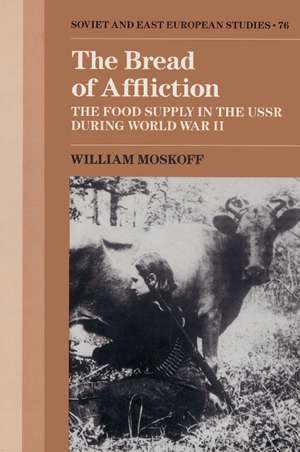
The Bread of Affliction
Autor William Moskoff, Moskoff Williamen Limba Engleză Paperback – 24 apr 2002
Preț: 357.05 lei
Puncte Express: 536
Carte tipărită la comandă
Livrare economică 27 noiembrie-11 decembrie
Livrare prin curier în România Termenul estimat este afișat lângă disponibilitate.
Transport gratuit de la 400.00 lei Plată online sau ramburs, în funcție de opțiunile comenzii.
Retur gratuit în 14 zile Comandă securizată și suport în română.
Specificații
ISBN-13: 9780521522830
ISBN-10: 0521522838
Pagini: 276
Ilustrații: 40 tables
Dimensiuni: 152 x 229 x 16 mm
Greutate: 0.45 kg
Ediția:Revised
Editura: Cambridge University Press
Locul publicării:New York, United States
ISBN-10: 0521522838
Pagini: 276
Ilustrații: 40 tables
Dimensiuni: 152 x 229 x 16 mm
Greutate: 0.45 kg
Ediția:Revised
Editura: Cambridge University Press
Locul publicării:New York, United States
V-ar putea interesa
-
 The Unbound PrometheusDavid LandesPreț: 273.83 lei
 -
 Hellenist World Alex Roman Conq 2edM. M. AustinPreț: 345.54 lei
 -
 A History of the University in EuropeHilde De Ridder-SymoensPreț: 315.30 lei
 -
 A Concise History of HungaryMiklós MolnárPreț: 192.98 lei
 -
 -11%Preț: 477.64 lei536.67 lei
 -
 Tommy RotJohn SadlerPreț: 68.21 lei
 -
 Women in the War ZoneAnne Powel-14%Preț: 134.01 lei156.62 lei
 -
 Byzantium in the Iconoclast Era, c. 680-850Leslie BrubakerPreț: 398.96 lei
 -
 July CrisisThomas OttePreț: 275.05 lei
 -
 Napoleonic Light Cavalry TacticsPhilip Haythornthwaite-32%Preț: 76.67 lei113.20 lei
 -
 Disaster at D-DayPeter TsourasPreț: 131.40 lei
Cuprins
Acknowledgement; Abbreviations; Introduction; 1. On the eve of the War; 2. The desperate months of 1941: invasion and evacuation; 3. The German Occupation; 4. Producing food for the Unoccupied USSR: the factors of production; 5. Local food sources; 6. The first priority: feeding the armed forces; 7. Feeding the cities and towns: civilian rationing; 8. White and Black Markets: the safety valve for civilian food supply; 9. Crime and privilege; 10. Death's dominion: the Siege of Leningrad; 11. The newly liberated areas: restoring the food supply; 12. The wages of hunger: direct and indirect consequences of wartime food shortages; Conclusion; Bibliography.
Recenzii
"This is the best book on the subject yet to appear in any language, and it is a delight to have it in print." W. Bruce Lincoln, Annals of the American Academy
"...a very readable and interesting account of Soviet efforts to feed the Red Army and civilian population during the Second World War....Moskoff has written an important book, one that helps fill a glaring gap in the historical literature. He has utilized a wide array of sources, including interviews of Soviet émigrés, in an effort to provide an informative account of this grim chapter of Soviet history." Thomas J. Greene, Canadian Slavonic Papers
"William Moskoff has produced a very informative, logically organized, and carefully written account of a topic that is important....The Bread of Affiction is a major contribution to our understanding of the social and economic crises confronting the USSR during the war with Germany." Richard Bidlack, The Russian Review
"...a very readable and interesting account of Soviet efforts to feed the Red Army and civilian population during the Second World War....Moskoff has written an important book, one that helps fill a glaring gap in the historical literature. He has utilized a wide array of sources, including interviews of Soviet émigrés, in an effort to provide an informative account of this grim chapter of Soviet history." Thomas J. Greene, Canadian Slavonic Papers
"William Moskoff has produced a very informative, logically organized, and carefully written account of a topic that is important....The Bread of Affiction is a major contribution to our understanding of the social and economic crises confronting the USSR during the war with Germany." Richard Bidlack, The Russian Review
Descriere
This book tells how the Soviet Union fed itself after the invasion in 1941.