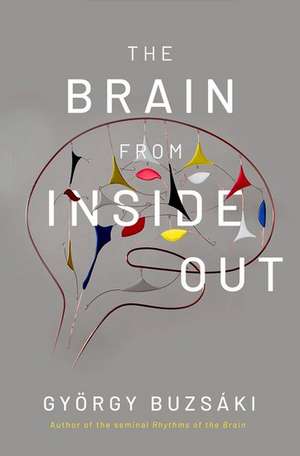
The Brain from Inside Out
Autor György Buzsákien Limba Engleză Hardback – 11 iul 2019
Preț: 476.61 lei
Preț vechi: 670.51 lei
-29%
Puncte Express: 715
Carte disponibilă
Livrare economică 19-24 noiembrie
Livrare prin curier în România Termenul estimat este afișat lângă disponibilitate.
Transport gratuit pentru acest produs Plată online sau ramburs, în funcție de opțiunile comenzii.
Retur gratuit în 14 zile Comandă securizată și suport în română.
Specificații
ISBN-13: 9780190905385
ISBN-10: 0190905387
Pagini: 464
Dimensiuni: 239 x 160 x 33 mm
Greutate: 0.79 kg
Editura: Oxford University Press
Colecția OUP USA
Locul publicării:New York, United States
ISBN-10: 0190905387
Pagini: 464
Dimensiuni: 239 x 160 x 33 mm
Greutate: 0.79 kg
Editura: Oxford University Press
Colecția OUP USA
Locul publicării:New York, United States
V-ar putea interesa
-
 Heavily MeditatedDave AspreyPreț: 123.34 lei
 -
 The Experience MachineAndy Clark-30%Preț: 65.21 lei93.13 lei
 -
 Brain and BehaviorDavid Eagleman-27%Preț: 1057.95 lei1449.25 lei
 -
 The Brain: A Very Short IntroductionMichael O'Shea-31%Preț: 49.03 lei71.12 lei
 -
 The Brain from Inside OutGyorgy Buzsaki-13%Preț: 260.35 lei300.20 lei
 -
 Your Stone Age Brain in the Screen AgeRichard E. CytowicPreț: 211.48 lei
 -
 Inside Your BrainLucy Ann UnwinPreț: 122.75 lei
 -
 The Spike - An Epic Journey Through the Brain in 2.1 SecondsMark HumphriesPreț: 161.65 lei
 -
 How to Create a MindRay Kurzweil-35%Preț: 65.25 lei100.21 lei
 -
 -32%Preț: 94.04 lei138.41 lei
 -
 Seven and a Half Lessons About the BrainLisa Feldman Barrett-34%Preț: 51.37 lei78.19 lei
 -
 Preț: 122.07 lei
 -
 Mind over Magick: The Psychology of Ritual MagickRichard Kaczynski-24%Preț: 118.13 lei154.71 leiRecomandat
 -
 Nature and the MindMarc BermanPreț: 122.36 lei
 -
 Introducing Mind and BrainAngus GellatlyPreț: 64.39 lei
 -
 Brainscapes: An Atlas of Your Life on EarthRebecca Schwarzlose-18%Preț: 65.23 lei79.65 lei
 -
 One Hand ClappingNikolay KukushkinPreț: 159.17 lei
 -
 The Brain at RestJoseph JebelliPreț: 75.26 lei
 -
 Phantoms in the BrainSandra Blakeslee-5%Preț: 88.61 lei93.27 lei
Recenzii
The Brain from Inside Out is an impressive display of erudition, rounded off with just the right amount of storytelling and autobiographical notes.
Overall, the book is profound and full of wisdom for both science and culture in general. It challenges the established views as to how the brain and the world work together, and it inspires new ideas regarding the psyche and consciousness.
a fascinating and impressive tour de force of contemporary neuroscience.
Inside Out offers crossover appeal, but it is unabashedly broad and ambitious, aspiring to articulate a philosophy of how to think about the brain that shapes the future of neuroscience research. ... It will fuel the imaginations of young neuroscientists, as they invent new ways to understand the strange and wonderful meat inside our heads.
The Brain from Inside Out is a fascinating guided tour by a leading brain scientist of the race to address the biggest challenge of our times: understanding the inner workings of the brain. Buzsáki's ideas are at the same time personal and universal, offering an intimate look at the major hypotheses and roadblocks that drive brain science today. A wonderful read.
In The Brain from Inside Out, György Buzsáki shows how dynamic patterns of activity in neurons actively generate good guesses rather than passively represent the outside world. Buzsáki is a master at vividly explaining what we know about brains and illuminating what we don't yet know.
This outstanding book will challenge you to think deeply about how we should view the route to discovery in brain research. The primary argument of the book is that the brain is a self-organized system with a preexisting organization designed to generate actions and to evaluate and predict the consequences of those actions. This is contrasted with the dominant view in modern neuroscience that the brain exists to represent the world, process information and decide how to respond. The consequences of this distinction are presented from an historical and a scientific perspective done with remarkable scholarship and scientific rigor. As a welcome addition to the rapidly expanding dialogue on brain science and society, I hope it finds its way onto the desks of young people commencing careers in the neurosciences.
Overall, the book is profound and full of wisdom for both science and culture in general. It challenges the established views as to how the brain and the world work together, and it inspires new ideas regarding the psyche and consciousness.
a fascinating and impressive tour de force of contemporary neuroscience.
Inside Out offers crossover appeal, but it is unabashedly broad and ambitious, aspiring to articulate a philosophy of how to think about the brain that shapes the future of neuroscience research. ... It will fuel the imaginations of young neuroscientists, as they invent new ways to understand the strange and wonderful meat inside our heads.
The Brain from Inside Out is a fascinating guided tour by a leading brain scientist of the race to address the biggest challenge of our times: understanding the inner workings of the brain. Buzsáki's ideas are at the same time personal and universal, offering an intimate look at the major hypotheses and roadblocks that drive brain science today. A wonderful read.
In The Brain from Inside Out, György Buzsáki shows how dynamic patterns of activity in neurons actively generate good guesses rather than passively represent the outside world. Buzsáki is a master at vividly explaining what we know about brains and illuminating what we don't yet know.
This outstanding book will challenge you to think deeply about how we should view the route to discovery in brain research. The primary argument of the book is that the brain is a self-organized system with a preexisting organization designed to generate actions and to evaluate and predict the consequences of those actions. This is contrasted with the dominant view in modern neuroscience that the brain exists to represent the world, process information and decide how to respond. The consequences of this distinction are presented from an historical and a scientific perspective done with remarkable scholarship and scientific rigor. As a welcome addition to the rapidly expanding dialogue on brain science and society, I hope it finds its way onto the desks of young people commencing careers in the neurosciences.
Notă biografică
György Buzsáki is Biggs Professor of Neuroscience at New York University. Member of the National Academy of Sciences USA, Co-recipient of the 2011 Brain Prize.His main interest is "neural syntax", how segmentation of neural information is organized to support cognitive functions.Book: G. Buzsáki, Rhythms of the Brain, Oxford University Press, 2006
Cuprins
- Preface
- Chapter 1: The Problem
- Chapter 2: Causation and Logic in Neuroscience
- Chapter 3: Perception from Action
- Chapter 4: Neuronal Assembly: The Fundamental Unit of Communication
- Chapter 5: Internalization of Experience: Cognition from Action
- Chapter 6: Brain Rhythms Provide a Framework for Neural Syntax
- Chapter 7: Internally Organized Cell-Assembly Trajectories
- Chapter 8: Internally Organized Activity During Off-Line Brain States
- Chapter 9: Enhancing Brain Performance by Externalizing Thought
- Chapter 10: Space and Time in the Brain
- Chapter 11: Gain and Abstraction
- Chapter 12: Everything is a Relationship: The Non-Egalitarian, Log-Scaled Brain
- Chapter 13: The Brain's Best Guess
- Chapter 14: Epilogue
- Index