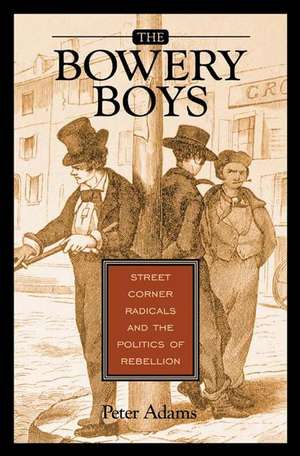
The Bowery Boys: Street Corner Radicals and the Politics of Rebellion
Autor Peter Adamsen Limba Engleză Hardback – 30 mar 2005
A radical and immensely popular voice in antebellum New York, Walsh spoke in the unvarnished language of class conflict. Admired by Walt Whitman and feared by Tammany Hall, Walsh was an original, wildly unstable character who directed his aptly named Spartan Band against the economic and political elite of New York City and New England. As a labor organizer, state legislator, and even U.S. Congressman, the leader of the Bowery Boys fought for shorter working hours, the right to strike, free land for settlers on the American frontier, against child labor, and to restore dignity to the city's growing number of industrial workers.
Preț: 355.74 lei
Preț vechi: 515.28 lei
-31%
Puncte Express: 534
Carte tipărită la comandă
Livrare economică 08-22 iunie
Specificații
ISBN-13: 9780275985387
ISBN-10: 0275985385
Pagini: 192
Dimensiuni: 156 x 235 x 21 mm
Greutate: 0.44 kg
Ediția:New.
Editura: Bloomsbury Publishing
Colecția Praeger
Locul publicării:New York, United States
ISBN-10: 0275985385
Pagini: 192
Dimensiuni: 156 x 235 x 21 mm
Greutate: 0.44 kg
Ediția:New.
Editura: Bloomsbury Publishing
Colecția Praeger
Locul publicării:New York, United States
V-ar putea interesa
-
 Coming Like Hell!Waldon LovingPreț: 97.05 lei
 -
 Preț: 92.11 lei
 -
 The InsurrectionistPeter AdamsPreț: 252.51 lei
 -
 Racing Yachts - Done in Cork ModelsPeter AdamsPreț: 196.58 lei
 -
 -18%Preț: 956.34 lei1166.27 lei
 -
 Otter TalesDennis WallerPreț: 37.94 lei
 -
 Prairie VoicesGerald AndersonPreț: 172.07 lei
 -
 Reaching the North PoleCharles River EditorsPreț: 44.42 lei
 -
 Lifting Oregon Out of the MudJoe R. BlakelyPreț: 109.39 lei
 -
 OrangeburgGene AtkinsonPreț: 174.74 lei
 -
 Great FallsDon PetersonPreț: 174.74 lei
 -
 S Q LPeter Adams-20%Preț: 84.78 lei105.97 lei
 -
 Hispanic & Latino Heritage in VirginiaChristine Sloan StoddardPreț: 112.53 lei
 -
 Preț: 94.52 lei
Cuprins
The Bowery Boys: Shirtless and Unterrified
The Bowery Boys: Radical in Everything
On to Providence: B'hoys
Workies, Loco Focos, and the Subterranean Masses
Go West Young Proletary
The Bowery Boy Goes to Washington
Boss Rule and the Eclipse of the Bowery Boys
Notes
Bibliography
Index
The Bowery Boys: Radical in Everything
On to Providence: B'hoys
Workies, Loco Focos, and the Subterranean Masses
Go West Young Proletary
The Bowery Boy Goes to Washington
Boss Rule and the Eclipse of the Bowery Boys
Notes
Bibliography
Index
Recenzii
[A] good story . we emerge at the end with greatly increased knowledge of the Democratic Party, the Whig Party, Tammany Hall and the social conditions of New York in the middle of the nineteenth century.
Did these leaders speak much to or for American workers? The evidence make clear only that they speak to historians in search of an American radical tradition.
Did these leaders speak much to or for American workers? The evidence make clear only that they speak to historians in search of an American radical tradition.