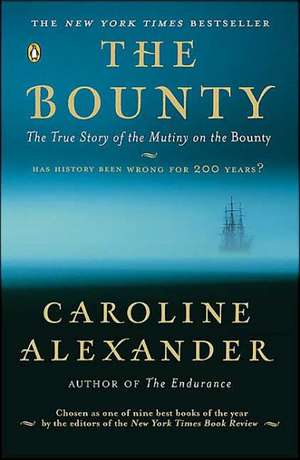
The Bounty
Autor Caroline Alexanderen Limba Engleză Paperback – 25 mai 2004
În capitolul dedicat procesului de la Portsmouth, Caroline Alexander reușește să demonteze unul dintre cele mai persistente mituri ale istoriei maritime: imaginea locotenentului William Bligh ca tiran și cea a lui Fletcher Christian ca erou romantic. Ne-a atras atenția modul în care autoarea nu se limitează la relatarea revoltei de pe The Bounty, ci investighează mecanismele politice și sociale care au urmat. Găsim în această lucrare o analiză minuțioasă a modului în care două familii influente au orchestrat o campanie de reabilitare a numelui lui Christian, sacrificând în schimb onoarea unui ofițer capabil. Structura cărții este cronologică, dar accentul cade pe consecințele legale și umane. De la periplul navei Pandora, trimisă să îi captureze pe rebeli, până la detaliile tehnice ale apărării din timpul curții marțiale, textul oferă o perspectivă riguroasă asupra disciplinei navale britanice. The Bounty reprezintă o evoluție firească față de The Endurance, lucrarea anterioară a autoarei; dacă acolo Alexander explora triumful spiritului uman în condiții extreme, aici ea analizează eșecul acestuia sub presiunea mândriei și a politicii de clasă. Ca alternativă la Mutiny on Board HMS Bounty de William Bligh pentru cursurile de istorie navală, acest volum aduce avantajul unei perspective critice, detașate de subiectivismul martorilor direcți. În timp ce relatările clasice, precum cele din The Mutiny and Piratical Seizure of HMS Bounty de John Barrow, tind să preia documentele oficiale ca adevăr absolut, Alexander le confruntă cu scrisori și jurnale inedite, oferind o imagine mult mai nuanțată a evenimentelor din 1789. Cele trei secțiuni de ilustrații, inclusiv inserțiile color, completează experiența de lectură, oferind chipuri și hărți unei povești care a definit începutul epocii romantice.
Preț: 172.31 lei
Carte tipărită la comandă
Livrare economică 08-22 decembrie
Specificații
ISBN-10: 0142004693
Pagini: 546
Ilustrații: Two 16-page b/w inserts and one 8-page color insert; b/w art in front matter and
Dimensiuni: 140 x 214 x 30 mm
Greutate: 0.51 kg
Editura: Penguin Publishing Group
V-ar putea interesa
-
 The Soldiers' TaleSamuel HynesPreț: 132.86 lei
 -
 Hell Riders: The Truth About the Charge of the Light BrigadeTerry BrightonPreț: 122.44 lei
 -
 Russia Against NapoleonDominic Lieven-18%Preț: 101.50 lei123.78 lei
 -
 The Peloponnesian WarDonald KaganPreț: 145.44 lei
 -
 The War That Made AmericaFred AndersonPreț: 112.74 lei
 -
 How to Plan a CrusadeChristopher Tyerman-18%Preț: 77.77 lei94.54 lei
 -
 The EnduranceCaroline AlexanderPreț: 245.08 lei
 -
 McDonnell Douglas F/A-18 HornetBill HolderPreț: 118.95 lei
 -
 Patton's Photographs: War as He Saw ItKevin HymelPreț: 136.03 lei
De ce să citești această carte
Pentru cititorii pasionați de istorie navală și investigație documentară, această carte este esențială. Caroline Alexander nu doar repovestește o revoltă celebră, ci explică modul în care se construiește adevărul istoric. Câștigați o înțelegere profundă a sistemului de justiție al Marinei Regale și a impactului pe care presiunea socială îl are asupra faptelor brute. Este o lectură despre onoare, putere și supraviețuire.
Despre autor
Caroline Alexander este o scriitoare și cercetătoare de renume, cunoscută pentru capacitatea sa de a revitaliza episoade istorice complexe. S-a remarcat prin volumul The Endurance, o cronică a expediției lui Shackleton în Antarctica, și prin traducerea de excepție a epopeii The Iliad de Homer. Interesul său pentru explorare și reziliență umană se reflectă și în alte lucrări precum Skies of Thunder. În prezent, locuiește în New Hampshire, continuând să exploreze teme legate de istoria regională și maritimă, fiind apreciată pentru rigoarea documentării și stilul narativ precis.
Descriere scurtă
Cuprins
Author's Note
Prelude
Pandora
Bounty
Voyage Out
Tahiti
Mutiny
Return
Portsmouth
Court-Martial
Defense
Sentence
Judgment
Latitude 25° S, Longitude 130° W
Home Is The Sailor
A Note on Sources
Select Bibliography
Acknowledgments
Index
Notă biografică
Extras
Spithead, winter 1787
His small vessel pitching in the squally winter sea, a young British naval lieutenant waited restlessly to embark upon the most important and daunting voyage of his still young but highly promising career. William Bligh, aged thirty-three, had been selected by His Majesty's government to collect breadfruit plants from the South Pacific island of Tahiti and to transport them to the plantations of the West Indies. Like most of the Pacific, Tahiti—Otaheite—was little known; in all the centuries of maritime travel, fewer than a dozen European ships had anchored in her waters. Bligh himself had been on one of these early voyages, ten years previously, when he had sailed under the command of the great Captain Cook. Now he was to lead his own expedition in a single small vessel called Bounty.
With his ship mustered and provisioned for eighteen months, Bligh had anxiously been awaiting the Admiralty's final orders, which would allow him to sail, since his arrival at Spithead in early November. A journey of some sixteen thousand miles lay ahead, including a passage around Cape Horn, some of the most tempestuous sailing in the world. Any further delay, Bligh knew, would ensure that he approached the Horn at the height of its worst weather. By the time the orders arrived in late November, the weather at Spithead itself had also deteriorated to the extent that Bligh had been able to advance no farther than the Isle of Wight, from where he wrote a frustrated letter to his uncle-in-law and mentor, Duncan Campbell.
"If there is any punishment that ought to be inflicted on a set of Men for neglect I am sure it ought on the Admiralty," he wrote irascibly on December 10, 1787, "for my three weeks detention at this place during a fine fair wind which carried all outward bound ships clear of the channel but me, who wanted it most."
Nearly two weeks later, he had retreated back to Spithead, still riding out bad weather.
"It is impossible to say what may be the result," Bligh wrote to Campbell, his anxiety mounting. "I shall endeavor to get round [the Horn]; but with heavy Gales, should it be accompanied with sleet &snow my people will not be able to stand it....Indeed I feel my voyage a very arduous one, and have only to hope in return that whatever the event may be my poor little Family may be provided for. I have this comfort," he continued with some complacency, "that my health is good and I know of nothing that can scarce happen but I have some resource for— My little Ship is in the best of order and my Men &officers all good &feel happy under my directions."
At last, on December 23, 1787, the Bounty departed England and after a rough passage arrived at Santa Cruz, in Tenerife. Here, fresh provisions were acquired and repairs made, for the ship had been mauled by severe storms.
"The first sea that struck us carryed away all my spare yards and some spars," Bligh reported, writing again to Campbell; "—the second broke the Boats chocks &stove them &I was buryed in the Sea with my poor little crew...."
Despite the exasperating delay of his departure, the tumultuous passage and the untold miles that still lay ahead, Bligh's spirits were now high—manifestly higher than when he had first set out. On February 17, 1788, off Tenerife, he took advantage of a passing British whaler, the Queen of London, to drop a line to Sir Joseph Banks, his patron and the man most responsible for the breadfruit venture.
"I am happy and satisfyed in my little Ship and we are now fit to go round half a score of worlds," Bligh wrote, "both Men &Officers tractable and well disposed &cheerfulness &content in the countenance of every one. I am sure nothing is even more conducive to health. —I have no cause to inflict punishments for I have no offenders and every thing turns out to my most sanguine expectations."
"My Officers and Young Gentlemen are all tractable and well disposed," he continued in the same vein to Campbell, "and we now understand each other so well that we shall remain so the whole voyage...."
Bligh fully expected these to be his last communications on the outward voyage. But monstrous weather off Cape Horn surpassed even his worst expectations. After battling contrary storms and gales for a full month, he conceded defeat and reversed his course for the Cape of Good Hope. He would approach Tahiti by way of the Indian Ocean and Van Diemen's Land (now Tasmania), a detour that would add well over ten thousand miles to his original voyage.
"I arrived here yesterday," he wrote to Campbell on May 25 from the southernmost tip of Africa, "after experiencing the worst of weather off Cape Horn for 30 Days....I thought I had seen the worst of every thing that could be met with at Sea, yet I have never seen such violent winds or such mountainous Seas." A Dutch ship, he could not resist adding, had also arrived at the Cape with thirty men having died on board and many more gravely ill; Bligh had brought his entire company through, safe and sound.
The Bounty passed a month at the Cape recovering, and was ready to sail at the end of June. A still arduous journey lay ahead but Bligh's confidence was now much greater than when he had embarked; indeed, in this respect he had shown himself to be the ideal commander, one whose courage, spirits and enthusiasm were rallied, not daunted, by difficulties and delays. Along with his ship and men, he had weathered the worst travails he could reasonably expect to face.
The long-anticipated silence followed; but when over a year later it was suddenly broken, Bligh's correspondence came not from the Cape, nor any other port of call on the expected route home, but from Coupang (Kupang) in the Dutch East Indies. The news he reported in letters to Duncan Campbell, to Joseph Banks and above all to his wife, Elizabeth, was so wholly unexpected, so unconnected to the stream of determined and complacent letters of the year before as to be almost incomprehensible.
"My Dear Dear Betsy," Bligh wrote with palpable exhaustion to his wife on August 19, 1789, "I am now in a part of the world that I never expected, it is however a place that has afforded me relief and saved my life....
"Know then my own Dear Betsy, I have lost the Bounty...."