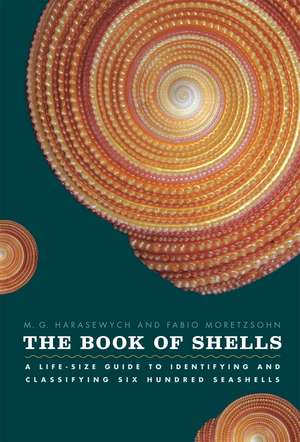
The Book of Shells: A Life-Size Guide to Identifying and Classifying Six Hundred Seashells: Life-Size Guides to the Best of Nature
Autor M. G. Harasewych, Fabio Moretzsohnen Limba Engleză Hardback – 30 iun 2010
Notăm cu interes apariția volumului The Book of Shells, o lucrare de referință semnată de M. G. Harasewych și Fabio Moretzsohn. Autorii, figuri proeminente în domeniul malacologiei, fundamentează acest ghid pe o cercetare riguroasă a filumului Mollusca, oferind o perspectivă științifică asupra scheletelor externe ale acestor nevertebrate vechi de peste 500 de milioane de ani. Subliniem rigoarea cu care cei doi cercetători au selectat cele 600 de specii pentru a ilustra diversitatea morfologică incredibilă a moluștelor.
Ne-a atras atenția elementul distinctiv al acestei ediții: fiecare cochilie este reprodusă la dimensiunea sa reală, în culori naturale, fiind însoțită de date precise despre habitat, distribuție și opercul. Această abordare vizuală transformă volumul dintr-un simplu catalog într-un instrument de identificare extrem de precis. Lucrarea acoperă o arie similară cu Shells de Giorgio Gabbi, dar se diferențiază printr-o structură mult mai tehnică și o organizare bazată pe filogenie, nu doar pe estetică.
Structura cărții facilitează o progresie logică, de la conceptele fundamentale despre ce este o moluscă, până la o cheie de identificare practică și indici detaliați (nume latine, nume comune și relații evolutive). Această organizare indică o acoperire exhaustivă a subiectului, transformând cele 656 de pagini într-o resursă esențială pentru studiul biodiversității marine. Tonul este unul precis, evitând speculațiile și concentrându-se pe fapte biologice și date istorice fascinante, precum valoarea de licitație a speciei Conus cedonulli în secolul al XVIII-lea.


Preț: 469.51 lei
Carte indisponibilă temporar
Specificații
ISBN-10: 0226315770
Pagini: 656
Ilustrații: 2400 color plates
Dimensiuni: 191 x 254 x 48 mm
Greutate: 2.24 kg
Editura: University of Chicago Press
Colecția University of Chicago Press
Seria Life-Size Guides to the Best of Nature
De ce să citești această carte
Recomandăm această lucrare colecționarilor și studenților la biologie marină care au nevoie de un instrument de identificare precis. Cititorul câștigă acces la o arhivă vizuală de 2400 de imagini color, beneficiind de expertiza unor cercetători de top. Motivul principal pentru achiziție este redarea cochiliilor la scară 1:1, ceea ce elimină erorile de percepție specifice ghidurilor clasice.
Despre autor
M. G. Harasewych este curator emerit la Departamentul de Zoologie a Nevertebratelor din cadrul National Museum of Natural History, Smithsonian Institution, fiind un expert recunoscut la nivel mondial în sistematica și biogeografia gasteropodelor marine. Fabio Moretzsohn este cercetător la Harte Research Institute, Texas A&M University-Corpus Christi, specializat în biodiversitatea moluștelor. Împreună, cei doi autori combină decenii de cercetare academică și expediții pe teren pentru a oferi o lucrare care respectă standardele științifice ale University of Chicago Press.
Descriere scurtă
Shells are the external skeletons of mollusks, an ancient and diverse phylum of invertebrates that are in the earliest fossil record of multicellular life over 500 million years ago. There are over 100,000 kinds of recorded mollusks, and some estimate that there are over amillion more that have yet to be discovered. Some breathe air, others live in fresh water, but most live in the ocean. They range in size from a grain of sand to a beach ball and in weight from a few grams to several hundred pounds. And in this lavishly illustrated volume, they finally get their full due.
The Book of Shells offers a visually stunning and scientifically engaging guide to six hundred of the most intriguing mollusk shells, each chosen to convey the range of shapes and sizes that occur across a range of species. Each shell is reproduced here at its actual size, in full color, and is accompanied by an explanation of the shell’s range, distribution, abundance, habitat, and operculum—the piece that protects the mollusk when it’s in the shell. Brief scientific and historical accounts of each shell and related species include fun-filled facts and anecdotes that broaden its portrait.
The Matchless Cone, for instance, or Conus cedonulli, was one of the rarest shells collected during the eighteenth century. So much so, in fact, that a specimen in 1796 was sold for more than six times as much as a painting by Vermeer at the same auction. But since the advent of scuba diving, this shell has become far more accessible to collectors—though not without certain risks. Some species of Conus produce venom that has caused more than thirty known human deaths.
The Zebra Nerite, the Heart Cockle, the Indian Babylon, the Junonia, the Atlantic Thorny Oyster—shells from habitats spanning the poles and the tropics, from the highest mountains to the ocean’s deepest recesses, are all on display in this definitive work.
Notă biografică
Cuprins
Introduction
What is a Mollusk?
What is a Shell?
Shell Collecting
Shell Identification Key
The Shells
Appendices
Glossary of Terms
Index of Species Aranged According to Evolutionary Relationships
Index of Common Names
Index of Latin Names
Acknowledgments