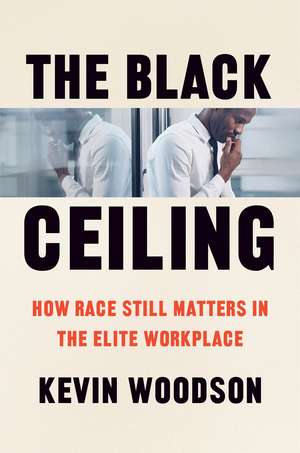
The Black Ceiling: How Race Still Matters in the Elite Workplace
Autor Kevin Woodsonen Limba Engleză Hardback – 17 noi 2023
Folosind ca bază de date interviurile aprofundate cu peste o sută de specialiști din domenii de prestigiu, The Black Ceiling oferă o perspectivă sociologică riguroasă asupra barierelor invizibile din mediile profesionale de elită. Autorul Kevin Woodson, el însuși profesor de drept și sociolog cu experiență în firme de avocatură de top, propune o schimbare de paradigmă: eșecul diversității în corporații nu este cauzat doar de discriminarea directă, ci de un „disconfort rasial” sistemic. Credem că această distincție este esențială pentru înțelegerea motivului pentru care programele actuale de training eșuează adesea.
Structura volumului ghidează cititorul de la mecanismele discriminării instituționale spre o analiză fină a culturii organizaționale „albe” și a impactului acesteia asupra sănătății psihice și traiectoriei de carieră a minorităților. Comparabil cu You Don't Look Like a Lawyer în rigurozitate, dar actualizat pentru a include o sferă mai largă de industrii (nu doar dreptul, ci și finanțele și consultanța), volumul lui Woodson investighează cum alienarea socială și teama de a fi stigmatizat devin obstacole insurmontabile. Găsim în capitolul final o direcție constructivă, autorul oferind pași concreți pentru lideri și organizații de a depăși simpla retorică a incluziunii. Este o lucrare esențială pentru cei care doresc să înțeleagă de ce, în ciuda eforturilor de recrutare, rata de retenție și promovare a profesioniștilor de culoare rămâne disproporționat de scăzută față de cea a colegilor lor albi.
Preț: 141.27 lei
Carte disponibilă
Livrare economică 31 octombrie-14 noiembrie
Livrare express 20-24 octombrie pentru 60.67 lei
Specificații
ISBN-10: 0226828727
Pagini: 216
Ilustrații: 3 line drawings, 1 table
Dimensiuni: 140 x 216 x 23 mm
Greutate: 0.39 kg
Ediția:First Edition
Editura: University of Chicago Press
Colecția University of Chicago Press
V-ar putea interesa
-
 I Met Lucky PeopleYaron Matras-19%Preț: 62.70 lei77.68 lei
 -
 The Southern Redneck: A Phenomenological Class StudyJulian B. Roebuck-31%Preț: 449.27 lei653.25 lei
 -
 Coping with Cultural and Racial Diversity in Urban AmericaWallace Lambert-40%Preț: 471.98 lei789.74 lei
 -
 Language and Muslim ChildhoodsGarcia-Sanchez-8%Preț: 652.54 lei709.28 lei
 -
 -18%Preț: 1121.44 lei1367.62 lei
 -
 The Handbook of Chicana/o Psychology and Mental HealthRoberto J. Velasquez-15%Preț: 577.64 lei679.59 lei
 -
 Race and Politics in North Carolina, 1872-1901Eric AndersonPreț: 215.63 lei
 -
 Crossing the LineLinda ValdezPreț: 124.76 lei
 -
 A Nation of NationsTom GjeltenPreț: 107.57 lei
 -
 No, Really, Where Are You From?Miss Nancy NgPreț: 124.62 lei
 -
 Jewish Community of West PhiladelphiaAllen MeyersPreț: 230.57 lei
 -
 Italians in HaverhillPatricia Trainor O'MalleyPreț: 223.19 lei
 -
 Assyrians in ChicagoVasili ShoumanovPreț: 220.61 lei
 -
 ChinkHenry Woongjae KongPreț: 147.94 lei
 -
 Preț: 149.46 lei
 -
 Swedes in the Twin CitiesPhilip J. AndersonPreț: 162.08 lei
 -
 Preț: 130.87 lei
 -
 Multiculturalism in Quebec. Die Besonderheiten Der ProvinzMoller, Kay-ChristinaPreț: 232.81 lei
De ce să citești această carte
Recomandăm această carte liderilor de organizații, managerilor HR și studenților interesați de sociologia muncii. Cititorul va câștiga o înțelegere profundă a conceptului de „disconfort rasial” și va descoperi de ce politicile clasice anti-discriminare nu sunt suficiente. Este un instrument valoros pentru oricine dorește să construiască un mediu de lucru cu adevărat echitabil, oferind soluții practice bazate pe date empirice, nu doar pe teorie.
Despre autor
Kevin Woodson este sociolog și profesor de drept, specializat în dinamica rasială din mediile profesionale de înalt statut. Cu o educație solidă și experiență directă în firme de avocatură de elită, Woodson îmbină rigoarea academică cu observația participativă. Expertiza sa se concentrează pe intersecția dintre drept, sociologie și inegalitate, fiind o voce autorizată în dezbaterile actuale despre diversitate și incluziune în sectorul corporativ american. Prin The Black Ceiling, el valorifică atât cercetarea de teren, cât și propria experiență pentru a deconstrui mecanismele excluderii sociale.
Descriere scurtă
America’s elite law firms, investment banks, and management consulting firms are known for grueling hours, low odds of promotion, and personnel practices that push out any employees who don’t advance. While most people who begin their careers in these institutions leave within several years, work there is especially difficult for Black professionals, who exit more quickly and receive far fewer promotions than their White counterparts, hitting a “Black ceiling.”
Sociologist and law professor Kevin Woodson knows firsthand what life at a top law firm feels like as a Black man. Examining the experiences of more than one hundred Black professionals at prestigious firms, Woodson discovers that their biggest obstacle in the workplace isn’t explicit bias but racial discomfort, or the unease Black employees feel in workplaces that are steeped in Whiteness. He identifies two types of racial discomfort: social alienation, the isolation stemming from the cultural exclusion Black professionals experience in White spaces, and stigma anxiety, the trepidation they feel over the risk of discriminatory treatment. While racial discomfort is caused by America’s segregated social structures, it can exist even in the absence of racial discrimination, which highlights the inadequacy of the unconscious bias training now prevalent in corporate workplaces. Firms must do more than prevent discrimination, Woodson explains, outlining the steps that firms and Black professionals can take to ease racial discomfort.
Offering a new perspective on a pressing social issue, The Black Ceiling is a vital resource for leaders at preeminent firms, Black professionals and students, managers within mostly White organizations, and anyone committed to cultivating diverse workplaces.
Notă biografică
Extras
Deborah’s career trajectory unfortunately is all too common for Black professionals working at large White firms. America’s elite professional services firms—its preeminent law firms, investment banks, and management consultant firms—can be difficult workplaces for employees of all races. Between the long, sometimes stressful hours, the low odds of promotion, the often unrewarding work assignments, and the up-or-out personnel practices, most professionals who begin their careers in these institutions leave within a few years. But although careers in these firms can be challenging for all professionals of all races, they are especially difficult for Black professionals. Black professionals leave these firms more quickly and receive far fewer promotions than their White counterparts.
As a result, they remain highly underrepresented in senior positions. As of 2021, the partnerships at Cravath, Swaine & Moore LLP and Skadden, Arps, Slate, Meagher & Flom LLP—two of the most prestigious law firms in the country—were each only 2 percent Black, up from 0 and 1 percent, respectively, in 2019. Other top law firms reported similarly disappointing numbers; some have no Black partners at all. Firms in other industries do not share their diversity statistics as openly as law firms do, but the data available for those professions do not appear to be any more encouraging. At Goldman Sachs, the nation’s preeminent investment bank, only 3 percent of executives, senior officials, and managers were Black as of 2021. Other banks, including Morgan Stanley (3 percent) and JPMorgan Chase (5 percent) also reported low percentages of Black senior professionals.
The difficulties facing Black professionals and the ongoing racial disparities at elite firms have been the subject of extensive coverage in scholarly and popular publications. But in reflecting on her law firm career, Deborah offered a new perspective not captured in these works. While many writings on the tribulations of Black professionals have focused in particular on the possible contributing role of racial bias—the positive and negative assessments and feelings people have regarding racial groups and their members—Deborah made clear that she did not attribute her problems to racial bias.10 Instead, Deborah described her difficulties as “more cultural than anything.” She spoke of certain social and cultural dynamics within her firm that she believed posed unique challenges for her as a racial outsider. She found that the cultural norms at the firm seemed to revolve around certain experiences, values, and lifestyles most common among affluent White Americans. She explained, “The corporate culture itself is based on White shit— [I’m] just being honest. It is more class too, but it just happens to fall in line with Whiteness.” She watched some of her White peers develop rapport with clients and influential colleagues with ease while she struggled to forge similar connections. She found engaging her senior colleagues in conversation difficult: her attempts to initiate small talk were generally awkward and unsuccessful, compounding her sense of alienation. She attributed these difficulties to differences between Black attorneys’ personal backgrounds and cultural repertoires and those of their White colleagues and clients. With evident frustration, Deborah observed that “the powers that be” evaluated associates through implicitly “cultural” criteria that placed her at a disadvantage. “There’s some part of the culture that I am not grasping,” she explained. “There are tons of things that come easy to some people and don’t come easy to me.” These interpersonal difficulties tarnished her professional image. During a recent performance review she had learned that partners in her group questioned whether she was engaged in her work or interested in a long-term career at the firm, a perception that she attributed in part to her lack of interpersonal rapport with them.
Cuprins
Chapter 1: Institutional Discrimination at Elite Firms
Chapter 2: The Dangers of Dodging Discrimination
Chapter 3: White Culture and Black Professionals
Chapter 4: Why Some Black Professionals Thrive
Conclusion: A New Understanding of Inequality at Elite Firms
Acknowledgments
Appendix A: Data and Methods
Appendix B: List of Respondents
Notes
References
Recenzii
“Woodson’s perceptive and well-researched new book, The Black Ceiling: How Race Still Matters in the Elite Workplace, marks an inflection point for legal education, employment discrimination scholarship, civil rights litigation, and the legal services industry, particularly BigLaw firms. . . . By interweaving theories of discrimination from the fields of cultural sociology, organizational studies, and social psychology, he carves out new pathways to remedy racial inequality within both for-profit and nonprofit organizations.”
“The Black Ceiling is a candid and valuable book that makes clear that we must move beyond the sole explanation of interpersonal racial bias if we want to gain a fuller picture of the obstacles relevant to the underrepresentation of Black professionals in elite jobs. As such, it should be read widely by students, Black professionals, and the professional service firms that seek to recruit them.”