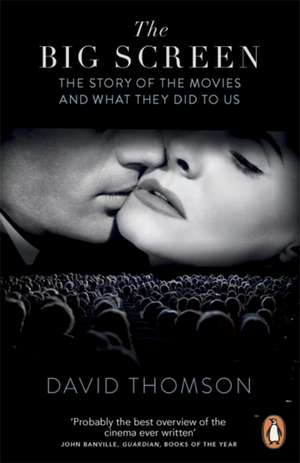
Big Screen
Autor David Thomsonen Limba Engleză Paperback – 3 oct 2013
Observăm în The Big Screen o coregrafie fascinantă între rigoarea analizei istorice și fluiditatea unei narațiuni despre condiția umană în era digitală. David Thomson nu ne propune o simplă cronologie a cinematografiei, ci un dialog profund între text și imaginea care a definit secolul XX. Eseurile sale reinterpretează arta cinematografică nu doar ca divertisment, ci ca un mecanism tehnologic care a reușit să ne schimbe percepția asupra realității, transformând spectatorul dintr-un martor activ într-un cetățean adesea captiv în fața ecranului. Apreciem modul în care autorul urmărește firul roșu de la primele experimente ale lui Muybridge până la dominația ecranelor portabile de astăzi, oferind o perspectivă senzorială asupra modului în care „privitul” a devenit o activitate centrală a existenței noastre. Pe raftul de artă, alături de Film de Michael Wood, acest volum se distinge prin anvergura sa enciclopedică și prin tonul personal, aproape confesiv, al lui Thomson. În timp ce alte lucrări se concentrează pe tehnica narativă, The Big Screen explorează impactul psihologic și social al mediului. Această abordare continuă preocupările autorului din A Light in the Dark, unde analiza regizorală era centrală, dar aici mizele sunt mult mai mari: este vorba despre biografia unui mediu care ne-a învățat cum să trăim, cum să iubim și, uneori, cum să evadăm din responsabilitățile vieții cotidiene. Experimentăm, prin lectura celor peste 600 de pagini, o călătorie vivace prin carierele unor titani precum Renoir sau Mizoguchi, totul sub egida unei întrebări esențiale: ne eliberează ecranul sau ne hipnotizează definitiv?
Preț: 90.99 lei
Preț vechi: 123.67 lei
-26%
Carte disponibilă
Livrare economică 20 noiembrie-01 decembrie
Livrare express 03-07 noiembrie pentru 63.51 lei
Specificații
ISBN-10: 0141047127
Pagini: 624
Dimensiuni: 128 x 198 x 35 mm
Greutate: 0.45 kg
Editura: Penguin Books
Locul publicării:London, United Kingdom
V-ar putea interesa
-
 Silver ScreensJane CrowtherPreț: 163.80 lei
 -
 Reading the Silver ScreenThomas C FosterPreț: 112.45 lei
 -
 The Fatal AllianceDavid ThomsonPreț: 192.72 lei
 -
 The Good, The Bad and The MultiplexMark Kermode-17%Preț: 65.57 lei79.43 lei
 -
 Ways of SeeingJohn BergerPreț: 78.02 lei
 -
 How to See the WorldNicholas Mirzoeff-19%Preț: 63.66 lei78.81 lei
 -
 Film: A Very Short IntroductionMichael Wood-19%Preț: 57.23 lei70.82 lei
 -
 But Is It Art?: An Introduction to Art TheoryCynthia Freeland-18%Preț: 89.70 lei109.04 lei
 -
 Thoughtful Cinema: Illustrating Philosophy Through FilmThomas E. Wartenberg-21%Preț: 168.74 lei212.95 lei
 -
 Preț: 266.00 lei
 -
 Preț: 153.55 leiRecomandat
 -
 What Art IsArthur C. DantoPreț: 105.25 lei
 -
 Disaster Mon AmourDavid ThomsonPreț: 141.19 lei
 -
 Remotely: Travels in the Binge of TVDavid ThomsonPreț: 162.37 lei
 -
 The Mysteries of CinemaPeter ConradPreț: 191.44 lei
 -
 PsychocinemaHelen RollinsPreț: 87.93 lei
 -
 50 Film Ideas You Really Need to KnowHelen O’Hara-28%Preț: 50.70 lei70.25 lei
 -
 How to Watch a MovieDavid Thomson-19%Preț: 74.94 lei92.60 lei
 -
 The Future of TruthWerner HerzogPreț: 106.62 lei
 -
 100 Movies of the 2010sJürgen MüllerPreț: 454.86 lei
De ce să citești această carte
Recomandăm această carte oricărui pasionat de cinema care dorește să înțeleagă dincolo de estetica unui cadru. Cititorul câștigă o perspectivă critică asupra modului în care tehnologia ecranului ne influențează deciziile și stările emoționale. Este o lectură densă, scrisă de unul dintre cei mai respectați critici ai momentului, ideală pentru a decoda cultura vizuală contemporană și pentru a redescoperi istoria filmului dintr-un unghi sociologic și filosofic.
Despre autor
David Thomson este unul dintre cei mai importanți critici de film contemporani, cunoscut la nivel internațional pentru volumul de referință 'The New Biographical Dictionary of Film'. Cu o carieră începută în Marea Britanie și continuată în Statele Unite, Thomson a colaborat constant cu publicații prestigioase precum The Guardian și The New York Times. Opera sa este marcată de o versatilitate rară, scriind atât critică cinematografică pură, cât și ficțiuni inspirate de universul filmului noir, precum 'Suspects'. Experiența sa vastă, ce include și producția de documentare pentru BBC, îi conferă o autoritate incontestabilă în analiza fenomenului vizual modern.
Notă biografică
Recenzii
A devilish, dazzling, out-there divination ... Criticism is rarely this passionate and brilliant. You come away wanting to watch it all
David Thomson is a giant in the world of film criticism, and his book is the chest-crusher you might expect: erudite, delightfully tangential and surprisingly polemical
Thomson has composed a grand aesthetic, spiritual, and moral account of cinema history assembled around the movies and artists that have meant the most to him. As Thomson reconstructs film history, movies bring us close to reality and deliver us into ecstatic dreams. A pungently written, brilliant book
The theme of The Big Screen is the weirdness of desire ... Drawing on his vast stock of knowledge, Thomson takes us on a meander through Nouvelle Vague and Italian neorealism; Coppola and Scorsese; MGM musicals and film noir. He always comes back in the end to the kind of fun it is possible to have only at the movies, sitting in the dark, staring at the light ... Line by line, Thomson is still the greatest biographical writer about film of all time ... to read him on his favourite films is to be sent back with renewed yearning to that land of Californian light and loveliness
Subtle, erudite and entertaining
Fascinating ... a loose-limbed, conversational narrative, moving fitfully through time, dawdling over directors and films that interest ... crackling with ideas and vivid impressionisms ... Thomson's stylish prose, simultaneously erudite and entertaining, captivates as it informs ... Buffs and casual fans alike will enjoy this extra-large serving of popcorn for thought
The greatest living writer on the movies ... The Big Screen is surely his magnum opus
Rigorous and rewarding, and a page rarely passes without insight
Nobody else would match its sweep, its erudition, its discernment or its warmth
There are always irreverent arguments about the status of filmmaking in David Thomson's writing: "Story ideas hang around in Hollywood longer than some marriages or buildings." Or "It would be said of British cinema that it was nothing until a band of Hungarians took it over." This goes alongside his real passion for the art: On Sweet Smell of Success - "The film was shot in a glittering harsh black and white by James Wong Howe and looked like the hide of a crocodile in the moonlight." On Colonel Blimp - "There is one scene of Deborah Kerr with auburn hair and in a cornflower blue dress, in shadow and firelight, that must be among the most romantic shots made during the war. No one in Britain before had seen that you could make a film because you were crazy about a girl."
David Thomson is, I think, the best writer on film in our time. If Have you Seen? was his most succinct and entertaining book, The Big Screen is a large and vivacious map on the history of 'the screen': beginning with Muybridge and then tracing careers ranging from Korda to Renoir to Hawkes to Mizoguchi, to David Lynch and Tarentino, then swerving over to television shows such as I love Lucy and The Sopranos. He has found and created a marvellous plot for the history of film with insights and revelations on every page, as well as a few mcguffins. He is our most argumentative and trustworthy historian of the screen
A great critic cuts both ways - he nudges you into reconsidering the films you love, as well as the ones you dislike. David Thomson's sensual prose has always amplified the imagination of a great critic. In broad outline, The Big Screen is a history of the movies, a wide-ranging task which usually carries with it a certain amount of connect-the-dots tedium. But Thomson's emphases are typically fresh and often ecstatic, even when he's disparaging a film you love. Nobody does it better
Of the medium's many distinguished critics, none is better informed or more authoritative than David Thomson ... [The Big Screen is] part film history, part thesis, part love letter and lament ... genuine insights abound ... Like any great work of criticism, the book is essentially an education in good taste, and crucially it sends us back to the movies. Thomson's montage of ecstasies and laments re-awakens in us the thrill and wonder of moving images and the need to know what happens next. In that, it is as close to definitive as any book on film can be. Just as we look at the movies, we should listen to him
David Thomson is a metaphysician of the movies ... Thomson's brain is the ultimate repertory theatre, perpetually rerunning our favourites and allowing us to wonder at them all over again. The highest praise I can give him is to say that the images he treasures are just as alive on his pages as they were on the big screen
A love letter to a dying art, [The Big Screen] is also a scathing indictment of its legacy. In over 500 pages of breathtaking criticism, [Thomson] seeks to understand the impact of the screen upon our collective consciousness
A cultural overview of the past, present and future of the movies
This is a wildly seductive love letter to what Thomson concludes is a 'lost love' ... he rapturously recalls a lifetime's enchantment with the big screen
A startling analysis of what happens to us in the darkness as we dream with eyes open
There's one standout in this year's slew of film literature, The Big Screen written by David Thomson, a giant in the world of film criticism. His book is erudite but readable, delightfully tangential, and surprisingly polemical. He provides a fascinating ride through the past century of mostly American cinema and posits a theory that 'the shining light and the huddled masses' of yore will be replaced by digital anomie, as the big screen is replaced by YouTube on an iPhone
[The Big Screen] works both as an engaging primer on film history and as a map for more numinous shifts in the path of popular art ... Thomson offers a nuanced portrait ... the details of his narrative glimmer with offbeat insight
Descriere scurtă
Sunday Times, New Statesman, The Times, Guardian, Observer and Independent BOOKS OF THE YEAR
Taking us around the globe, through time and across multiple media, Thomson tracks the ways in which we were initially enchanted by this mesmerizing imitation of life and let movies - the stories, the stars, the look - show us how to live. But at the same time he shows us how movies, offering a seductive escape from the everyday reality and its responsibilities, have made it possible for us to evade life altogether. The entranced audience has become a model for powerless citizens trying to pursue happiness by sitting quietly in a dark room. Does the big screen take us out into the world, or merely mesmerize us? That is Thomson's question in this great adventure of a book. A passionate feat of storytelling that is vital to anyone trying to make sense of the age of screens - the age that, more than ever, we are living in.
Descriere
The definitive story of the medium that defines our times
"The Big Screen "tells the enthralling story of the movies: their rise and spread, their remarkable influence over us, and the technology that made the screen as important as the images it carries.
But "The Big Screen "is not another history of the movies. Rather, it is a wide-ranging narrative about the movies and their signal role in modern life. The celebrated film authority David Thomson takes us around the globe, through time, and across many media to tell the complex, gripping, paradoxical story of the movies. He tracks the ways we were initially enchanted by movies as imitations of life--the stories, the stars, the look--and how we allowed them to show us how to live. At the same time, movies, offering a seductive escape from everyday reality and its responsibilities, have made it possible for us to evade life altogether. The entranced audience has become a model for powerless and anxiety-ridden citizens trying to pursue happiness and dodge terror by sitting quietly in a dark room.
Does the big screen take us out into the world or merely mesmerize us? That is Thomson's question in this grand adventure of a book, vital to anyone trying to make sense of the age of screens--the age that, more than ever, we are living in.