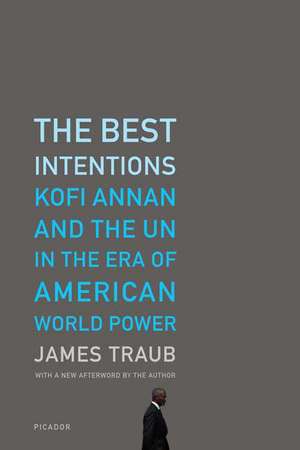
The Best Intentions
Autor James Trauben Limba Engleză Paperback – oct 2007
Updated for the Paperback Edition
For most of his career as secretary-general of the United Nations, Kofi Annan was the embodiment of the institution's best elements: A Nobel Prize winner, gracious, even-handed, and brilliant, he was considered one of the best ever to hold the position. By the end, after genocide in Darfur, the Oil For Food scandal and war in Iraq, many felt the UN had failed its constituents too many times to forgive, and Annan had nearly been forced from office.
Did the U.N.'s failures arise from its own structure and culture, or from a clash with an American administration determined to go its own way in defiance of world opinion?
In The Best Intentions, New York Times Magazine writer James Traub traces the intertwined histories of Kofi Annan and the U.N. from 1992 to the present. In Annan he sees a conscientious idealist given too little credit for advancing causes like humanitarian intervention, an honest broker crushed between American conservatives and Third World opponents. But he also describes a U.N. careerist, a bureaucrat who has absorbed the institutional culture and can not, in the end, escape its limitations.
Preț: 206.07 lei
Puncte Express: 309
Carte disponibilă
Livrare economică 26 octombrie-09 noiembrie
Livrare prin curier în România Termenul estimat este afișat lângă disponibilitate.
Transport gratuit de la 400.00 lei Plată online sau ramburs, în funcție de opțiunile comenzii.
Retur gratuit în 14 zile Comandă securizată și suport în română.
Specificații
ISBN-13: 9780312426743
ISBN-10: 0312426747
Pagini: 528
Dimensiuni: 140 x 216 x 31 mm
Greutate: 0.74 kg
Editura: St. Martins Press-3pl
ISBN-10: 0312426747
Pagini: 528
Dimensiuni: 140 x 216 x 31 mm
Greutate: 0.74 kg
Editura: St. Martins Press-3pl
Notă biografică
James Traub has been a contributing writer for The New York Times Magazine since 1998. He has written three books, including City on a Hill and The Devil's Playground. He lives in New York City.
Descriere
Traub recounts the dramatically entwined history of Kofi Annan and the U.N. from 1992 to the present. In Annan he sees a conscientious idealist given too little credit for advancing causes like humanitarian intervention, an honest broker crushed between American conservatives and Third World opponents, and a U.N. careerist who has absorbed that culture and cannot, in the end, escape its limitations.