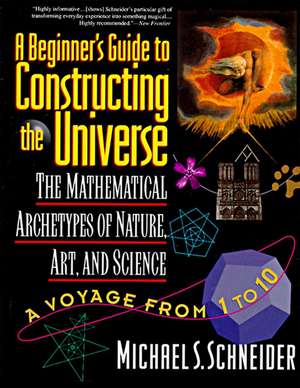
The Beginner's Guide to Constructing the Universe
Autor Michael S Schneideren Limba Engleză Paperback – 29 sep 1995
În această ediție a lucrării The Beginner's Guide to Constructing the Universe, observăm o abordare sistematică a modului în care secvențele matematice și tiparele geometrice guvernează realitatea înconjurătoare. Deși nu este un manual tehnic, volumul reușește să sintetizeze observațiile anticilor despre limbajul designului geometric, aplicându-le pe structuri diverse, de la arhitectura catedralelor până la biologia microscopică. Suntem de părere că forța acestui text rezidă în capacitatea de a face vizibil ceea ce este adesea ignorat: ordinea matematică din spatele haosului aparent al naturii. Textul este îmbogățit cu ilustrații și fotografii alb-negru care servesc drept demonstrații vizuale pentru conceptele de rezonanță și simbolism numeric. Schneider, în calitate de scriitor pe teme educaționale, evită jargonul arid, preferând o expunere care îmbină rigoarea științifică cu perspectiva filozofică. Această ediție pune un accent deosebit pe continuitatea dintre lumea naturală și creația umană, evidențiind modul în care formele geometrice fundamentale reapar constant sub diverse înfățișări. Considerăm această lucrare o alternativă viabilă la Nature's Numbers de Ian Stewart pentru cursurile de introducere în estetica matematică sau filozofia științei. Față de abordarea lui Ian Stewart, care se concentrează pe deducția matematică a structurilor naturale, The Beginner's Guide to Constructing the Universe aduce avantajul unei perspective holistice, integrând simbolismul cultural și istoria artei în analiza formelor geometrice. De asemenea, dacă o comparăm cu Patterns in Nature de Philip Ball, lucrarea lui Schneider este mai orientată spre latura hermeneutică și spre înțelegerea principiilor de construcție universală, fiind accesibilă oricărui cititor curios, indiferent de pregătirea academică.
Preț: 122.54 lei
Carte disponibilă
Livrare economică 05-19 noiembrie
Specificații
ISBN-10: 0060926716
Pagini: 384
Dimensiuni: 187 x 237 x 27 mm
Greutate: 0.51 kg
Editura: Harpercollins
V-ar putea interesa
-
 Here Is a Human BeingMisha AngristPreț: 106.82 lei
 -
 X-EventsJohn L. CastiPreț: 109.27 lei
 -
 The Science of InterstellarKip ThornePreț: 164.00 lei
 -
 -28%Preț: 65.90 lei91.18 lei
 -
 FreedomJeremy GriffithPreț: 128.50 lei
 -
 Das geheime Leben der BäumePeter WohllebenPreț: 138.01 lei
De ce să citești această carte
Această carte se adresează celor care doresc să descopere ordinea ascunsă a lumii fără a fi intimidați de formule complexe. Cititorul câștigă o nouă perspectivă asupra realității, învățând să recunoască tiparele geometrice în artă, natură și arhitectură. Este un instrument esențial pentru a înțelege cum principiile matematice simple se manifestă în cele mai complexe structuri ale universului.
Despre autor
Michael S Schneider este un autor specializat în educație și consultant în domeniul tehnologiei, recunoscut pentru capacitatea sa de a traduce concepte abstracte în limbaj accesibil. Cu o experiență vastă în analiza tiparelor geometrice și a simbolismului matematic, el a reușit să creeze o punte între științele exacte și disciplinele umaniste. Lucrarea sa de referință reflectă interesul său profund pentru modul în care natura și cultura umană sunt interconectate prin limbajul universal al geometriei, oferind cititorilor o viziune integrată asupra cosmosului.
Descriere scurtă
You need not be a philosopher or a botanist, and certainly not a mathematician, to enjoy the bounty of the world around us. But is there some sort of order, a pattern, to the things that we see in the sky, on the ground, at the beach? In A Beginner's Guide to Constructing the Universe, Michael Schneider, an education writer and computer consultant, combines science, philosophy, art, and common sense to reaffirm what the ancients observed: that a consistent language of geometric design underpins every level of the universe, from atoms to galaxies, cucumbers to cathedrals. Schneider also discusses numerical and geometric symbolism through the ages, and concepts such as periodic renewal and resonance. This book is an education in the world and everything we can't see within it.
Contains numerous b&w photos and illustrations.
Textul de pe ultima copertă
But It's No Secret
Michael Schneider leads us on a spectacular, lavishly illustrated journey along the numbers one through ten to explore the mathematical principles made visible in flowers, shells, crystals, plants, and the human body, expressed in the symbolic language of folk sayings and fairy tales, myth and religion, art and architecture. This is a new view of mathematics, not the one we learned at school but a comprehensive guide to the patterns that recur through the universe and underlie human affairs. A Beginner's Guide to Constructing, the Universe shows you:
- Why cans, pizza, and manhole covers are round.
- Why one and two weren't considered numbers by the ancient Greeks.
- Why squares show up so often in goddess art and board games.
- What property makes the spiral the most widespread shape in nature, from embryos and hair curls to hurricanes and galaxies.
- How the human body shares the design of a bean plant and the solar system.
- How a snowflake is like Stonehenge, and a beehive like a calendar.
- How our ten fingers hold the secrets of both a lobster and a cathedral.
- And much more.
Notă biografică
Michael S. Schneider is an educator developing new perceptions of nature, science, art, and mathematics, holding workshops for teachers, artists, architects, and children concerning nature's numerical language. He has a Bachelor of Science degree in Mathematics from the Polytechnic Institute of Brooklyn and a Master's Degree in Math Education from the University of Florida. He was a Fulbright-Hayes Scholar in India and taught in public schools for eleven years. An education writer and computer consultant, he designed the geometry harmonizing the statues at the entrance to the Cathedral of St. John the Divine in New York City, where he lives.