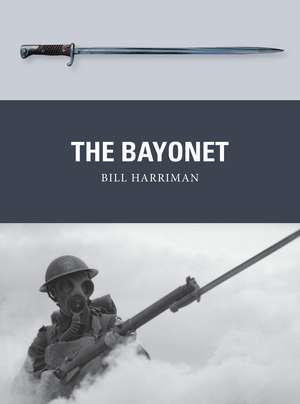
The Bayonet: Weapon
Autor Bill Harriman Ilustrat de Adam Hook, Alan Gillilanden Limba Engleză Paperback – 15 apr 2021
Featuring specially commissioned color artwork and drawing upon a range of sources, this engaging study casts new light on the origins, development, construction, and use of the bayonet in warfare from the mid-17th century onwards.
Although muskets delivered devastating projectiles at comparatively long ranges, their slow rate of fire left the soldier very vulnerable while reloading, and early muskets were useless for close-quarter fighting. Consequently, European infantry regiments of the 17th century were composed of both musketeers and pikemen, who protected the musketeers while loading but also formed the shock component for close-quarter combat. The development of the flintlock musket produced a much less cumbersome and faster-firing firearm. When a short knife was stuck into its muzzle, every soldier could be armed with a missile weapon as well as one that could be used for close combat. The only disadvantage was that the musket could not be loaded or fired while the plug bayonet was in place. The socket bayonet solved this problem and the musket/bayonet combination became the universal infantry weapon from c.1700 to c.1870.
The advent of shorter rifled firearms saw the attachment of short swords to rifle barrels. Their longer blades still gave the infantryman the "reach" that contemporaries believed he needed to fend off cavalry attacks. The perfection of the small-bore magazine rifle in the 1890s saw the bayonet lose its tactical importance, becoming smaller and more knife-like, a trend that continued in the world wars. When assault rifles predominated from the 1950s onwards, the bayonet became a weapon of last resort. Its potential usefulness continued to be recognized, but its blade was often combined with an item with some additional function, most notably a wire-cutter.
Ultimately, for all its fearsome reputation as a visceral, close-quarter fighting weapon, the bayonet's greatest impact was actually as a psychological weapon. Featuring full-color artwork as well as archive and close-up photographs, this is the absorbing story of the complementary weapon to every soldier's firearm from the army of Louis XIV to modern-day forces in all global theaters of conflict.
Din seria Weapon
- 35%
 Preț: 74.35 lei
 - 35%
 Preț: 74.38 lei
 - 27%
 Preț: 81.83 lei
 - 27%
 Preț: 84.12 lei
 - 27%
 Preț: 83.68 lei
 - 26%
 Preț: 85.09 lei
 - 31%
 Preț: 79.66 lei
 - 26%
 Preț: 84.55 lei
 - 27%
 Preț: 78.88 lei
 - 26%
 Preț: 73.91 lei
 - 31%
 Preț: 78.84 lei
 - 35%
 Preț: 73.98 lei
 - 27%
 Preț: 83.78 lei
 - 27%
 Preț: 84.12 lei
 - 31%
 Preț: 78.80 lei
 - 26%
 Preț: 79.27 lei
 - 27%
 Preț: 78.61 lei
 - 27%
 Preț: 82.30 lei
 - 40%
 Preț: 84.05 lei
 - 26%
 Preț: 79.23 lei
 - 27%
 Preț: 78.80 lei
 - 35%
 Preț: 69.10 lei
 - 27%
 Preț: 83.43 lei
 - 27%
 Preț: 84.12 lei
 - 26%
 Preț: 74.15 lei
 - 27%
 Preț: 83.73 lei
 - 31%
 Preț: 78.94 lei
 - 26%
 Preț: 84.69 lei
 - 26%
 Preț: 73.91 lei
 - 26%
 Preț: 73.98 lei
 - 26%
 Preț: 85.33 lei
 - 44%
 Preț: 69.08 lei
 - 31%
 Preț: 84.37 lei
 - 43%
 Preț: 69.91 lei
 - 32%
 Preț: 84.16 lei
 - 31%
 Preț: 84.86 lei
 - 31%
 Preț: 84.45 lei
 - 31%
 Preț: 84.59 lei
 - 31%
 Preț: 85.11 lei
 - 35%
 Preț: 79.66 lei
 - 31%
 Preț: 84.98 lei
 - 32%
 Preț: 84.12 lei
 - 32%
 Preț: 84.12 lei
 - 39%
 Preț: 74.86 lei
 - 31%
 Preț: 84.63 lei
 - 31%
 Preț: 79.28 lei
 - 31%
 Preț: 84.55 lei
 - 31%
 Preț: 84.59 lei
 - 35%
 Preț: 79.71 lei
Preț: 73.95 lei
Preț vechi: 100.49 lei
-26%
Carte disponibilă
Livrare economică 16-30 noiembrie
Livrare express 30 octombrie-05 noiembrie pentru 48.69 lei
Specificații
ISBN-10: 1472845366
Pagini: 80
Ilustrații: Colour artwork plates; black & white and colour photographs and illustrations
Dimensiuni: 180 x 246 x 2 mm
Greutate: 0.26 kg
Editura: Bloomsbury Publishing
Colecția Osprey Publishing
Seria Weapon
Locul publicării:London, United Kingdom
V-ar putea interesa
-
 Percussion Pistols and RevolversMike CumpstonPreț: 100.00 lei
 -
 A Guide to 3rd Reich Cutlery, Its Monograms, Logos, and Maker MarksA. Yannes James a. YannesPreț: 177.05 lei
 -
 The Painting on the Window Blind,Neil DavisPreț: 71.71 lei
 -
 The Medieval LongswordNeil Grant-39%Preț: 75.58 lei123.13 lei
 -
 The Cavalry LanceAlan Larsen-44%Preț: 69.08 lei122.62 lei
 -
 Weapons of the Viking WarriorGareth Williams-27%Preț: 83.78 lei114.43 lei
 -
 The CrossbowMike Loades-27%Preț: 84.12 lei114.62 lei
 -
 The Sterling Submachine GunMatthew Moss-39%Preț: 74.86 lei123.10 lei
 -
 The Medieval Cannon 1326–1494Jonathan Davies-32%Preț: 66.84 lei98.96 lei
 -
 The Numidians 300 BC–AD 300William Horsted-37%Preț: 62.77 lei99.07 lei
 -
 Weapons of the Civil War CavalrymanJohn Walter-26%Preț: 73.91 lei100.49 lei
 -
 The M4 CarbineChris McNab-35%Preț: 73.98 lei114.40 lei
 -
 Early Military Rifles: 1740–1850Balázs Németh-39%Preț: 75.48 lei123.12 lei
 -
 -26%Preț: 74.05 lei100.55 lei
 -
 Lindner Carbines and RiflesEdward a. HullPreț: 92.88 lei
 -
 Roberts Breechloading FirearmsEdward HullPreț: 116.86 lei
 -
 Preț: 114.56 lei
 -
 SixgunsElmer KeithPreț: 182.51 lei
 -
 The Cossacks 1799–1815Laurence Spring-31%Preț: 79.19 lei114.90 lei
 -
 Yorktown 1781Brendan Morrissey-31%Preț: 90.49 lei131.21 lei
 -
 Greek Hoplite 480–323 BCNicholas Sekunda-31%Preț: 79.32 lei114.98 lei
 -
 Preț: 77.39 lei
 -
 Preț: 77.39 lei
 -
 Preț: 77.39 lei
 -
 Preț: 77.39 lei
 -
 What Lay Abouts Say about Kakashi HatakeAdam HookPreț: 77.39 lei
Descriere
The development of the flintlock musket produced a much less cumbersome and faster-firing firearm, which could be used for close combat with a short knife stuck into its muzzle. However, the musket could not be loaded or fired while the plug bayonet was in place. The socket bayonet solved this problem and the musket/bayonet combination became the universal infantry weapon from c.1700 to c.1870.
The perfection of the small-bore magazine rifle in the 1890s saw the bayonet lose its tactical importance, a trend that continued in the world wars. Its potential usefulness continued to be recognized from the 1950s, but its blade was often combined with an item with some additional function, most notably a wire-cutter.
Ultimately, for all its fearsome reputation as a visceral, close-quarter fighting weapon, the bayonet's greatest impact was actually as a psychological weapon. Featuring full-colour artwork as well as archive and close-up photographs, this is the absorbing story of the complementary weapon to every soldier's firearm from the army of Louis XIV to modern-day forces in all global theatres of conflict.
Cuprins
Development
Use
Impact
Conclusion
Glossary
Bibliography
Index