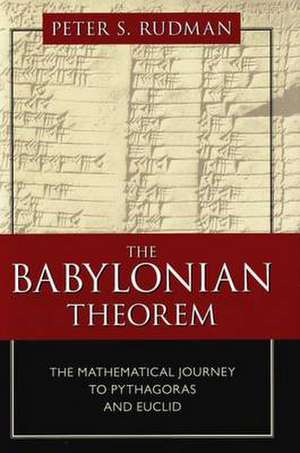
The Babylonian Theorem: The Mathematical Journey to Pythagoras and Euclid
Autor Peter S. Rudmanen Limba Engleză Hardback – 31 dec 2009
He also concludes that what enabled the Greek mathematicians to surpass their predecessors was the insertion of alphabetic notation onto geometric figures. Such symbolic notation was natural for users of an alphabetic language, but was impossible for the Babylonians and Egyptians, whose writing systems (cuneiform and hieroglyphics, respectively) were not alphabetic. Rudman intersperses his discussions of early math conundrums and solutions with "Fun Questions" for those who enjoy recreational math and wish to test their understanding. The Babylonian Theorem is a masterful, fascinating, and entertaining book, which will interest both math enthusiasts and students of history.
Preț: 193.97 lei
Puncte Express: 291
Preț estimativ în valută:
34.29€ • 40.67$ • 29.75£
34.29€ • 40.67$ • 29.75£
Carte tipărită la comandă
Livrare economică 11-25 martie
Specificații
ISBN-13: 9781591027737
ISBN-10: 159102773X
Pagini: 248
Ilustrații: b/w illus
Dimensiuni: 159 x 235 x 25 mm
Greutate: 0.46 kg
Editura: Prometheus Books
ISBN-10: 159102773X
Pagini: 248
Ilustrații: b/w illus
Dimensiuni: 159 x 235 x 25 mm
Greutate: 0.46 kg
Editura: Prometheus Books
Notă biografică
Peter S. Rudman (Tel Aviv, Israel), a retired professor of physics at the Technion-Israel Institute of Technology, is the author of How Mathematics Happened: The First 50,000 Years, which was selected in 2008 as an Outstanding Academic Text by the American Library Association.
Descriere
Rudman explores the facisnating history of mathematics among the Babylonians and Egyptians. He formulates a Babylonian Theorem, which he shows was used to derive the Pythagorean Theorem about a millennium before its purported discovery by Pythagoras.