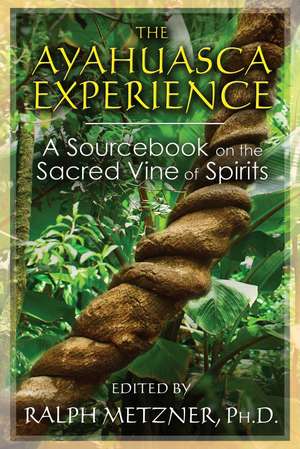
The Ayahuasca Experience: A Sourcebook on the Sacred Vine of Spirits
Editat de Ralph Metzner Ph.D.en Limba Engleză Paperback – 10 apr 2014
Preț: 69.70 lei
Preț vechi: 91.58 lei
-24%
Puncte Express: 105
Carte disponibilă
Livrare economică 13-25 noiembrie
Livrare express 24-30 octombrie pentru 45.35 lei
Livrare prin curier în România Termenul estimat este afișat lângă disponibilitate.
Transport gratuit de la 400.00 lei Plată online sau ramburs, în funcție de opțiunile comenzii.
Retur gratuit în 14 zile Comandă securizată și suport în română.
Specificații
ISBN-13: 9781620552629
ISBN-10: 1620552620
Pagini: 272
Ilustrații: 13 b&w illustrations
Dimensiuni: 152 x 229 x 15 mm
Greutate: 0.29 kg
Ediția:3rd Edition, New Edition of Sacred Vine of Spirits: Ayahuasca
Editura: Inner Traditions/Bear & Company
Colecția Park Street Press
ISBN-10: 1620552620
Pagini: 272
Ilustrații: 13 b&w illustrations
Dimensiuni: 152 x 229 x 15 mm
Greutate: 0.29 kg
Ediția:3rd Edition, New Edition of Sacred Vine of Spirits: Ayahuasca
Editura: Inner Traditions/Bear & Company
Colecția Park Street Press
V-ar putea interesa
-
 Entering the CircleOlga KharitidiPreț: 99.38 lei
 -
 Preț: 299.96 lei
 -
 Practical Ayurveda: Find Out Who You Are and What You Need to Bring Balance to Your LifeSivananda Yoga Vedanta Centre-19%Preț: 104.70 lei128.63 lei
 -
 Ayurveda: A Comprehensive Guide to Traditional Indian Medicine for the WestFrank John Ninivaggi-18%Preț: 370.70 lei452.05 lei
 -
 Tantric Yoga and the Wisdom GoddessesDavid FrawleyPreț: 98.40 lei
 -
 Preț: 125.53 lei
 -
 -5%Preț: 1584.53 lei1667.92 lei
 -
 Preț: 102.45 lei
 -
 Aura-Soma: Self-Discovery through ColorVicky Wall-25%Preț: 115.40 lei153.28 lei
 -
 -23%Preț: 107.58 lei140.14 lei
 -
 -21%Preț: 106.94 lei135.48 lei
 -
 -25%Preț: 74.91 lei99.63 lei
 -
 Magic Mushroom Explorer: Psilocybin and the Awakening EarthSimon G. Powell-23%Preț: 89.27 lei115.75 lei
 -
 Fight Parkinson's and Huntington's with Vitamins and AntioxidantsKedar N. Prasad Ph.D.-40%Preț: 77.13 lei127.69 lei
 -
 -24%Preț: 75.56 lei99.62 lei
 -
 Overcoming Acute and Chronic Pain: Keys to Treatment Based on Your Emotional TypeMarc S. Micozzi M.D., Ph.D.-40%Preț: 89.03 lei147.35 lei
 -
 Freedom from Constipation: Natural Remedies for Digestive HealthChristopher Vasey N.D.-42%Preț: 73.12 lei125.44 lei
 -
 -19%Preț: 75.78 lei93.55 lei
 -
 -29%Preț: 146.79 lei205.34 lei
 -
 -29%Preț: 146.88 lei206.05 lei
 -
 The Keys to the Universe CardsDiana CooperPreț: 74.75 lei
 -
 Marma Therapy: The Healing Power of Ayurvedic Vital Point MassageDr Ernst SchrottPreț: 151.08 lei
 -
 The Doors of Perception & Heaven and HellAldous Huxley-5%Preț: 48.06 lei50.59 lei
Notă biografică
Ralph Metzner (1936–2019) obtained his Ph.D. in Clinical Psychology at Harvard University, where he collaborated with Timothy Leary and Richard Alpert on psychedelic research. He was Professor Emeritus at the California Institute of Integral Studies in San Francisco and president and co-founder of the Green Earth Foundation. Dr. Metzner is the author of numerous books, including Overtones and Undercurrents, Searching for the Philosophers’ Stone, and Green Psychology.
Extras
INTRODUCTION
Amazonian Vine of Visions
Ralph Metzner, Ph.D.
Ayahuasca is an hallucinogenic Amazonian plant concoction that has been used by native Indian and mestizo shamans in Peru, Colombia, and Ecuador for healing and divination for hundreds, perhaps thousands, of years. It is known by various names in the different tribes, including caapi, natéma, mihi, and yagé. The name ayahuasca is from Quechua, a South American Indian language: huasca means “vine” or “liana” and aya means “souls” or “dead people” or “spirits.” Thus “vine of the dead,” “vine of the souls,” or “vine of the spirits” would all be appropriate English translations. It is however slightly misleading as a name, since the vine Banisteriopsis caapi is only one of two essential ingredients in the hallucinogenic brew, the other one being the leafy plant Psychotria viridis, which contains the powerful psychoactive dimethyltryptamine (DMT). It is the DMT, derivatives of which are also present in various other natural hallucinogens, including the magic mushroom of Mexico, that provides visionary experiences and thus access to the realm of spirits and the souls of deceased ancestors. DMT is not orally active but is metabolized by the stomach enzyme monoamine oxidase (MAO). Certain chemicals in the vine inhibit the action of MAO and are therefore referred to as MAO-inhibitors: their presence in the brew makes the psychoactive principle available and allows it to circulate through the bloodstream into the brain, where it triggers the visionary access to otherworldly realms and beings. The details of this remarkably sophisticated indigenous psychoactive drug delivery system, and the history of its discovery by science, will be described and explored in this volume.
As a plant drug or medicine, ayahuasca is one of a group of similar substances that defy classification: they include psilocybin derived from the Aztec sacred mushroom teonanácatl, mescaline derived from the Mexican and North American peyote cactus, DMT and various chemical relatives derived from South American snuff powders known as epena or cohoba, the infamous LSD derived from the ergot fungus that grows on grains, ibogaine derived from the root of the African Tabernanthe iboga tree, and many others. As plant extracts or synthesized drugs, these substances have been the subject of a large variety of scientific research approaches over the past fifty years, particularly as to their potential applications in psychotherapy, in the expansion of consciousness for the enhancement of creativity, and as amplifiers of spiritual exploration. They have been called psychotomimetic (“madness mimicking”), psycholytic (“psyche loosening”), psychedelic (“mind manifesting”), hallucinogenic (“vision inducing”), and entheogenic (“connecting to the sacred within”). The different terms reflect the widely differing attitudes and intentions, the varying set and setting with which these substances have been approached. We will be describing the Western scientific psychological and psychiatric approaches to ayahuasca in this book also.
The concepts of shaman and shamanism are not peculiar to South America; the terms themselves are derived from a Siberian language. In recent years they have come to be used for any practice of healing and divination that involves the purposive induction of an altered state of consciousness, called the “shamanic journey,” in which the shaman enters into “nonordinary reality” and seeks knowledge and healing power from spirit beings in those worlds. The two most widespread shamanic techniques for entering into this altered state are rhythmic drumming, practiced more in the Northern Hemisphere (Asia, America, and Europe), and hallucinogenic plants or fungi, practiced more in the tropics and particularly in Central and South America. Ayahuasca is widely recognized by anthropologists as being probably the most powerful and most widespread shamanic hallucinogen. In the tribal societies where these plants and plant preparations are used, they are regarded as embodiments of conscious intelligent beings that only become visible in special states of consciousness, and who can function as spiritual teachers and sources of healing power and knowledge. The plants are referred to as “medicines,” a term that means more than a drug: something like a healing power or energy that can be associated with a plant, a person, an animal, even a place. They are also referred to as “plant teachers,” and there are still extant traditions of many-years-long initiations and trainings in the use of these medicines.
Many Western-trained physicians and psychologists have acknowledged that these substances can afford access to spiritual or transpersonal dimensions of consciousness, even mystical experiences indistiguishable from classic religious mysticism, whether Eastern or Western. The new term entheogen attempts to recognize this element of access to sacred dimensions and states.
In several Brazilian churches using ayahuasca, we have seen the incorporation of an entheogenic or hallucinogenic plant extract as a sacrament--developing both syncretic and highly original forms of religious ceremony. These churches have thousands of followers, both in South America and in North America and Europe, and they are growing in numbers and influence. So here we have a substance that has profoundly affected the transformation of individuals now beginning to bring about something like a cultural transformation movement. These facets of the ayahuasca story will also be explored in this book.
As hundreds, perhaps thousands, of Westerners and Northerners have participated in shamanic practices involving ayahuasca (as well as other medicines and nondrug practices) and joined the ceremonies of the various ayahuasca churches, it has become clear that there is a profound discontinuity in fundamental worldview and values of traditional shamanistic societies and practitioners. A powerful resurgence of respectful and reverential attitudes toward the living Earth and all its creatures seems to be a natural consequence of explorations with visionary plant teachers. As such, this revival of entheogenic shamanism can be seen as part of a worldwide response to the degradation of ecosystems and the biosphere--a response that includes movements such as deep ecology, ecofeminism, bioregionalism, ecopsychology, herbal and natural medicine, organic farming, and others. In each of these movements there is a new awareness, or rather a revival of ancient awareness, of the organic and spiritual interconnectedness of all life on this planet.
Amazonian Vine of Visions
Ralph Metzner, Ph.D.
Ayahuasca is an hallucinogenic Amazonian plant concoction that has been used by native Indian and mestizo shamans in Peru, Colombia, and Ecuador for healing and divination for hundreds, perhaps thousands, of years. It is known by various names in the different tribes, including caapi, natéma, mihi, and yagé. The name ayahuasca is from Quechua, a South American Indian language: huasca means “vine” or “liana” and aya means “souls” or “dead people” or “spirits.” Thus “vine of the dead,” “vine of the souls,” or “vine of the spirits” would all be appropriate English translations. It is however slightly misleading as a name, since the vine Banisteriopsis caapi is only one of two essential ingredients in the hallucinogenic brew, the other one being the leafy plant Psychotria viridis, which contains the powerful psychoactive dimethyltryptamine (DMT). It is the DMT, derivatives of which are also present in various other natural hallucinogens, including the magic mushroom of Mexico, that provides visionary experiences and thus access to the realm of spirits and the souls of deceased ancestors. DMT is not orally active but is metabolized by the stomach enzyme monoamine oxidase (MAO). Certain chemicals in the vine inhibit the action of MAO and are therefore referred to as MAO-inhibitors: their presence in the brew makes the psychoactive principle available and allows it to circulate through the bloodstream into the brain, where it triggers the visionary access to otherworldly realms and beings. The details of this remarkably sophisticated indigenous psychoactive drug delivery system, and the history of its discovery by science, will be described and explored in this volume.
As a plant drug or medicine, ayahuasca is one of a group of similar substances that defy classification: they include psilocybin derived from the Aztec sacred mushroom teonanácatl, mescaline derived from the Mexican and North American peyote cactus, DMT and various chemical relatives derived from South American snuff powders known as epena or cohoba, the infamous LSD derived from the ergot fungus that grows on grains, ibogaine derived from the root of the African Tabernanthe iboga tree, and many others. As plant extracts or synthesized drugs, these substances have been the subject of a large variety of scientific research approaches over the past fifty years, particularly as to their potential applications in psychotherapy, in the expansion of consciousness for the enhancement of creativity, and as amplifiers of spiritual exploration. They have been called psychotomimetic (“madness mimicking”), psycholytic (“psyche loosening”), psychedelic (“mind manifesting”), hallucinogenic (“vision inducing”), and entheogenic (“connecting to the sacred within”). The different terms reflect the widely differing attitudes and intentions, the varying set and setting with which these substances have been approached. We will be describing the Western scientific psychological and psychiatric approaches to ayahuasca in this book also.
The concepts of shaman and shamanism are not peculiar to South America; the terms themselves are derived from a Siberian language. In recent years they have come to be used for any practice of healing and divination that involves the purposive induction of an altered state of consciousness, called the “shamanic journey,” in which the shaman enters into “nonordinary reality” and seeks knowledge and healing power from spirit beings in those worlds. The two most widespread shamanic techniques for entering into this altered state are rhythmic drumming, practiced more in the Northern Hemisphere (Asia, America, and Europe), and hallucinogenic plants or fungi, practiced more in the tropics and particularly in Central and South America. Ayahuasca is widely recognized by anthropologists as being probably the most powerful and most widespread shamanic hallucinogen. In the tribal societies where these plants and plant preparations are used, they are regarded as embodiments of conscious intelligent beings that only become visible in special states of consciousness, and who can function as spiritual teachers and sources of healing power and knowledge. The plants are referred to as “medicines,” a term that means more than a drug: something like a healing power or energy that can be associated with a plant, a person, an animal, even a place. They are also referred to as “plant teachers,” and there are still extant traditions of many-years-long initiations and trainings in the use of these medicines.
Many Western-trained physicians and psychologists have acknowledged that these substances can afford access to spiritual or transpersonal dimensions of consciousness, even mystical experiences indistiguishable from classic religious mysticism, whether Eastern or Western. The new term entheogen attempts to recognize this element of access to sacred dimensions and states.
In several Brazilian churches using ayahuasca, we have seen the incorporation of an entheogenic or hallucinogenic plant extract as a sacrament--developing both syncretic and highly original forms of religious ceremony. These churches have thousands of followers, both in South America and in North America and Europe, and they are growing in numbers and influence. So here we have a substance that has profoundly affected the transformation of individuals now beginning to bring about something like a cultural transformation movement. These facets of the ayahuasca story will also be explored in this book.
As hundreds, perhaps thousands, of Westerners and Northerners have participated in shamanic practices involving ayahuasca (as well as other medicines and nondrug practices) and joined the ceremonies of the various ayahuasca churches, it has become clear that there is a profound discontinuity in fundamental worldview and values of traditional shamanistic societies and practitioners. A powerful resurgence of respectful and reverential attitudes toward the living Earth and all its creatures seems to be a natural consequence of explorations with visionary plant teachers. As such, this revival of entheogenic shamanism can be seen as part of a worldwide response to the degradation of ecosystems and the biosphere--a response that includes movements such as deep ecology, ecofeminism, bioregionalism, ecopsychology, herbal and natural medicine, organic farming, and others. In each of these movements there is a new awareness, or rather a revival of ancient awareness, of the organic and spiritual interconnectedness of all life on this planet.
Cuprins
Introduction: Amazonian Vine of Visions
Ralph Metzner, Ph.D.
1. Ayahuasca: An Ethnopharmacologic History
Dennis J. McKenna, Ph.D.
2. The Psychology of Ayahuasca
Charles S. Grob, M.D.
3. Phytochemistry and Neuropharmacology of Ayahuasca
J. C. Callaway, Ph.D.
4. The Experience of Ayahuasca: Teachings of the Amazonian Plant Spirits
Initiation into Ancient Lineage of Visionary Healers
Raoul Adamson
We Are Experiencing the Joyful Phenomenon of Re-creation
Cristina Santos
Having So Recently Experienced My Death, It Felt Miraculous to Be Alive
Stefan C.
Breaking from the Bondage of the Mind
Kate S.
A Vision of Sekhmet
Ganesha
The Pieces of My Life Fell Together in a More Meaningful Pattern
Ava S.
Knowledge Was Graciously Invoked in Me by the Plant Teacher
Oregon T.
Here Began a Series of Teachings about the Nature of the Heart
Joseph S.
A Vision of the Fabric That Is Woven by Us All
Caroline S.
Ethereal Serpents Held Me in Thrall
Shyloh Ravenswood
I Was Exploring Being with Greenness
Pamela C.
Liquid Plum’r for the Soul
I. M. Lovetree
The Plant Spirits Help Me to Heal Myself and Others
Eugenia G.
The Great Serpentine Dance of Life
Raimundo D.
A Most Palpably Buddhist-like Experience
Renata S.
Journey to the Emerald Forest
Richard N.
The Long, Multifaceted Journey of Jewish Experience
Abraham L.
Teaching the Body Its Relationship to the Spirit
Wahtola H.
Ancient Augury of My Resurrection
Barry F.
An Entirely New World of Spirit Beings
Frank Owings
Death and Rebirth in Santo Daime
Madalena Fonseca
Nature Has Embraced Me, Blown the Breath of Life into Me
Stefan C.
The Buddha, the Christ, and the Queen of the Jungle
Ganesha
Agony and Rapture with Santo Daime
Raoul Adamson
5. Conclusions, Reflections, and Speculations
Ralph Metzner, Ph.D.
Notes on Contributors
Ralph Metzner, Ph.D.
1. Ayahuasca: An Ethnopharmacologic History
Dennis J. McKenna, Ph.D.
2. The Psychology of Ayahuasca
Charles S. Grob, M.D.
3. Phytochemistry and Neuropharmacology of Ayahuasca
J. C. Callaway, Ph.D.
4. The Experience of Ayahuasca: Teachings of the Amazonian Plant Spirits
Initiation into Ancient Lineage of Visionary Healers
Raoul Adamson
We Are Experiencing the Joyful Phenomenon of Re-creation
Cristina Santos
Having So Recently Experienced My Death, It Felt Miraculous to Be Alive
Stefan C.
Breaking from the Bondage of the Mind
Kate S.
A Vision of Sekhmet
Ganesha
The Pieces of My Life Fell Together in a More Meaningful Pattern
Ava S.
Knowledge Was Graciously Invoked in Me by the Plant Teacher
Oregon T.
Here Began a Series of Teachings about the Nature of the Heart
Joseph S.
A Vision of the Fabric That Is Woven by Us All
Caroline S.
Ethereal Serpents Held Me in Thrall
Shyloh Ravenswood
I Was Exploring Being with Greenness
Pamela C.
Liquid Plum’r for the Soul
I. M. Lovetree
The Plant Spirits Help Me to Heal Myself and Others
Eugenia G.
The Great Serpentine Dance of Life
Raimundo D.
A Most Palpably Buddhist-like Experience
Renata S.
Journey to the Emerald Forest
Richard N.
The Long, Multifaceted Journey of Jewish Experience
Abraham L.
Teaching the Body Its Relationship to the Spirit
Wahtola H.
Ancient Augury of My Resurrection
Barry F.
An Entirely New World of Spirit Beings
Frank Owings
Death and Rebirth in Santo Daime
Madalena Fonseca
Nature Has Embraced Me, Blown the Breath of Life into Me
Stefan C.
The Buddha, the Christ, and the Queen of the Jungle
Ganesha
Agony and Rapture with Santo Daime
Raoul Adamson
5. Conclusions, Reflections, and Speculations
Ralph Metzner, Ph.D.
Notes on Contributors
Recenzii
“The Ayahuasca Experience is a most valuable resource, encompassing the history, psychology, spirituality, scientific understanding, and raw experience of the Amazonian ‘vine of the spirits’ now entwining itself into the Western psyche. Metzner’s work is particularly recommended to those first encountering ayahuasca, who require an authoritative, user-friendly guide to the mysterious terrains opened by this traditional, sacred medicine.”
“Thought provoking, wide ranging, and well reasoned, Metzner’s collection of essays and self-reports contains an extraordinarily wide representation of subjective effects of, and scientific findings regarding, ayahuasca in the modern West. It provides ideas for future research and is essential for beginners and veterans in the field.”
“Ralph Metzner, world-famous pioneer of psychedelic research and consciousness explorer, brings together a masterful collection of writings exploring the nature of this extraordinary sacred potion, from its chemical and biological properties and psychological effects to its enormous healing and spiritual potential. This book will be an inspiration for lay audiences and a treasure trove of information for scholars studying consciousness and the human psyche.”
“The Ayahuasca Experience is a classic in the enthogenic literature genre.”
“Thought provoking, wide ranging, and well reasoned, Metzner’s collection of essays and self-reports contains an extraordinarily wide representation of subjective effects of, and scientific findings regarding, ayahuasca in the modern West. It provides ideas for future research and is essential for beginners and veterans in the field.”
“Ralph Metzner, world-famous pioneer of psychedelic research and consciousness explorer, brings together a masterful collection of writings exploring the nature of this extraordinary sacred potion, from its chemical and biological properties and psychological effects to its enormous healing and spiritual potential. This book will be an inspiration for lay audiences and a treasure trove of information for scholars studying consciousness and the human psyche.”
“The Ayahuasca Experience is a classic in the enthogenic literature genre.”
Descriere
An exploration of the chemical, biological, psychological, and experiential dimensions of ayahuasca.