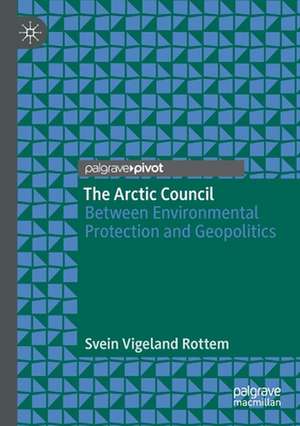
The Arctic Council
Autor Svein Vigeland Rottemen Limba Engleză Paperback – 16 aug 2020
Preț: 364.19 lei
Puncte Express: 546
Carte tipărită la comandă
Livrare economică 08-22 iunie
Livrare express 02-08 mai pentru 33.63 lei
Specificații
ISBN-13: 9789811392924
ISBN-10: 9811392927
Pagini: 112
Ilustrații: V, 104 p.
Dimensiuni: 148 x 210 x 7 mm
Greutate: 0.16 kg
Ediția:1st ed. 2020
Editura: Springer
Locul publicării:Singapore, Singapore
ISBN-10: 9811392927
Pagini: 112
Ilustrații: V, 104 p.
Dimensiuni: 148 x 210 x 7 mm
Greutate: 0.16 kg
Ediția:1st ed. 2020
Editura: Springer
Locul publicării:Singapore, Singapore
Cuprins
The Arctic Council: from environmental protection to geopolitics.- Organisation, actors and member states interests.- The Arctic Council in Arctic Governance.- Challenges and recommendations.- The Arctic Council: between environmental protection and geopolitics.
Notă biografică
Svein Vigeland Rottem is Senior Research Fellow at Fridtjof Nansen Institute, Norway. Rottem’s research interests are within the fields of Arctic security, Arctic governance and the Arctic Council. He has published several books, articles in academic journals and reports on these issues and have broad experience in engaging with relevant Arctic stakeholders.
Textul de pe ultima copertă
This pivot introduces the Arctic Council and its role as a platform for dealing with local, national, regional and global challenges of relevance to the “new” Arctic. Against the backdrop of climate change and increasing commercial activity, it considers what a future Arctic should look like, from ideas of total protection to expansive oil and gas extraction. It examines the Arctic’s position on the political agenda, from Norway’s High North hype to a more peripheral place in the foreign policy of the US and explores the Council's role as an important international forum for dialogue and cooperation on Arctic challenges and opportunities, and a significant arena for developing knowledge and learning about a changing region.