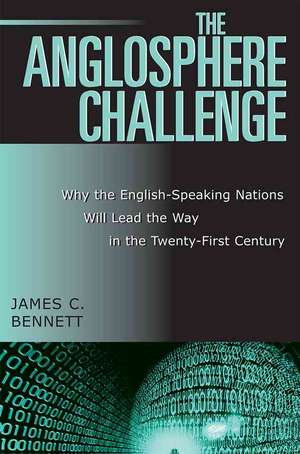
The Anglosphere Challenge: Why the English-Speaking Nations Will Lead the Way in the Twenty-First Century
Autor James C. Bennetten Limba Engleză Paperback – 3 apr 2007
Preț: 325.71 lei
Preț vechi: 400.31 lei
-19%
Puncte Express: 489
Carte tipărită la comandă
Livrare economică 11-25 noiembrie
Livrare prin curier în România Termenul estimat este afișat lângă disponibilitate.
Transport gratuit de la 400.00 lei Plată online sau ramburs, în funcție de opțiunile comenzii.
Retur gratuit în 14 zile Comandă securizată și suport în română.
Specificații
ISBN-13: 9780742533332
ISBN-10: 0742533336
Pagini: 341
Dimensiuni: 148 x 228 x 24 mm
Greutate: 0.52 kg
Editura: Bloomsbury Publishing
Colecția Rowman & Littlefield
Locul publicării:New York, United States
ISBN-10: 0742533336
Pagini: 341
Dimensiuni: 148 x 228 x 24 mm
Greutate: 0.52 kg
Editura: Bloomsbury Publishing
Colecția Rowman & Littlefield
Locul publicării:New York, United States
V-ar putea interesa
-
 Broker, Trader, Lawyer, SpyEamon JaversPreț: 87.08 lei
 -
 Escape VelocityGeoffrey A. MoorePreț: 134.55 lei
 -
 Non-Parametric EconometricsIbrahim Ahamada-31%Preț: 638.25 lei927.32 lei
 -
 How to SellJo OwenPreț: 106.84 lei
 -
 Your Body at WorkDavid GivensPreț: 107.23 lei
 -
 Modern Political Economics: Making Sense of the Post-2008 WorldYanis Varoufakis-15%Preț: 635.90 lei748.12 lei
 -
 Energy Security for the EU in the 21st Century: Markets, Geopolitics and CorridorsJosé María Marín Quemada-18%Preț: 1316.74 lei1605.78 lei
 -
 The Shibumi StrategyMatthew E. MayPreț: 107.98 lei
 -
 Professionalism the ABC for SuccessSusie KayPreț: 147.63 lei
 -
 Preț: 319.65 lei
 -
 Preț: 177.83 lei
 -
 Two Speed WorldGerald Ashley-27%Preț: 64.78 lei88.44 lei
Cuprins
Chapter 1 Introduction: Three Questions about the Future: Answers from the Past
Chapter 2 The Internet Era-and Beyond
Chapter 3 The Anglosphere and Its Revolutions
Chapter 4 Trust, Civil Society, Government, and Cyberspace
Chapter 5 The Civic State and the Network Commonwealth
Chapter 6 The Anglosphere as a Unique Civilization
Chapter 7 The Anglosphere Century
Chapter 2 The Internet Era-and Beyond
Chapter 3 The Anglosphere and Its Revolutions
Chapter 4 Trust, Civil Society, Government, and Cyberspace
Chapter 5 The Civic State and the Network Commonwealth
Chapter 6 The Anglosphere as a Unique Civilization
Chapter 7 The Anglosphere Century
Recenzii
It is very unusual to come across a genuinely new idea or a really original book. But the central thesis of The Anglosphere Challenge-that a new world order based on cultural affinity is evolving in response to the information revolution-is the most original attempt yet to make sense of the post-cold war world. New and original ideas are often strange or unsettling. Yet when Mr. Bennett has finished making his case, it seems the most obvious common sense. In short, this may be the Next Big Idea.
The most original foreign policy book of the year . . . James C. Bennett has sketched how the international order might be reshaped by the Internet and the communications revolution-and what allies the United States would have in that new world.
James C. Bennett's book leads one on a journey of discovery disguised as a journey of rediscovery. He lends expression to ideas one feels one has always known, but which were never formulated until Bennett put them into words.
It is clear that [James C.] Bennett and [Samuel] Huntington have similar conceptions about the core elements of 'Anglo' culture. But for Bennett, the dynamics of this culture, interacting with the global economy and Internet technology, are driving Americans beyond a mere national identity which is limited to the United States to a transnational identity which is grounded in the dense interrelations-the network commonwealth-among the English-speaking nations. The Anglosphere, Bennett foresees, will be the most coherent, advanced, and effective association of nations of any operating and competing within the global economy and the information age. As such, Bennett projects a more expansive and optimistic future for Americans than that provided by Huntington's analysis.
The first full-length treatment of the idea [of the 'Anglosphere']-and a powerful one. [Bennett's] book is bound to ratchet up serious discussion of it to an altogether higher level-and bring it to a new and larger audience.
James C. Bennett in his pathbreaking book The Anglosphere Challenge sees the contemporary English-speaking world as what he calls a 'network civilization' - that is, a set of countries that shares a common cultural heritage going far beyond language.
The Anglosphere Challenge is one of the important books of our time.
The volume will be of interest to readers that seek a thorough understanding of the technological revolution of the last few decades and its claimed Anglosphere heritage.
Recommended
In his book, The Anglosphere Challenge, James C. Bennett talks about a shared set of values in which Magna Carta, trial by jury, "innocent until proven guilty", "a man's home is his castle", and "a man's word is his bond" are common themes.
Stresses the pivotal nature of English fluency in the information-age economy to come.
The most original foreign policy book of the year . . . James C. Bennett has sketched how the international order might be reshaped by the Internet and the communications revolution-and what allies the United States would have in that new world.
James C. Bennett's book leads one on a journey of discovery disguised as a journey of rediscovery. He lends expression to ideas one feels one has always known, but which were never formulated until Bennett put them into words.
It is clear that [James C.] Bennett and [Samuel] Huntington have similar conceptions about the core elements of 'Anglo' culture. But for Bennett, the dynamics of this culture, interacting with the global economy and Internet technology, are driving Americans beyond a mere national identity which is limited to the United States to a transnational identity which is grounded in the dense interrelations-the network commonwealth-among the English-speaking nations. The Anglosphere, Bennett foresees, will be the most coherent, advanced, and effective association of nations of any operating and competing within the global economy and the information age. As such, Bennett projects a more expansive and optimistic future for Americans than that provided by Huntington's analysis.
The first full-length treatment of the idea [of the 'Anglosphere']-and a powerful one. [Bennett's] book is bound to ratchet up serious discussion of it to an altogether higher level-and bring it to a new and larger audience.
James C. Bennett in his pathbreaking book The Anglosphere Challenge sees the contemporary English-speaking world as what he calls a 'network civilization' - that is, a set of countries that shares a common cultural heritage going far beyond language.
The Anglosphere Challenge is one of the important books of our time.
The volume will be of interest to readers that seek a thorough understanding of the technological revolution of the last few decades and its claimed Anglosphere heritage.
Recommended
In his book, The Anglosphere Challenge, James C. Bennett talks about a shared set of values in which Magna Carta, trial by jury, "innocent until proven guilty", "a man's home is his castle", and "a man's word is his bond" are common themes.
Stresses the pivotal nature of English fluency in the information-age economy to come.