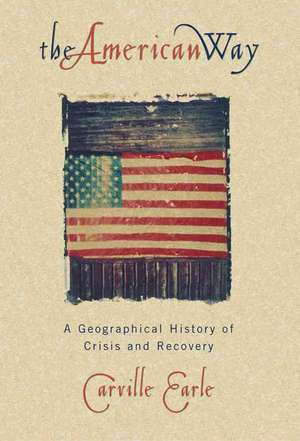
The American Way: A Geographical History of Crisis and Recovery
Autor Carville Earleen Limba Engleză Paperback – 11 iul 2005
Preț: 362.69 lei
Preț vechi: 540.33 lei
-33%
Puncte Express: 544
Carte tipărită la comandă
Livrare economică 08-22 iunie
Specificații
ISBN-13: 9780847687138
ISBN-10: 0847687139
Pagini: 472
Dimensiuni: 170 x 241 x 22 mm
Greutate: 0.8 kg
Editura: Bloomsbury Publishing
Colecția Rowman & Littlefield
Locul publicării:New York, United States
ISBN-10: 0847687139
Pagini: 472
Dimensiuni: 170 x 241 x 22 mm
Greutate: 0.8 kg
Editura: Bloomsbury Publishing
Colecția Rowman & Littlefield
Locul publicării:New York, United States
Cuprins
Introduction 1 Introduction
Part I 2 Theoretical Foundations
Chapter 1 3 Space, Time, and the American Way
Chapter 2 4 The Periodic Structuring of the American Past
Chapter 3 5 The Dynamics of Policy Regimes: Liberalism, Republicanism, and Their Variants
Chapter 4 6 Policy Regimes and Geographical Reconstructions
Chapter 5 7 Regulatory Regimes and the Geographies of Producer and Consumer Revolutions
Chapter 6 8 Spatial Enlargements in American Power: Sectional, National, and Transnational States
Part II 9 Colonial Foundations
Chapter 7 10 Backing into Empire
Chapter 8 11 We are all English. That is one good fact.: Cromwell's Model Republican Geographies, 1630s-1680s
Chapter 9 12 Lockean Geographies: Liberalism and Its Geographical Consequences, 1680s-1730s
Chapter 10 13 Imperial Geographies: The Republican Restoration, 1740s-1780s
Part III 14 National Geographies
Chapter 11 15 Out with the Old, in with the New: The Reconstitution of the American States and Its Geographical Parameters
Chapter 12 16 Space/Time: Four Spatial Variables across Two Centuries and Five Policy Regimes: The National Era 1780s-2000
Part I 2 Theoretical Foundations
Chapter 1 3 Space, Time, and the American Way
Chapter 2 4 The Periodic Structuring of the American Past
Chapter 3 5 The Dynamics of Policy Regimes: Liberalism, Republicanism, and Their Variants
Chapter 4 6 Policy Regimes and Geographical Reconstructions
Chapter 5 7 Regulatory Regimes and the Geographies of Producer and Consumer Revolutions
Chapter 6 8 Spatial Enlargements in American Power: Sectional, National, and Transnational States
Part II 9 Colonial Foundations
Chapter 7 10 Backing into Empire
Chapter 8 11 We are all English. That is one good fact.: Cromwell's Model Republican Geographies, 1630s-1680s
Chapter 9 12 Lockean Geographies: Liberalism and Its Geographical Consequences, 1680s-1730s
Chapter 10 13 Imperial Geographies: The Republican Restoration, 1740s-1780s
Part III 14 National Geographies
Chapter 11 15 Out with the Old, in with the New: The Reconstitution of the American States and Its Geographical Parameters
Chapter 12 16 Space/Time: Four Spatial Variables across Two Centuries and Five Policy Regimes: The National Era 1780s-2000
Recenzii
A magnificent piece of work. Not only is the book highly original in its combining of political and economic themes in a geographical history of the American past, it is based on a thorough review of appropriate literature and a considerable amount of pathbreaking original empirical research.
Will surely stand as a challenging and thought-provoking work in the years to come. . . . The abundance of historical data and argument [Earle] presents can only add to our understanding of American history. It is a fitting monument to his life's work as a historical geographer.
In The American Way, Carville Earle advances a sweeping, even breathtaking in scope, synthesis of American political economy, which challenges scholars to rethink conventional interpretations of the nation's changing geographies associated with different periods of time.
[A] bold and sweeping work that attempts to provide an intellectual coherence to the patterns of historical geography from the colonial period to modern times.
Earle provides depth and analysis toward a greater understanding of [U.S.] economic might. . . . Complemented by a liberal number of maps and a rich and varied bibliography. Recommended.
The American Way is a provocative work that deserves our attention.
This is a stimulating book that may leave readers less optimistic than the author. Earle helps us appreciate why the debate about republican and Whig origins of the American Constitution will likely be unending. Earle's provocative vision gives historians and historical geographers, as well as Americans and their global neighbors, some ideas to challenge and even more to ponder.
Will surely stand as a challenging and thought-provoking work in the years to come. . . . The abundance of historical data and argument [Earle] presents can only add to our understanding of American history. It is a fitting monument to his life's work as a historical geographer.
In The American Way, Carville Earle advances a sweeping, even breathtaking in scope, synthesis of American political economy, which challenges scholars to rethink conventional interpretations of the nation's changing geographies associated with different periods of time.
[A] bold and sweeping work that attempts to provide an intellectual coherence to the patterns of historical geography from the colonial period to modern times.
Earle provides depth and analysis toward a greater understanding of [U.S.] economic might. . . . Complemented by a liberal number of maps and a rich and varied bibliography. Recommended.
The American Way is a provocative work that deserves our attention.
This is a stimulating book that may leave readers less optimistic than the author. Earle helps us appreciate why the debate about republican and Whig origins of the American Constitution will likely be unending. Earle's provocative vision gives historians and historical geographers, as well as Americans and their global neighbors, some ideas to challenge and even more to ponder.