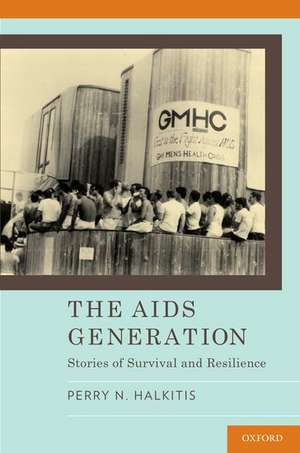
The AIDS Generation: Stories of Survival and Resilience
Autor Perry Halkitisen Limba Engleză Paperback – 15 ian 2015
Preț: 368.22 lei
Preț vechi: 496.51 lei
-26%
Puncte Express: 552
Carte tipărită la comandă
Livrare economică 03-08 decembrie
Livrare prin curier în România Termenul estimat este afișat lângă disponibilitate.
Transport gratuit de la 400.00 lei Plată online sau ramburs, în funcție de opțiunile comenzii.
Retur gratuit în 14 zile Comandă securizată și suport în română.
Specificații
ISBN-13: 9780190234331
ISBN-10: 0190234334
Pagini: 272
Dimensiuni: 122 x 264 x 18 mm
Greutate: 0.32 kg
Editura: Oxford University Press
Colecția OUP USA
Locul publicării:New York, United States
ISBN-10: 0190234334
Pagini: 272
Dimensiuni: 122 x 264 x 18 mm
Greutate: 0.32 kg
Editura: Oxford University Press
Colecția OUP USA
Locul publicării:New York, United States
V-ar putea interesa
-
 The Invisible CureHelen EpsteinPreț: 116.27 lei
 -
 A Crisis of Meaning: How Gay Men Are Making Sense of AIDSSteven Schwartzberg-18%Preț: 364.97 lei445.96 lei
 -
 HIV, AIDS and Childbearing: Public Policy, Private LivesRuth R. Faden-24%Preț: 511.50 lei669.79 lei
 -
 Human Rights and Public Health in the AIDS PandemicLawrence O. Gostin-24%Preț: 373.37 lei488.56 lei
 -
 AIDS in the UK: The Making of Policy, 1981-1994Virginia Berridge-24%Preț: 447.70 lei587.92 lei
 -
 The HIV Pandemic: Local and global implicationsEduard J Beck-26%Preț: 1319.78 lei1775.82 lei
 -
 -30%Preț: 673.19 lei967.55 lei
 -
 Love in the Time of AIDSMark HunterPreț: 180.62 lei
 -
 Preț: 402.86 lei
 -
 Teaching AIDSDouglas TonksPreț: 239.17 lei
 -
 Lessons from the Damned: Queers, Whores and Junkies Respond to AIDSNancy E. Stoller-15%Preț: 416.38 lei489.87 lei
 -
 AIDS and Masculinity in the African CityRobert Wyrod-23%Preț: 564.92 lei733.67 lei
 -
 Preț: 176.96 lei
 -
 Infectious IdeasJennifer BrierPreț: 264.06 lei
 -
 The Anthropology of AIDSPatricia WhelehanPreț: 254.81 lei
 -
 AIDS, Culture, and Gay MenDouglas A. FeldmanPreț: 182.73 lei
 -
 Treating AIDS: Politics of Difference, Paradox of PreventionThurka SangaramoorthyPreț: 396.13 lei
 -
 The Secret: Love, Marriage, and HIVJennifer S. HirschPreț: 314.92 lei
 -
 -5%Preț: 308.31 lei324.54 lei
 -
 Modernizing Medicine in Zimbabwe: HIV/AIDS and Traditional HealersDavid S. Simmons-23%Preț: 610.67 lei793.07 lei
 -
 Preț: 370.24 lei
 -
 Mobilizing New YorkTamar W. CarrollPreț: 338.22 lei
Recenzii
A modern day parable of loss and resilience. Dr. Halkitis relates the stories of these men with empathy, compassion and connection. Yet, he also embeds the tale within a scientific and historical framework that contextualizes the AIDS epidemic as the public health crisis that rewrote the book on activism and the politics of disease. By focusing on the narratives of individual men, The AIDS Generation artfully illuminates and humanizes the history of the AIDS pandemic.
This book is a remarkable testament to members of the AIDS generation, to the terrors and wonders, the loneliness of illness and loss but also the power of community and resilience that evolved. Dr. Halkitis presents the voices of 15 gay men framed in the context of his own conceptualizations derived from his years of research and teaching about HIV/AIDS and the lives of gay men. The stories are gripping, the writing lucid, and the book will be a lasting contribution to the history of the times and members of his
I felt such kinship reading these stories. It was mostly luck that got us through the plague years, but I share more than a virus with these men. We are proudly gay, and have forged unique strengths by getting this far. The AIDS generation shattered the American myth of gay weakness.
From one of our leading researchers on HIV among gay men comes a powerful portrayal of courage and resilience that is hopeful and deeply personal. Through compelling interviews with 15 middle age gay men who have been living with HIV for decades, Halkitis conveys the fear and anger of the dark days before antiretroviral therapy when prejudice and hysteria reigned. He describes the strength and vision of many gay men living with HIV whose activism helped transform the disease in the 1980s and 1990s. He also addresses emerging issues of older adults living with HIV, and the connection between anti-gay public policies and social norms and gay men's health. Halkitis weaves in epidemiological research and policy analysis to create a picture of the HIV/AIDS pandemic that is both accessible and nuanced.
Upon completing Perry's beautiful volume, the reader will come to understand two things. First, antiretroviral therapy is not the panacea that many may believe it to be. Perry demonstrates that aging gay men face a gauntlet of unpredictable physical and psychological challenges. Second, resilience, courage, and strength are three terms that best characterize the current generation of gay men bravely aging with HIV/AIDS.
This book allows a group of remarkable men to tell us about their survival during a remarkable period of gay history. They have a lot to teach future historians
I believe there are two audiences for this book: long-term survivors who count themselves among the warriors, and younger men who need to learn. If you fall into either category, then reading The AIDS Generation will be a worthwhile experience.
A groundbreaking new book.
Lest the world forget, Perry Halkitis tells the stories of pain, suffering, survival, and resilience of his generation of gay men
There is plenty for academics in this book, but casual readers will find something here, too.
Halkitis, a longtime LGBT and HIV researcher, has collected the deeply moving life stories of 15 men who tell not only of surviving the grimmest years of the epidemic, but also of aging with HIV, something many never dreamed possible.
These are stories that need to be heard. It's a remarkable and accessible book about a terrifying time in gay history, a time that's still with all of us, even a little bit, no matter how badly we want to move on.
The AIDS Generation spoke not only to my own academic interests, but more deeply, it evoked something in my own life history and that of my friends and colleagues. I am sure many readers will have a similar response. Halkitis's writing is accessible to audiences beyond academic circles. Social workers, psychologists, and other social services professionals will find it helpful and enjoyable.
One can view this book as an important contribution in documenting the journeys of those of the AIDS generation, and perhaps with more contributions like this book, the helping professionals can generate more inclusive perspectives and frameworks to use in their professional activities and in our personal lives.
This book is a remarkable testament to members of the AIDS generation, to the terrors and wonders, the loneliness of illness and loss but also the power of community and resilience that evolved. Dr. Halkitis presents the voices of 15 gay men framed in the context of his own conceptualizations derived from his years of research and teaching about HIV/AIDS and the lives of gay men. The stories are gripping, the writing lucid, and the book will be a lasting contribution to the history of the times and members of his
I felt such kinship reading these stories. It was mostly luck that got us through the plague years, but I share more than a virus with these men. We are proudly gay, and have forged unique strengths by getting this far. The AIDS generation shattered the American myth of gay weakness.
From one of our leading researchers on HIV among gay men comes a powerful portrayal of courage and resilience that is hopeful and deeply personal. Through compelling interviews with 15 middle age gay men who have been living with HIV for decades, Halkitis conveys the fear and anger of the dark days before antiretroviral therapy when prejudice and hysteria reigned. He describes the strength and vision of many gay men living with HIV whose activism helped transform the disease in the 1980s and 1990s. He also addresses emerging issues of older adults living with HIV, and the connection between anti-gay public policies and social norms and gay men's health. Halkitis weaves in epidemiological research and policy analysis to create a picture of the HIV/AIDS pandemic that is both accessible and nuanced.
Upon completing Perry's beautiful volume, the reader will come to understand two things. First, antiretroviral therapy is not the panacea that many may believe it to be. Perry demonstrates that aging gay men face a gauntlet of unpredictable physical and psychological challenges. Second, resilience, courage, and strength are three terms that best characterize the current generation of gay men bravely aging with HIV/AIDS.
This book allows a group of remarkable men to tell us about their survival during a remarkable period of gay history. They have a lot to teach future historians
I believe there are two audiences for this book: long-term survivors who count themselves among the warriors, and younger men who need to learn. If you fall into either category, then reading The AIDS Generation will be a worthwhile experience.
A groundbreaking new book.
Lest the world forget, Perry Halkitis tells the stories of pain, suffering, survival, and resilience of his generation of gay men
There is plenty for academics in this book, but casual readers will find something here, too.
Halkitis, a longtime LGBT and HIV researcher, has collected the deeply moving life stories of 15 men who tell not only of surviving the grimmest years of the epidemic, but also of aging with HIV, something many never dreamed possible.
These are stories that need to be heard. It's a remarkable and accessible book about a terrifying time in gay history, a time that's still with all of us, even a little bit, no matter how badly we want to move on.
The AIDS Generation spoke not only to my own academic interests, but more deeply, it evoked something in my own life history and that of my friends and colleagues. I am sure many readers will have a similar response. Halkitis's writing is accessible to audiences beyond academic circles. Social workers, psychologists, and other social services professionals will find it helpful and enjoyable.
One can view this book as an important contribution in documenting the journeys of those of the AIDS generation, and perhaps with more contributions like this book, the helping professionals can generate more inclusive perspectives and frameworks to use in their professional activities and in our personal lives.
Notă biografică
Perry N. Halkitis, PhD, MS, MPH, is Professor of Applied Psychology and Public Health (Steinhardt School), and Population Health (Langone School of Medicine), Director of the Center for Health, Identity, Behavior & Prevention Studies, and Associate Dean at New York University. Dr. Halkitis' program of research examines the intersection between the HIV epidemic, drug abuse, and mental health burden in LGBT populations, and he is well known as one of the nation's leading experts on substance use and HIV behavioral research. Dr. Halkitis hold degrees in both psychology and public health.