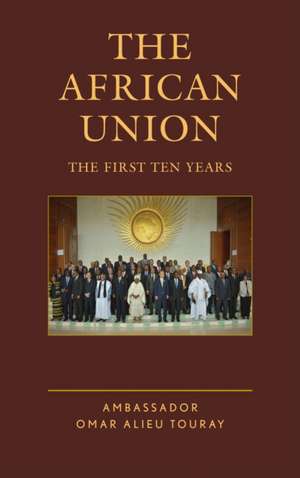
The African Union: The First Ten Years
Autor Ambassador Omar Alieu Tourayen Limba Engleză Hardback – dec 2016
At a more general level, the study argues that the African Union offers clear insights into integration as a multidimensional process that no single theoretical tradition can explain in a comprehensive manner. The author's response to such a theoretical limitation is "fusionism", an integrated approach that amalgamates various analytical traditions in order to provide a better explanation of the processes of international integration.
The detailed analysis and bold proposals will undoubtedly make the study appealing not only to specialists in African Studies, but equally to a broader spectrum of international relations and development scholars.
Preț: 550.63 lei
Preț vechi: 722.70 lei
-24%
Puncte Express: 826
Preț estimativ în valută:
97.35€ • 113.27$ • 84.23£
97.35€ • 113.27$ • 84.23£
Carte tipărită la comandă
Livrare economică 23 aprilie-07 mai
Specificații
ISBN-13: 9781442268975
ISBN-10: 1442268972
Pagini: 260
Ilustrații: 5 b/w illustrations; 4 tables
Dimensiuni: 158 x 239 x 25 mm
Greutate: 0.57 kg
Editura: Bloomsbury Publishing
Colecția Rowman & Littlefield
Locul publicării:New York, United States
ISBN-10: 1442268972
Pagini: 260
Ilustrații: 5 b/w illustrations; 4 tables
Dimensiuni: 158 x 239 x 25 mm
Greutate: 0.57 kg
Editura: Bloomsbury Publishing
Colecția Rowman & Littlefield
Locul publicării:New York, United States
V-ar putea interesa
-
 Justice in a Globalized World: A Normative FrameworkLaura Valentini-30%Preț: 634.19 lei908.24 lei
 -
 -14%Preț: 765.62 lei890.26 lei
 -
 -31%Preț: 402.02 lei579.91 lei
 -
 -6%Preț: 364.41 lei388.62 lei
 -
 -15%Preț: 456.74 lei537.34 lei
 -
 Preț: 223.03 lei
 -
 A History of Modern LebanonFawwaz TraboulsiPreț: 244.36 lei
 -
 Self-Criticism After the Defeat: Traces, Faces and PlacesSadik J. Al-AzmPreț: 109.93 lei
 -
 The Power of Scientific Knowledge: From Research to Public PolicyReiner GrundmannPreț: 250.74 lei
 -
 A Nation of Wusses: How America's Leaders Lost the Guts to Make Us GreatEdward G. RendellPreț: 147.59 lei
 -
 -18%Preț: 1200.65 lei1464.21 lei
 -
 Central America: Security ChallengesSara P Kovac-30%Preț: 337.93 lei480.74 lei
 -
 Congressional Commissions & Advisory BodiesDevlin P O'Rourke-31%Preț: 1261.44 lei1822.09 lei
Cuprins
List of Tables and Figures
List of Abbreviations
Preface
Chapter 1: Introduction
Chapter 2: The Context: Africa On The Eve Of The 21st Century
Chapter 3: The Genesis and Evolution of The African Union: A Study In Intergovernmental Processes
Chapter 4: Decolonization And After: The OAU and Africa's Challenges
Chapter 5: From the Lagos Plan of Action to Nepad: The Development Blueprints Of A Continent
Chapter 6: Breaking the Poverty Trap: The Human Development Agenda of The African Union
Chapter 7: "An Agenda for Peace": The Theory and Practice of Collective Security In Africa
Chapter 8: Some 'Larger Freedom': A Catalogue Of Human Rights And Governance Norms In Africa
Chapter 9: The Policy Organs: The Assembly, The Council And The PRC
Chapter 10: The Voice Of The People: The Pan African Parliament
Chapter 11: The Continental Bureaucracy: The Commission Of The African Union
Chapter 12: Conclusion
References
List of Abbreviations
Preface
Chapter 1: Introduction
Chapter 2: The Context: Africa On The Eve Of The 21st Century
Chapter 3: The Genesis and Evolution of The African Union: A Study In Intergovernmental Processes
Chapter 4: Decolonization And After: The OAU and Africa's Challenges
Chapter 5: From the Lagos Plan of Action to Nepad: The Development Blueprints Of A Continent
Chapter 6: Breaking the Poverty Trap: The Human Development Agenda of The African Union
Chapter 7: "An Agenda for Peace": The Theory and Practice of Collective Security In Africa
Chapter 8: Some 'Larger Freedom': A Catalogue Of Human Rights And Governance Norms In Africa
Chapter 9: The Policy Organs: The Assembly, The Council And The PRC
Chapter 10: The Voice Of The People: The Pan African Parliament
Chapter 11: The Continental Bureaucracy: The Commission Of The African Union
Chapter 12: Conclusion
References
Recenzii
An excellent, detailed, and lucid account of the historical perspectives, achievements, and challenges of the African Union in its first 10 years of existence, contributing to filling the gap in available published material on the Union. Authored by someone who has interacted with the Union in different capacities, including as his country's representative, the book is a "must read" for all interested in having a better and a deeper understanding of one of Africa's premier continental organizations.
Africa is a question whose answer is as huge, as complicated and as difficult as the Continent is big and diverse. Africa is, and shall remain, an enigma for a long time to come. Of the tomes of analysis and prescriptions, often over-simplified or patronizing, few insights are given into "the belly of the beast" to be able to understand sufficiently what lies at the heart of Africa, its problems and prospects.
By pointing to integration, Dr Omar Touray is pointing us in the right direction and to a substantial part of the answer to the African question. That is the advantage of being the insider and the participant that he has been in birthing the African Union which is the pre-eminent continental institution for promoting and coordinating Africa's integration efforts.
This book is also a source of valuable information, not only as a compendium of the AU's/Africa's continental policy frameworks on everything from peace and security, to agriculture, to health and education, human rights, gender, trade and development, terrorism, immigration, trafficking in persons, drugs and arms, corruption, etc., etc. but, in most cases, also brings and insider's perspective of how these frameworks were conceived, the main actors and the compromises that had to be made. It goes further to highlight limitations in the policy frameworks and the statuses of implementation; making the point that while Africa has an abundance of policy frameworks few of these are ever implemented, not least because of the AU's limited autonomy or lack of enforcement authority.
Another important point made in the book is that, whatever its weaknesses-and they are many-the OAU/AU has, on balance, accomplished much particularly with respect to its core mandate of decolonization of the continent, settling border disputes between Member States, dealing with disease epidemics like Ebola, HIV/AIDS, tuberculosis and malaria, coordinating Africa's responses or positions in international for a and, much more than people ever give the AU credit for, its role in conflict prevention, management, resolution and peace-keeping where the AU is often the first responders, as was the case in Mali, Somalia, Central African Republic, Somalia and South Sudan.
It is in this regard that the book makes the point emphatically that the AU, whatever its shortcomings, is not only indispensable to Africa, but that it is the pre-eminent organization of the continent and its importance has been, or should be recognized as such by any external partner wishing to have any meaningful engagement with Africa. It is no wonder that world leaders, including those of the United States, China, Japan, Germany, South Korea and others have trekked to Addis Ababa to the African Union Headquarters.
Ambassador Touray's book is a treasure trove of information that should be on the book-shelf of every student of Africa, researchers, and anyone interested in Africa and/ or the African Union.
Touray's account of the first ten years of the African Union is an interesting, very well-informed, balanced and properly referenced narrative of the achievements and challenges of the Union. ... The particular strength of the book is that the author manages to bring in both his experience as a senior diplomat as much as his training as a scholar of International Relations.
Africa is a question whose answer is as huge, as complicated and as difficult as the Continent is big and diverse. Africa is, and shall remain, an enigma for a long time to come. Of the tomes of analysis and prescriptions, often over-simplified or patronizing, few insights are given into "the belly of the beast" to be able to understand sufficiently what lies at the heart of Africa, its problems and prospects.
By pointing to integration, Dr Omar Touray is pointing us in the right direction and to a substantial part of the answer to the African question. That is the advantage of being the insider and the participant that he has been in birthing the African Union which is the pre-eminent continental institution for promoting and coordinating Africa's integration efforts.
This book is also a source of valuable information, not only as a compendium of the AU's/Africa's continental policy frameworks on everything from peace and security, to agriculture, to health and education, human rights, gender, trade and development, terrorism, immigration, trafficking in persons, drugs and arms, corruption, etc., etc. but, in most cases, also brings and insider's perspective of how these frameworks were conceived, the main actors and the compromises that had to be made. It goes further to highlight limitations in the policy frameworks and the statuses of implementation; making the point that while Africa has an abundance of policy frameworks few of these are ever implemented, not least because of the AU's limited autonomy or lack of enforcement authority.
Another important point made in the book is that, whatever its weaknesses-and they are many-the OAU/AU has, on balance, accomplished much particularly with respect to its core mandate of decolonization of the continent, settling border disputes between Member States, dealing with disease epidemics like Ebola, HIV/AIDS, tuberculosis and malaria, coordinating Africa's responses or positions in international for a and, much more than people ever give the AU credit for, its role in conflict prevention, management, resolution and peace-keeping where the AU is often the first responders, as was the case in Mali, Somalia, Central African Republic, Somalia and South Sudan.
It is in this regard that the book makes the point emphatically that the AU, whatever its shortcomings, is not only indispensable to Africa, but that it is the pre-eminent organization of the continent and its importance has been, or should be recognized as such by any external partner wishing to have any meaningful engagement with Africa. It is no wonder that world leaders, including those of the United States, China, Japan, Germany, South Korea and others have trekked to Addis Ababa to the African Union Headquarters.
Ambassador Touray's book is a treasure trove of information that should be on the book-shelf of every student of Africa, researchers, and anyone interested in Africa and/ or the African Union.
Touray's account of the first ten years of the African Union is an interesting, very well-informed, balanced and properly referenced narrative of the achievements and challenges of the Union. ... The particular strength of the book is that the author manages to bring in both his experience as a senior diplomat as much as his training as a scholar of International Relations.