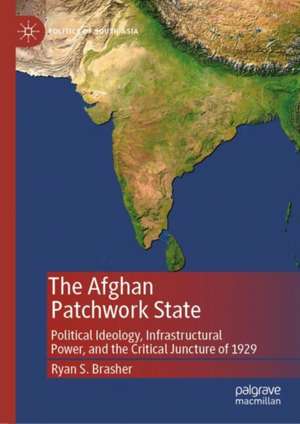
The Afghan Patchwork State: Politics of South Asia
Autor Ryan S. Brasheren Limba Engleză Hardback – 24 sep 2024


Preț: 745.29 lei
Preț vechi: 818.99 lei
-9%
Puncte Express: 1118
Carte tipărită la comandă
Livrare economică 23-30 noiembrie
Livrare prin curier în România Termenul estimat este afișat lângă disponibilitate.
Transport gratuit pentru acest produs Plată online sau ramburs, în funcție de opțiunile comenzii.
Retur gratuit în 14 zile Comandă securizată și suport în română.
Specificații
ISBN-13: 9789819765980
ISBN-10: 9819765986
Pagini: 224
Ilustrații: Approx. 140 p. 13 illus.
Dimensiuni: 153 x 216 x 17 mm
Greutate: 0.41 kg
Ediția:2025
Editura: Springer
Colecția Politics of South Asia
Seria Politics of South Asia
Locul publicării:Singapore, Singapore
ISBN-10: 9819765986
Pagini: 224
Ilustrații: Approx. 140 p. 13 illus.
Dimensiuni: 153 x 216 x 17 mm
Greutate: 0.41 kg
Ediția:2025
Editura: Springer
Colecția Politics of South Asia
Seria Politics of South Asia
Locul publicării:Singapore, Singapore
Cuprins
Chapter 1: Introduction.- Chapter 2: Political Ideology in Afghanistan: The Modernist Alternative.- Chapter 3: Political Ideology in Afghanistan: Patrimonial Absolutism.- Chapter 4: 1929 as a Critical Juncture.- Chapter 5: Regime Perception of and Actions Toward Local Elites: Allies.- Chapter 6: Regime Perceptions of and Actions Toward Local Elites: Rivals.- Chapter 7: Long-Term Development of Infrastructural Power.- Chapter 8: Conclusion.
Textul de pe ultima copertă
This book provides a theoretically grounded and empirically fine-grained analysis of uneven state development in Afghanistan beginning in the early 20th Century. Based on archival research, the book shows that after Amanullah Shah’s abortive modernist authoritarian experiment and Habibullah Kalakani’s brief rule, a newly empowered Musahiban dynasty charted a patrimonial absolutist course. The new regime delegated considerable authority to traditional tribal areas in the southeastern and eastern part of the country, while pursuing a coercive strategy in other parts of the country that usurped traditional leadership at the regional and local levels. Previous explanations of the weakness of the Afghan state tend to emphasize structural determinants such as difficult geography, acephalous tribal organization, ethnic heterogeneity, as well as colonial interventions. Others have focused only on events after the Soviet or NATO interventions, pointing out faulty external decision-making, corrupt government officials and warlords, neighboring insurgent safe havens, or the international aid-fueled rentier economy. This book proposes an intermediate explanation for the patchwork nature of the Afghan state rooted in institutional choices made by a new ruling elite that took over in 1929. The year represents one critical juncture in Afghan history, where individual agency based on certain ideological preferences set in motion a path-dependent process that shaped its politics well into the latter half of the century.
Ryan Brasher is Associate Professor of Political Science in the Department of History and Political Science at Simpson University in Redding California. His research focus is centered on ethnic identity, nationalism, political religion, and state-building in Central and South Asia. He has previously published on the construction of Tajik identity in Tajikistan and Afghanistan, on different manifestations of Political Islam in Afghanistan and Pakistan, on domestic determinants of Pakistan’s foreign policy toward its neighbors, the political attitudes of the Christian minority in Pakistan, as well as ethnic identity and assimilation of Afghan refugees in Pakistan.
Ryan Brasher is Associate Professor of Political Science in the Department of History and Political Science at Simpson University in Redding California. His research focus is centered on ethnic identity, nationalism, political religion, and state-building in Central and South Asia. He has previously published on the construction of Tajik identity in Tajikistan and Afghanistan, on different manifestations of Political Islam in Afghanistan and Pakistan, on domestic determinants of Pakistan’s foreign policy toward its neighbors, the political attitudes of the Christian minority in Pakistan, as well as ethnic identity and assimilation of Afghan refugees in Pakistan.
Caracteristici
Provides context for recent events in Afghanistan Uses Persian, English, and German-language archival sources Contributes to theoretical understanding of state development in the discipline of Political Science