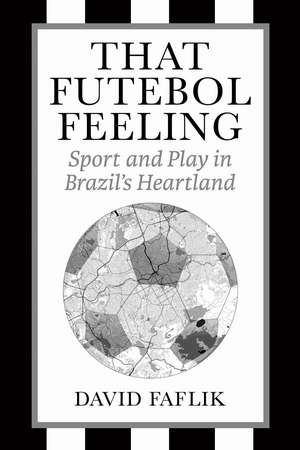
That Futebol Feeling: Sport and Play in Brazil's Heartland
Autor David Fafliken Limba Engleză Paperback – 7 feb 2025
That Futebol Feeling captures the region’s enthrallment with “the beautiful game,” and shows us how and why play is central to the human condition. David Faflik profiles members of the most celebrated local team, Clube Atlético Mineiro (CAM), as well as its passionate, never-say-die fans, to show how futebol and fandom shape their everyday lives and perspectives. He discovers bonds of work and play, as well as pride, identity, and community. Additionally, Faflik’s analysis of Brazil’s futebol culture reflects sports fandom worldwide.
CAM stands as a symbol for a way of life in Minas Gerais, the birthplace of Pelé. Faflik interrogates what playing the game means to those who dedicate their lives to the sport. He writes, “The feelings that football inspires are the best of me.” That Futebol Feeling shares that special feeling with the rest of us.
Preț: 161.55 lei
Puncte Express: 242
Carte tipărită la comandă
Livrare economică 08-22 decembrie
Livrare prin curier în România Termenul estimat este afișat lângă disponibilitate.
Transport gratuit de la 400.00 lei Plată online sau ramburs, în funcție de opțiunile comenzii.
Retur gratuit în 14 zile Comandă securizată și suport în română.
Specificații
ISBN-13: 9781439926055
ISBN-10: 1439926050
Pagini: 202
Ilustrații: 7
Dimensiuni: 140 x 210 x 15 mm
Greutate: 0.2 kg
Editura: Temple University Press
Colecția Temple University Press
ISBN-10: 1439926050
Pagini: 202
Ilustrații: 7
Dimensiuni: 140 x 210 x 15 mm
Greutate: 0.2 kg
Editura: Temple University Press
Colecția Temple University Press
Recenzii
“The value of That Futebol Feeling is multifold: It is a call to preserve and cultivate the game’s essence; it offers a new material for 'reading' a specific culture and society through sport; and it is an homage to Atlético Mineiro’s history and identity. But first and foremost, it is an answer to the question, 'How much do we play?'—a question we should all, from time to time, ask ourselves.”—Journal of Sports History
“This is a fascinating book that will make important contributions to our understanding of what soccer means in (and for) Brazil—and what it can mean to anyone who engages with it. Faflik’s knowledge is deep and intimate; he displays a mastery of the historiography on soccer in Brazil. That Futebol Feeling also powerfully delivers the emotions in the game for the Brazilians who watch and play it.” —Roger Kittleson, Professor of History at Williams College, and author of The Country of Football: Soccer and the Making of Modern Brazil
“Drawn from complex personal and professional involvements with his beloved Clube Atlético Mineiro (CAM)—and in light of the game’s seemingly stultifying wider commercialization—David Faflik provides reassuring evidence of football’s continued, and arguably unique, ability to move fans and players alike. Indeed, at its most revelatory, That Futebol Feeling pieces together a compelling account of the feelings associated with (and in some senses obligated by) actually playing for CAM. Eschewing the dispassionate sterility of many accounts of sporting phenomena, Faflik entangles the personal with the contextual in this illuminating reading of Brazilian football’s emotive economy.” —David Andrews, Professor in the Physical Cultural Studies Research Group in the Department of Kinesiology at the University of Maryland, and coeditor of Sport and Neoliberalism: Politics, Consumption, and Culture (Temple)
“This is a fascinating book that will make important contributions to our understanding of what soccer means in (and for) Brazil—and what it can mean to anyone who engages with it. Faflik’s knowledge is deep and intimate; he displays a mastery of the historiography on soccer in Brazil. That Futebol Feeling also powerfully delivers the emotions in the game for the Brazilians who watch and play it.” —Roger Kittleson, Professor of History at Williams College, and author of The Country of Football: Soccer and the Making of Modern Brazil
“Drawn from complex personal and professional involvements with his beloved Clube Atlético Mineiro (CAM)—and in light of the game’s seemingly stultifying wider commercialization—David Faflik provides reassuring evidence of football’s continued, and arguably unique, ability to move fans and players alike. Indeed, at its most revelatory, That Futebol Feeling pieces together a compelling account of the feelings associated with (and in some senses obligated by) actually playing for CAM. Eschewing the dispassionate sterility of many accounts of sporting phenomena, Faflik entangles the personal with the contextual in this illuminating reading of Brazilian football’s emotive economy.” —David Andrews, Professor in the Physical Cultural Studies Research Group in the Department of Kinesiology at the University of Maryland, and coeditor of Sport and Neoliberalism: Politics, Consumption, and Culture (Temple)
Notă biografică
David Faflik is Professor of English at the University of Rhode Island. He is the author of Boarding Out: Inhabiting the American Urban Literary Imagination, 1840-1860; Melville and the Question of Meaning; Urban Formalism: The Work of City Reading; Transcendental Heresies: Harvard and the Modern American Practice of Unbelief; and The Literary Gift in Early America.