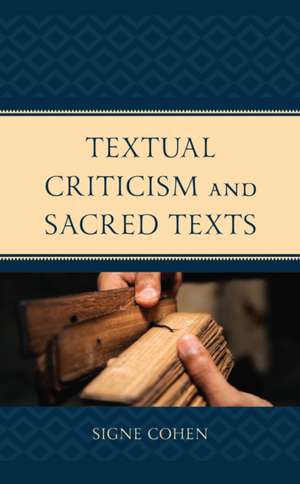
Textual Criticism and Sacred Texts
Autor Signe Cohenen Limba Engleză Hardback – 28 mar 2023
Preț: 494.17 lei
Preț vechi: 745.58 lei
-34%
Puncte Express: 741
Carte tipărită la comandă
Livrare economică 08-22 iunie
Specificații
ISBN-13: 9781666901603
ISBN-10: 1666901601
Pagini: 228
Dimensiuni: 158 x 236 x 23 mm
Greutate: 0.52 kg
Editura: Bloomsbury Publishing
Colecția Lexington Books
Locul publicării:New York, United States
ISBN-10: 1666901601
Pagini: 228
Dimensiuni: 158 x 236 x 23 mm
Greutate: 0.52 kg
Editura: Bloomsbury Publishing
Colecția Lexington Books
Locul publicării:New York, United States
Cuprins
Acknowledgments
Introduction: What is Textual Criticism?
Chapter One: The Lachmannian Method, Criticisms, Refinements, and Alternatives
Chapter Two: Textual Criticism of Sacred Texts: The State of the Scholarship
Chapter Three: Textual Criticism and Oral Texts
Chapter Four: Translations, Commentaries, and Textual Criticism
Chapter Five: Textual Criticism and Religion: Towards an Ethics of Textual Criticism of Sacred Texts
Chapter Six: Computer-Aided Textual Criticism and the Religious Text
Conclusion: Towards a Comparative Textual Criticism
Bibliography
About the Author
Introduction: What is Textual Criticism?
Chapter One: The Lachmannian Method, Criticisms, Refinements, and Alternatives
Chapter Two: Textual Criticism of Sacred Texts: The State of the Scholarship
Chapter Three: Textual Criticism and Oral Texts
Chapter Four: Translations, Commentaries, and Textual Criticism
Chapter Five: Textual Criticism and Religion: Towards an Ethics of Textual Criticism of Sacred Texts
Chapter Six: Computer-Aided Textual Criticism and the Religious Text
Conclusion: Towards a Comparative Textual Criticism
Bibliography
About the Author
Recenzii
This book presents the reader with an innovative suggestion of an interdisciplinary and comparative approach towards the various fields of textual analysis of sacred texts. With a strong background in Asian texts, and with laudable expertise in all forms of textual criticism, Signe Cohen succeeded in reviewing the many relevant aspects of this cross-disciplinary discussion. While doing so, and by focusing on Asian texts, she created a new dimension within the text-critical investigation.
In recent decades there has been a sea-change in the study of sacred texts. The ancient manuscripts are scattered across the globe in museums, libraries, and private collections and they are difficult to access. But now, high-resolution images of these ancient manuscripts are available online on any device, and comparisons of thousands of manuscripts now require only a few strokes on a keyboard. What we need is a global perspective on the development of sacred texts and that is what Textual Criticism and Sacred Texts provides. Drawing on sacred texts from India, China, the Middle East, Europe, and beyond, Prof. Cohen challenges us to reconsider their authority and power. Does their power come from a lost "authentic" original text, or are there always multiple meaningful versions? Did "accuracy" mean the same thing for scribes copying Hindu epics, Taoist philosophical treatises, Hebrew prophetic oracles, Christian canonical letters, and Qur'anic suras? And who gets the final word on sacred texts-academic specialists or religious practitioners? The global study of the transmission of sacred literatures has begun.
In recent decades there has been a sea-change in the study of sacred texts. The ancient manuscripts are scattered across the globe in museums, libraries, and private collections and they are difficult to access. But now, high-resolution images of these ancient manuscripts are available online on any device, and comparisons of thousands of manuscripts now require only a few strokes on a keyboard. What we need is a global perspective on the development of sacred texts and that is what Textual Criticism and Sacred Texts provides. Drawing on sacred texts from India, China, the Middle East, Europe, and beyond, Prof. Cohen challenges us to reconsider their authority and power. Does their power come from a lost "authentic" original text, or are there always multiple meaningful versions? Did "accuracy" mean the same thing for scribes copying Hindu epics, Taoist philosophical treatises, Hebrew prophetic oracles, Christian canonical letters, and Qur'anic suras? And who gets the final word on sacred texts-academic specialists or religious practitioners? The global study of the transmission of sacred literatures has begun.