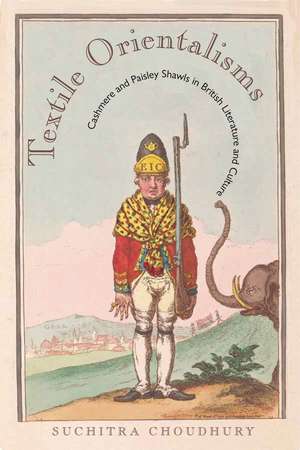
Textile Orientalisms: Cashmere and Paisley Shawls in British Literature and Culture: Series in Victorian Studies
Autor Suchitra Choudhuryen Limba Engleză Hardback – 7 mar 2023
The first major study of Cashmere and Paisley shawls in nineteenth-century British literature, this book shows how they came to represent both high fashion and the British Empire. During the late eighteenth century, Cashmere shawls from the Indian subcontinent began arriving in Britain. At first, these luxury goods were tokens of wealth and prestige. Subsequently, affordable copies known as “Paisley” shawls were mass-produced in British factories, most notably in the Scottish town of the same name. Textile Orientalisms is the first full-length study of these shawls in British literature of the extended nineteenth century. Attentive to the juxtaposition of objects and their descriptions, the book analyzes the British obsession with Indian shawls through a convergence of postcolonial, literary, and cultural theories. Surveying a wide range of materials—plays, poems, satires, novels, advertisements, and archival sources—Suchitra Choudhury argues that while Cashmere and Paisley shawls were popular accoutrements in Romantic and Victorian Britain, their significance was not limited to fashion. Instead, as visible symbols of British expansion, for many imaginative writers they emerged as metaphorical sites reflecting the pleasures and anxieties of the empire. Attentive to new theorizations of history, fashion, colonialism, and gender, the book offers innovative readings of works by Sir Walter Scott, Wilkie Collins, William Thackeray, Frederick Niven, and Elizabeth Inchbald. In determining a key status for shawls in nineteenth-century literature, Textile Orientalisms reformulates the place of fashion and textiles in imperial studies. The book’s distinction rests primarily on three accounts. First, in presenting an original and extended discussion of Cashmere and Paisley shawls, Choudhury offers a new way of interpreting the British Empire. Second, by tracing how shawls represented the social and imperial experience, she argues for an associative link between popular consumption and the domestic experience of colonialism on the one hand and a broader evocation of texts and textiles on the other. Finally, discussions about global objects during the Victorian period tend to overlook that imperial Britain not only imported goods but also produced their copies and imitations on an industrial scale. By identifying the corporeal tropes of authenticity and imitation that lay at the heart of nineteenth-century imaginative production, Choudhury’s work points to a new direction in critical studies.
Din seria Series in Victorian Studies
- 23%
 Preț: 475.82 lei
 - 19%
 Preț: 514.17 lei
 - 19%
 Preț: 477.88 lei
 - 23%
 Preț: 474.01 lei
 - 23%
 Preț: 479.52 lei
 -
 Preț: 322.23 lei
 -
 Preț: 296.36 lei
 - 23%
 Preț: 480.57 lei
 - 23%
 Preț: 476.87 lei
 - 23%
 Preț: 457.91 lei
 - 23%
 Preț: 476.87 lei
 - 23%
 Preț: 464.16 lei
 - 23%
 Preț: 473.13 lei
 - 23%
 Preț: 477.76 lei
 - 38%
 Preț: 367.64 lei
 -
 Preț: 292.50 lei
 - 5%
 Preț: 575.28 lei
 - 5%
 Preț: 562.26 lei
 - 5%
 Preț: 542.19 lei
 - 5%
 Preț: 540.48 lei
 - 19%
 Preț: 478.52 lei
 - 19%
 Preț: 479.40 lei
Preț: 590.18 lei
Preț vechi: 694.33 lei
-15%
Puncte Express: 885
Carte disponibilă
Livrare economică 19 septembrie-03 octombrie
Livrare express 08-12 septembrie pentru 32.30 lei
Livrare prin curier în România Termenul estimat este afișat lângă disponibilitate.
Transport gratuit pentru acest produs Plată online sau ramburs, în funcție de opțiunile comenzii.
Retur gratuit în 14 zile Comandă securizată și suport în română.
Specificații
ISBN-13: 9780821425008
ISBN-10: 0821425005
Pagini: 242
Ilustrații: 12
Dimensiuni: 152 x 229 x 20 mm
Greutate: 0.48 kg
Editura: Ohio University Press
Colecția Ohio University Press
Seria Series in Victorian Studies
ISBN-10: 0821425005
Pagini: 242
Ilustrații: 12
Dimensiuni: 152 x 229 x 20 mm
Greutate: 0.48 kg
Editura: Ohio University Press
Colecția Ohio University Press
Seria Series in Victorian Studies
Recenzii
“From diplomatic gift to fashion trend, literary trope to colonialism’s violent accessory, the cashmere shawl is the star of Textile Orientalisms. Expertly weaving historical and literary sources, Suchitra Choudhury spins a vibrant tale of this culturally rich textile, intertwining the object and its many soft powers with British Empire scholarship.”—Susan Hiner, author of Accessories to Modernity: Fashion and the Feminine in Nineteenth-Century France
“Suchitra Choudhury weaves together entangled histories and discovers that the humble shawl is in fact a powerful symbol of empire, trade, industry, class, gender, design, and fashion, as well as being a symbol of identity, authenticity, family, and belonging.”—Leonie Bell, director, Victoria and Albert Museum Dundee
“A magisterial exploration…. Suchitra Choudhury has dug deeply in the archives of British India to reveal the shawl’s multiple meanings as a desired fashion accessory and orientalist icon. Linking the fashion system to imperial governance, gender and class insurrection, her book demonstrates that despite its privileged place at the heart of British domesticity, the ‘old Cashmere shawl’ possessed an uncanny power to disturb and disrupt. An important, original, and long-awaited contribution to the literary study of British India.”—Nigel Leask, author of Stepping Westward: Writing the Highland Tour, c.1720-1830
"The definitive work on the subject of Cashmere and Paisley shawls in all of their intricate significances within eighteenth- and nineteenth-century English history and fiction.”—Deborah Denenholz Morse, Sara E. Nance Professor of English, College of William & Mary
“An original and arresting piece of scholarship…. With its broad range, it should find a wide readership among those interested in fashion and the novel, literary critics, and cultural and imperial historians alike.”—Kate Teltscher, author of India Inscribed: European and British Writing on India, 1600–1800
Notă biografică
Suchitra Choudhury is a research fellow supported by the William Lind Foundation at the University of Glasgow and an independent scholar. Her articles have appeared in Textile History and Victorian Literature and Culture. She is the cocurator of the display Paisley Shawls in Literature at Scotland’s Paisley Museum (2023).
Cuprins
List of Illustrations ix
Acknowledgments xi
Introduction: Textile Orientalisms 1
1 Historical Contexts 19
2 “It Came over but Last Night from India” The Shawl as Gift in Elizabeth Inchbald’s Appearance Is against Them (1785) 60
3 “There Are Braw Shawls Made at Paisley, That Ye Will Scarce Ken frae Foreign” Imperialism, Materiality, and Ecology in Walter Scott’s St. Ronan’s Well and The Surgeon’s Daughter 80
4 “An Infinity of Shawls” Emotions and Irony in Thackeray’s Vanity Fair 102
5 “The Woman in the Red Paisley Shawl” The Texture of Rebellion in Wilkie Collins’s Armadale 124
6 Frederick Niven’s The Paisley Shawl (1931) 142
Notes 161
Bibliography 197
Index 221
Acknowledgments xi
Introduction: Textile Orientalisms 1
1 Historical Contexts 19
2 “It Came over but Last Night from India” The Shawl as Gift in Elizabeth Inchbald’s Appearance Is against Them (1785) 60
3 “There Are Braw Shawls Made at Paisley, That Ye Will Scarce Ken frae Foreign” Imperialism, Materiality, and Ecology in Walter Scott’s St. Ronan’s Well and The Surgeon’s Daughter 80
4 “An Infinity of Shawls” Emotions and Irony in Thackeray’s Vanity Fair 102
5 “The Woman in the Red Paisley Shawl” The Texture of Rebellion in Wilkie Collins’s Armadale 124
6 Frederick Niven’s The Paisley Shawl (1931) 142
Notes 161
Bibliography 197
Index 221
Descriere
Considering popular literary images of Indian and Paisley shawls as markers of fashion, class, gender, and race during the long nineteenth century, this book shows how Indian imports and influences shaped wider discussions of British literature, art, politics, and empire.