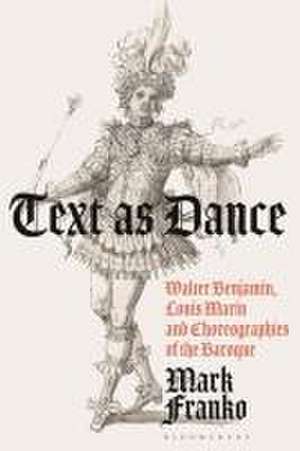
Text as Dance: Walter Benjamin, Louis Marin and Choreographies of the Baroque
Autor Mark Frankoen Limba Engleză Hardback – 23 ian 2025
Mark Franko uses powerful interpretive tools derived from historiography and critical theory, especially the work of German-Jewish philosopher Walter Benjamin, to offer the reader both a historical and a theoretical interpretation of this genre of dance in France (c. 1615-1654), as well as its aftermath and legacy today.
Through doing so, he reaches conclusions about how sovereignty and power were both perceived by viewers at the time and how they were represented through dance, given that it was the noble class who devised and performed court ballets. He enquires into the role of choreography and theatricality as potentially critical forces operating at the heart of sovereignty.
Franko places the work of Louis Marin on power, representation and movement in French Baroque painting and performance in juxtaposition to that of Benjamin on theater. Other historians whose work is prominent in this study are Ernst Kantorowicz, Michel Foucault and José Antonio Maravall.
With wide breadth in the work of historians, philosophers, political scientists, critical theorists, musicologists and dance historians, this is the culmination of a career's-worth of scholarship and research in the field.
Preț: 522.64 lei
Preț vechi: 790.05 lei
-34%
Puncte Express: 784
Preț estimativ în valută:
92.56€ • 108.10$ • 80.40£
92.56€ • 108.10$ • 80.40£
Carte disponibilă
Livrare economică 31 ianuarie-14 februarie
Preluare comenzi: 021 569.72.76
Specificații
ISBN-13: 9781350236882
ISBN-10: 1350236888
Pagini: 288
Ilustrații: 25 bw illus
Dimensiuni: 146 x 218 x 20 mm
Greutate: 0.44 kg
Editura: Bloomsbury Publishing
Colecția Bloomsbury Academic
Locul publicării:London, United Kingdom
ISBN-10: 1350236888
Pagini: 288
Ilustrații: 25 bw illus
Dimensiuni: 146 x 218 x 20 mm
Greutate: 0.44 kg
Editura: Bloomsbury Publishing
Colecția Bloomsbury Academic
Locul publicării:London, United Kingdom
Cuprins
Introduction: The Problem of the Baroque in Trans-historical Perspective
Chapter 1: The Conduct of Contemplation and the Gestural Ethics of Interpretation in Walter Benjamin's "Epistemo-Critical Prologue"
Chapter 2: Between Sacrality and Perspectivalism: Theories of Spectatorship in Jose´ Antonio Maravall and Louis Marin
Chapter 3: The Problem Ballets: Theatricality and The Paradox of Sovereignty
Chapter 4: The Melancholy of Figurability: Marin with Benjamin and the Allegory of Absolutism
Chapter 5: "A Subtle System of Feints": Phenomenological Description and Theatricality in Michel Foucault's "Las Meninas"
Chapter 6: The Language Model in William Forsythe's Artifact
Notes
Bibliography:
Index
Chapter 1: The Conduct of Contemplation and the Gestural Ethics of Interpretation in Walter Benjamin's "Epistemo-Critical Prologue"
Chapter 2: Between Sacrality and Perspectivalism: Theories of Spectatorship in Jose´ Antonio Maravall and Louis Marin
Chapter 3: The Problem Ballets: Theatricality and The Paradox of Sovereignty
Chapter 4: The Melancholy of Figurability: Marin with Benjamin and the Allegory of Absolutism
Chapter 5: "A Subtle System of Feints": Phenomenological Description and Theatricality in Michel Foucault's "Las Meninas"
Chapter 6: The Language Model in William Forsythe's Artifact
Notes
Bibliography:
Index
Recenzii
No one who engages academically with dance can ignore Mark Franko . Another standard work!
In this magisterial contribution to dance and performance studies, Mark Franko builds on the views of the Baroque by Walter Benjamin, Louis Marin, and Michel Foucault to provide a new perspective on the interplay between movement, body, language, and voice occurring on early modern stages. The study culminates in a spectacular reading of William Forsythe's pioneering Artefact offering a powerful critical vocabulary to interpret postmodern ballet and its critique of dance history.
In this magisterial contribution to dance and performance studies, Mark Franko builds on the views of the Baroque by Walter Benjamin, Louis Marin, and Michel Foucault to provide a new perspective on the interplay between movement, body, language, and voice occurring on early modern stages. The study culminates in a spectacular reading of William Forsythe's pioneering Artefact offering a powerful critical vocabulary to interpret postmodern ballet and its critique of dance history.