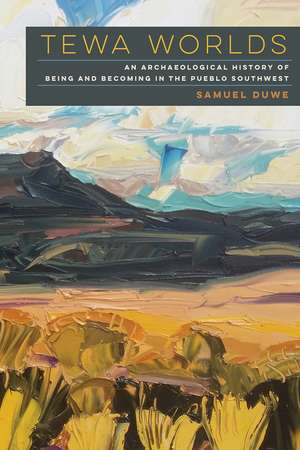
Tewa Worlds: An Archaeological History of Being and Becoming in the Pueblo Southwest
Autor Samuel Duween Limba Engleză Paperback – 9 sep 2025
Anthropologists have long trekked through Tewa country, but the literature remains deeply fractured among the present and the past, nuanced ethnographic description, and a growing body of archaeological research. Samuel Duwe bridges this divide by drawing from contemporary Pueblo philosophical and historical discourse to view the long arc of Tewa history as a continuous journey. The result is a unique history that gives weight to the deep past, colonial encounters, and modern challenges, with the understanding that the same concepts of continuity and change have guided the people in the past and present, and will continue to do so in the future.
Focusing on a decade of fieldwork in the northern portion of the Tewa world—the Rio Chama Valley—Duwe explores how incorporating Pueblo concepts of time and space in archaeological interpretation critically reframes ideas of origins, ethnogenesis, and abandonment. It also allows archaeologists to appreciate something that the Tewa have always known: that there are strong and deep ties that extend beyond modern reservation boundaries.
Preț: 259.09 lei
Puncte Express: 389
Preț estimativ în valută:
45.86€ • 53.27$ • 39.73£
45.86€ • 53.27$ • 39.73£
Carte disponibilă
Livrare economică 09-23 februarie
Preluare comenzi: 021 569.72.76
Specificații
ISBN-13: 9780816556892
ISBN-10: 081655689X
Pagini: 304
Ilustrații: 28 b&w illustrations, 7 maps, 5 tables
Dimensiuni: 152 x 229 mm
Greutate: 0.41 kg
Editura: University of Arizona Press
Colecția University of Arizona Press
ISBN-10: 081655689X
Pagini: 304
Ilustrații: 28 b&w illustrations, 7 maps, 5 tables
Dimensiuni: 152 x 229 mm
Greutate: 0.41 kg
Editura: University of Arizona Press
Colecția University of Arizona Press
Notă biografică
Samuel Duwe is an assistant professor in the Department of Anthropology at the University of Oklahoma. He is co-editor of The Continuous Path: Pueblo Movement and the Archaeology of Becoming.
Recenzii
“... Tewa Worlds ... stands out as exemplary in its investigative scope, rich and thought-provoking interpretations, and focus on establishing a deep history from the archaeological and ethnographic record."—Thatcher A. Rogers, New Mexico Archeological Council
“This book is a deeply thoughtful consideration of Tewa history, putting archaeology and anthropology in dialogue with Tewa epistemology. In addition, it is beautifully written with an engaging style that will make it readable to a wide audience. I predict that it will make a major mark in southwestern archaeology.”—Robert W. Preucel, editor of Archaeologies of the Pueblo Revolt: Identity, Meaning, and Renewal in the Pueblo World
"Duwe’s project is to present an archaeological history but give heritage its due, by 'keeping an open but critical mind when thinking of the many ways to understand history, and accepting that I might have gotten things wrong.' In the end this sounds like a description of responsible research."—Erina Gruner, Kiva, Journal of Southwestern Anthropology and History
“This book is a deeply thoughtful consideration of Tewa history, putting archaeology and anthropology in dialogue with Tewa epistemology. In addition, it is beautifully written with an engaging style that will make it readable to a wide audience. I predict that it will make a major mark in southwestern archaeology.”—Robert W. Preucel, editor of Archaeologies of the Pueblo Revolt: Identity, Meaning, and Renewal in the Pueblo World
"Duwe’s project is to present an archaeological history but give heritage its due, by 'keeping an open but critical mind when thinking of the many ways to understand history, and accepting that I might have gotten things wrong.' In the end this sounds like a description of responsible research."—Erina Gruner, Kiva, Journal of Southwestern Anthropology and History
Descriere
Tewa Worlds offers an archaeological history of eight centuries of Tewa Pueblo history in the Rio Chama Valley through the lens of contemporary Pueblo philosophical and historical discourse. The result gives weight to the deep past, colonial encounters, and modern experiences. It challenges archaeologists to both critically reframe interpretation and to acknowledge the Tewa’s deep but ongoing connection with the land.