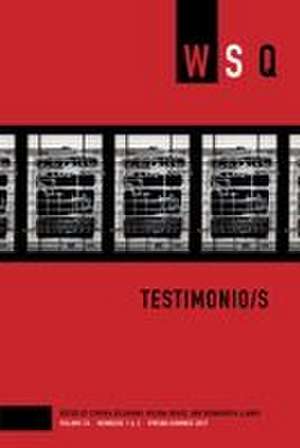
Testimonio/S
en Limba Engleză Paperback – 25 mai 2027
A special issue of WSQ that focuses on testimonio as a practice used by women from the Américas to claim their agency while challenging multiple forms of oppression.
Testimonio/s have evolved into different forms incorporating human rights discourse and varied standpoints, from individual testimonialistas, truth-tellers, knowledge holders, and “witness-observers” to feminist activists and collectives who denounce systemic violence against women and other marginalized communities throughout Latin America.
Works included in this issue use testimonio/s as a vessel to call for the recognition of people’s lived experiences; grievances; individual, gender, cultural, political, economic, collective, and human rights struggles; and triumphs in acts of bearing witness, testifying and recounting memories, and sharing origin and truth-telling stories.
Preț: 235.78 lei
Precomandă
Carte nepublicată încă
Specificații
Notă biografică
Cynthia Bejarano (she/her/ella) is a Regents Professor and the College of Arts and Sciences Stan Fulton Endowed Chair at New Mexico State University. Her publications, research interests and activism focus on a myriad of borderlands issues through activism and scholarship including migrant and immigrant advocacy, working to end gender-based violence and feminicides, farmworker advocacy, and critiquing the militarization/securitization of the border and its impact on border people. Her publications include Qúe Onda? Urban Youth Culture and Border Identity (2005), Terrorizing Women: Feminicide in the Americas (2010), and numerous peer-reviewed scholarly articles, chapters, and creative works. Currently she is cocreating with Dr. Sylvia Fernandez “Fuerza Feminista: Intimate Recovery and Archiving Memory (FFIRMA),” a feminist and transborder digital humanities project that documents, contextualizes, and will make digitally accessible the activist and feminist participation of the first local feminist movements in the Paso del Norte Region. With her co-editor Dr. Cristina Morales (University of Texas at El Paso), Bejarano published a transborder anthology titled Frontera Madre(hood): Brown Mothers Challenging Transborder Violence and Oppression at the U.S.-Mexico Border. This anthology is a collection of thirty mothers, activists, and scholars from across both sides of the US–Mexico border, published with the University of Arizona Press in 2024. She is based in Las Cruces, New Mexico.
Milena Grass is a professor at Pontificia Universidad Católica de Chile. She holds a master's degree in Latin American studies from Universidad de Chile and a PhD in literature from Pontificia Universidad Católica de Chile. She has published Spanish translations of English, American, and French plays, as well as books on Chilean history and theater studies. Her main fields of research have been theater and ritual, history, and memory in post-conflict contexts. Her longstanding work on practice and research methodologies can be found in the book La investigación de los procesos teatrales: Manuel de uso (Santiago: Frontera Sur/Ediciones Apuntes, 2011). From 1996 to 2004 she was the manager of Teatro UC, the professional theater of the Pontificia Universidad Católica de Chile, created in 1943. Since the year 2008, she has been the director of the drama school at the Pontificia Universidad Católica de Chile. She is based in Santiago, Chile.
Bernardita Llanos is professor of Latin American culture, film, and literature in the Modern Languages and Literatures Department at Brooklyn College. She received her PhD in Hispanic and Luso-Brasilian literatures and linguistics from the University of Minnesota. Professor Llanos is currently the cochair of the Southern Cone Studies Section in the Latin American Studies Association (LASA) and has been the president and vice president of the Association of Gender and Sexualities Studies (AEGS, formerly AILFH). Her research focuses on gender and authoritarianism, especially the legacy of the dictatorships in the Southern Cone, namely, Argentina, Chile, and Uruguay. Professor Llanos’s current book project on the feminist surge in Chile draws from the fourth wave of feminism to unveil systemic and structural oppressions that cut across institutions and cultural practices. She is based in New York City.